Aix galericulata
Mandarin Duck
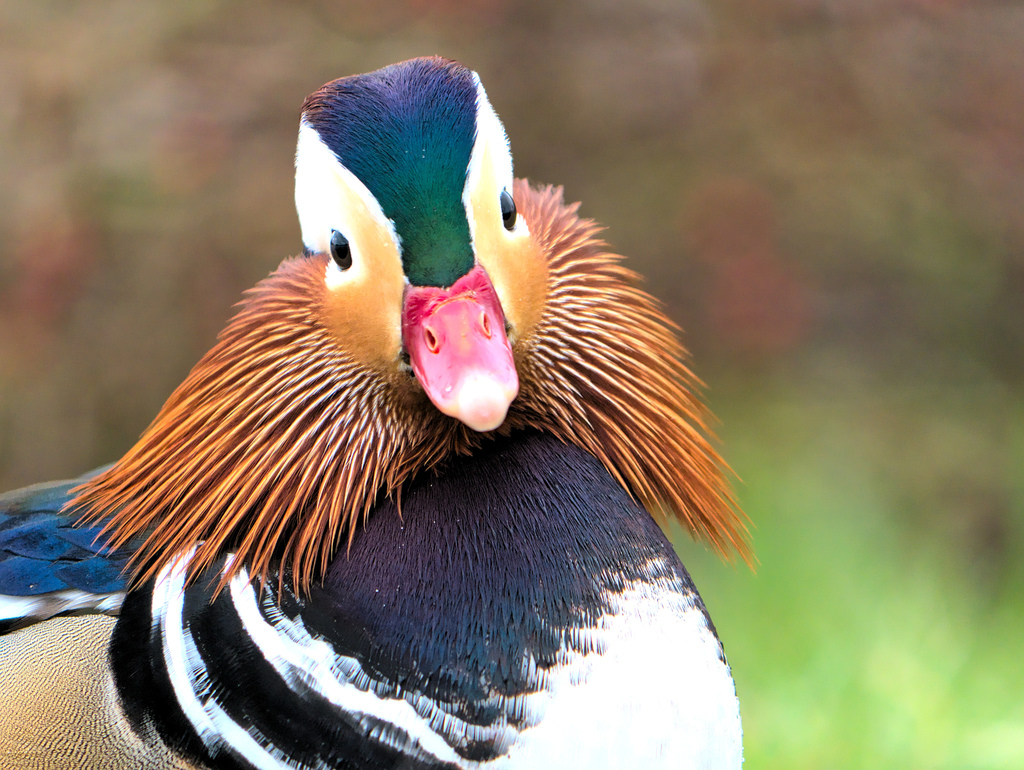
(c) Blake Ross, some rights reserved (CC BY) · licence
Family: Anatidae · Class: Aves · Order: Anseriformes
Aix galericulata (Mandarin Duck) is a California animal in the Anatidae family.
The Mandarin Duck is a medium-sized perching duck native to East Asia, measuring 41-49 cm (16-19 inches) in length with a wingspan of 65-75 cm (26-30 inches). Males in breeding plumage display distinctive coloration with an iridescent green and purple crest, white facial stripes extending from the eye to the nape, and prominent orange 'sail' feathers on the back. The breast is purple with white vertical stripes, while the flanks are orange-buff. Females are cryptically colored with grayish-brown plumage, a white eye-ring, and white spotting on the breast and flanks. Both sexes have dark bills and orange-yellow legs. Native to temperate forests across eastern Russia, northeastern China, Mongolia, Japan, and Korea, Mandarin Ducks have established non-native populations in several regions including parts of Europe. In California, this species occurs as an occasional vagrant or escaped captive bird rather than an established breeding population. Sightings have been documented in various California counties, typically in urban parks, golf course ponds, and wetland areas where escaped or released birds may temporarily establish territories. Mandarin Ducks inhabit wooded areas near freshwater bodies including rivers, streams, ponds, and marshes with overhanging vegetation. In their native range, they prefer deciduous and mixed forests with nearby water sources, requiring mature trees with natural cavities for nesting. The species shows strong preference for areas with dense canopy cover and abundant aquatic vegetation. Elevation preferences in native habitat range from sea level to approximately 1,500 meters (4,900 feet). This species exhibits a varied omnivorous diet consisting of aquatic plants, seeds, insects, small fish, and mollusks. During breeding season, which occurs from April to September, pairs form monogamous bonds and seek tree cavities or nest boxes 4-10 meters (13-33 feet) above ground. Females lay 9-12 glossy white eggs and incubate them for 28-30 days. Ducklings are precocial, jumping from nest cavities to the ground within 24 hours of hatching. Males undergo a flightless molt period during summer, becoming temporarily flightless while regrowing flight feathers. The Mandarin Duck is classified as Least Concern globally by the International Union for Conservation of Nature, though populations have declined in parts of their native range due to habitat loss and hunting pressure. The global population is estimated at 65,000-66,000 individuals, with the largest populations in Russia and China. In California, this species has no established conservation status as it does not maintain breeding populations. Any individuals observed are likely escaped captive birds or temporary visitors. The species faces ongoing threats in native habitat from deforestation, wetland drainage, and dam construction that fragments suitable breeding areas. Climate change may affect the timing of breeding cycles and food availability in their native range.
Classification
Class: Aves · Order: Anseriformes · Family: Anatidae
Frequently asked questions
How is Aix galericulata classified?
Aix galericulata belongs to class Aves, order Anseriformes, family Anatidae.
What family does Aix galericulata belong to?
Aix galericulata is in the Anatidae family.
What is Aix galericulata?
The Mandarin Duck is a medium-sized perching duck native to East Asia, measuring 41-49 cm (16-19 inches) in length with a wingspan of 65-75 cm (26-30 inches).
Is Aix galericulata found in California?
Yes. Aix galericulata is recorded in California in The California Species Project's catalogue.
Related species
Other California species in the same genus, family, or bioregion.
Data from The California Species Project — 14,000+ California species with verified data from CNPS, CDFW, USFWS, and more.