Alaus melanops
Western Eyed Click Beetle
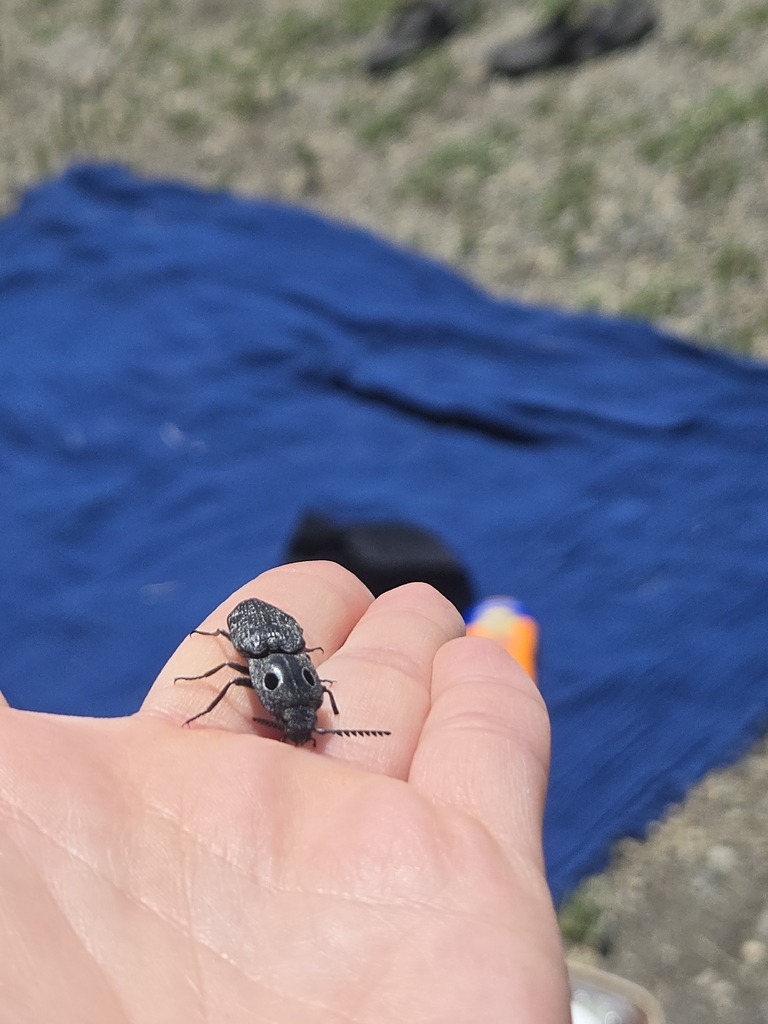
(c) Cass Reaume, some rights reserved (CC BY) · licence
Family: Elateridae · Class: Insecta · Order: Coleoptera
Alaus melanops (Western Eyed Click Beetle) is a California animal in the Elateridae family.
The Western Eyed Click Beetle is a large, distinctive member of the click beetle family Elateridae. Adults measure 28 to 45 millimeters (1.1 to 1.8 inches) in length, making them among the largest click beetles in western North America. The species is characterized by its elongated, robust body and prominent eyespots on the pronotum that give it its common name. The dorsal surface is typically black or dark brown with gray to white mottled patterns, while the two large, oval eyespots on the thorax are rimmed with white or pale coloration and contain dark centers that resemble vertebrate eyes. Alaus melanops occurs throughout much of western North America, with its range extending from British Columbia, Canada, south through the western United States to northern Mexico. In California, the species is distributed from the coast to mountainous regions, with documented occurrences from sea level to elevations exceeding 2,000 meters (6,600 feet). According to BugGuide observations, the species has been recorded across multiple western states including Washington, Idaho, Oregon, California, Nevada, Utah, Colorado, Arizona, and New Mexico. This beetle inhabits diverse forest ecosystems, showing a preference for coniferous and mixed woodlands. Adults are commonly found on or near decaying logs, stumps, and other dead wood where they seek mates and oviposition sites. The species occurs in Douglas fir, pine, oak, and mixed hardwood-conifer forests. Larvae develop within rotting wood, particularly in larger diameter logs and stumps where they create extensive tunnel systems while feeding on decaying organic matter. Western Eyed Click Beetles are primarily active during warmer months, with adults emerging from late spring through early fall. Peak activity typically occurs from June through August. Adults are attracted to lights at night and may be found crawling on tree bark or resting on vegetation during daylight hours. When disturbed, they exhibit the characteristic click beetle behavior of arching their back and producing an audible clicking sound while propelling themselves into the air. Larvae are wood-boring insects that can take two to three years to complete development, feeding on fungi, decaying wood fibers, and other organic matter within rotting logs (BugGuide). The larvae are elongated, cylindrical, and heavily sclerotized with a yellowish-brown coloration. They play an important ecological role as decomposers in forest ecosystems, helping break down dead wood and contributing to nutrient cycling. Adults are believed to feed on plant juices, nectar, and possibly other insects, though detailed dietary studies are limited. Currently, Alaus melanops does not hold any special conservation status and appears to maintain stable populations throughout its range. The species benefits from forest management practices that retain dead wood and snags for wildlife habitat. Climate change and intensive forest management that removes all dead wood could potentially impact local populations, though the species' wide distribution and habitat flexibility suggest it remains relatively secure. No specific population monitoring programs exist for this species as of December 2025.
Classification
Class: Insecta · Order: Coleoptera · Family: Elateridae
Frequently asked questions
How is Alaus melanops classified?
Alaus melanops belongs to class Insecta, order Coleoptera, family Elateridae.
What family does Alaus melanops belong to?
Alaus melanops is in the Elateridae family.
What is Alaus melanops?
The Western Eyed Click Beetle is a large, distinctive member of the click beetle family Elateridae.
Is Alaus melanops found in California?
Yes. Alaus melanops is recorded in California in The California Species Project's catalogue.
Related species
Other California species in the same genus, family, or bioregion.
Data from The California Species Project — 14,000+ California species with verified data from CNPS, CDFW, USFWS, and more.