Alectoris chukar
Chukar
(c) SIA, some rights reserved (CC BY) · licence
Family: Phasianidae · Class: Aves · Order: Galliformes
Alectoris chukar (Chukar) is a California animal in the Phasianidae family.
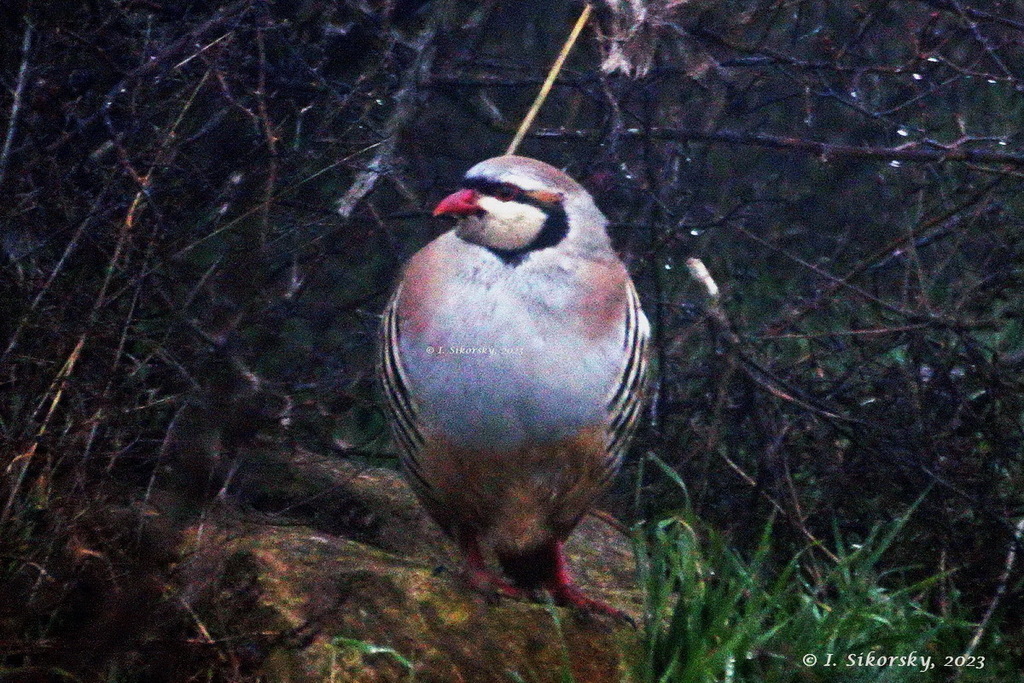
The Chukar (Alectoris chukar) is a medium-sized partridge native to Eurasia that was successfully introduced to California in the mid-20th century. Adult birds measure 32-38 cm (12.6-15.0 inches) in length and weigh 450-800 grams (1.0-1.8 pounds). The species displays distinctive plumage with a cream-colored throat and cheeks bordered by a prominent black band extending from the forehead through the eye and down to form a bib. The back and wings are brownish-gray with darker barring, while the flanks show bold black and white stripes. Both sexes appear similar, though males are typically larger and may have slightly more pronounced spurs. Chukars were first introduced to California between 1932 and 1960, with multiple releases across suitable habitat areas. The species has established self-sustaining populations primarily in the northeastern counties, including Mono, Inyo, Lassen, Modoc, and Siskiyou counties. Populations also occur in portions of the Sierra Nevada, Cascade Range, and desert mountain ranges. According to the California Department of Fish and Wildlife, the species' range has remained relatively stable since initial establishment, with some localized fluctuations based on habitat quality and precipitation patterns. Chukars occupy arid and semi-arid mountainous terrain, typically at elevations ranging from 1,200 to 4,000 meters (4,000-13,100 feet). The species shows strong preference for steep, rocky slopes with scattered shrub cover, particularly areas dominated by sagebrush (Artemisia spp.), bitterbrush (Purshia spp.), and cheatgrass (Bromus tectorum). Suitable habitat requires a combination of escape cover provided by rock outcrops and cliffs, foraging areas with herbaceous vegetation, and reliable water sources within 1.6 km (1 mile) of roosting sites. Chukars are primarily granivorous, feeding on seeds of grasses, forbs, and shrubs. During spring and summer, the diet expands to include green vegetation, berries, and insects, particularly for growing chicks. The species exhibits strong gregarious behavior outside the breeding season, forming coveys of 10-40 individuals. Breeding occurs from April through June, with pairs establishing territories on steep hillsides. Females construct ground nests in shallow scrapes lined with vegetation, typically laying 10-20 cream-colored eggs with brown speckles. Incubation lasts 23-25 days, with chicks capable of flight at approximately two weeks of age. As a successfully established non-native species, Chukars are managed as a game bird in California with regulated hunting seasons. The IUCN lists the global population as Least Concern, and California populations appear stable within their established range. Population estimates suggest several thousand breeding pairs across suitable habitat, though precise numbers are difficult to determine due to the species' preference for remote, rugged terrain. Primary factors affecting populations include annual precipitation patterns that influence vegetation growth and seed production, predation pressure, and habitat modifications from wildfire and grazing activities.
Classification
Class: Aves · Order: Galliformes · Family: Phasianidae
Frequently asked questions
How is Alectoris chukar classified?
Alectoris chukar belongs to class Aves, order Galliformes, family Phasianidae.
What family does Alectoris chukar belong to?
Alectoris chukar is in the Phasianidae family.
What is Alectoris chukar?
The Chukar (Alectoris chukar) is a medium-sized partridge native to Eurasia that was successfully introduced to California in the mid-20th century.
Is Alectoris chukar found in California?
Yes. Alectoris chukar is recorded in California in The California Species Project's catalogue.
Related species
Other California species in the same genus, family, or bioregion.
Data from The California Species Project — 14,000+ California species with verified data from CNPS, CDFW, USFWS, and more.