Allograpta exotica
Exotic Streaktail
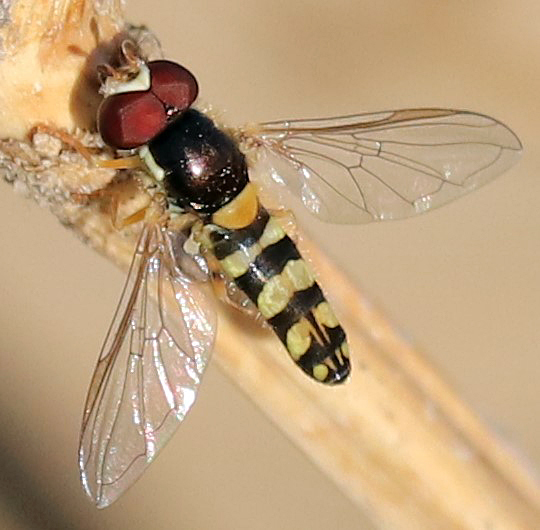
(c) Catherine C. Galley, some rights reserved (CC BY) · licence
Family: Syrphidae · Class: Insecta · Order: Diptera
Allograpta exotica (Exotic Streaktail) is a California animal in the Syrphidae family.
The Exotic Streaktail is a medium-sized hover fly in the family Syrphidae, subfamily Syrphinae. Adult flies typically measure 8-12 mm in length and exhibit the characteristic yellow and black striped pattern common to many syrphid flies. The abdomen displays distinctive pale yellow markings that form interrupted streaks or bands, giving rise to the common name. Like other members of the genus Allograpta, this species has large compound eyes and short antennae, with wings that extend beyond the tip of the abdomen when at rest. Allograpta exotica has a broad distribution across North America, extending from southern Canada through the continental United States to Mexico. In California, the species occurs throughout much of the state, from coastal regions to inland valleys and montane areas. According to NatureServe, the species maintains a Global Status of G5, indicating it is secure globally with populations stable across its range (NatureServe 2024). This hover fly inhabits diverse environments including gardens, agricultural areas, wildflower meadows, and forest edges. The species shows particular association with areas containing abundant flowering plants, which provide essential nectar resources for adults. Allograpta exotica demonstrates considerable habitat flexibility, occurring from sea level to moderate elevations in mountainous regions. The species is commonly found in human-modified landscapes, including urban parks and suburban gardens where flowering plants are present. Adult Exotic Streaktails are active fliers that hover near flowers while feeding on nectar, serving as pollinators for various plant species. Males establish territories around flowering patches and engage in aerial displays to attract mates. Females deposit eggs singly on leaves or stems of plants infested with soft-bodied insects. The larvae are predatory, feeding primarily on aphids, scale insects, and other small arthropods, making them beneficial for biological pest control. Development from egg to adult typically requires 3-4 weeks under favorable conditions, with multiple generations occurring annually in warmer regions. Adults are most active during daylight hours and are frequently observed from spring through fall. The species has been documented visiting various native and non-native plant species. In Hawaiian ecosystems, Allograpta exotica has been observed as a floral visitor to the endangered plant Sicyos macrophyllus, along with other introduced insects (USFWS 2024). This highlights the species' adaptability to different ecological contexts and its role in pollination networks, though as a non-native species in Hawaii, its ecological impacts require further study. Allograpta exotica faces no significant conservation concerns and is not listed under federal or state endangered species legislation. The species appears to benefit from human activities that create diverse flowering resources, and populations remain stable throughout its range. Climate change may affect seasonal activity patterns and distribution boundaries, but the species' broad habitat tolerance suggests resilience to environmental changes. As of December 2025, no specific conservation actions are required for this widespread and adaptable hover fly.
Classification
Class: Insecta · Order: Diptera · Family: Syrphidae
Frequently asked questions
How is Allograpta exotica classified?
Allograpta exotica belongs to class Insecta, order Diptera, family Syrphidae.
What family does Allograpta exotica belong to?
Allograpta exotica is in the Syrphidae family.
What is Allograpta exotica?
The Exotic Streaktail is a medium-sized hover fly in the family Syrphidae, subfamily Syrphinae.
Is Allograpta exotica found in California?
Yes. Allograpta exotica is recorded in California in The California Species Project's catalogue.
Related species
Other California species in the same genus, family, or bioregion.
Data from The California Species Project — 14,000+ California species with verified data from CNPS, CDFW, USFWS, and more.