Alypia langtoni
Langston's Forester
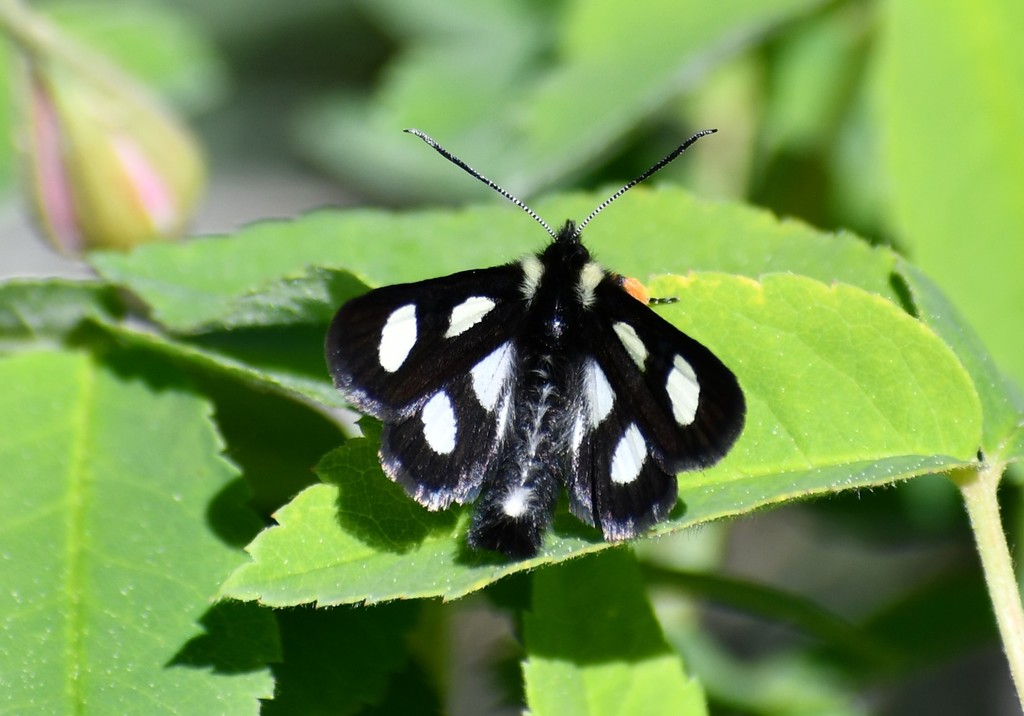
no rights reserved · CC0
Family: Noctuidae · Class: Insecta · Order: Lepidoptera
Alypia langtoni (Langston's Forester) is a California animal in the Noctuidae family.
Langston's Forester is a moth in the family Noctuidae, subfamily Agaristinae. Members of the genus Alypia are commonly known as forester moths and are characterized by their day-flying behavior and distinctive wing patterns. The U.S. Fish and Wildlife Service recognizes five species within the genus Alypia, with Langston's Forester being one of the less documented members of this group. Specific morphological details for Langston's Forester have not been comprehensively documented in the scientific literature. Like other forester moths, this species likely exhibits the characteristic metallic wing markings and robust body structure typical of the subfamily Agaristinae. Adult foresters generally display dark wings with metallic spots or patches, distinguishing them from other noctuoid moths that fly during daylight hours. The geographic range and distribution of Alypia langtoni remain poorly documented. The species appears in the U.S. Fish and Wildlife Service taxonomic database, indicating its presence within areas of federal interest, but specific locality records and range boundaries have not been published in readily accessible scientific literature. This lack of distributional data reflects the broader knowledge gap surrounding many North American microlepidoptera species. Habitat requirements for Langston's Forester have not been specifically documented. Other members of the genus Alypia typically inhabit areas where their larval host plants occur, often in woodland edges, clearings, and disturbed habitats. Forester moths generally require specific host plant relationships for successful reproduction, with larvae often feeding on particular plant families or genera. The life history and ecological requirements of this species remain largely unknown. Forester moths typically have univoltine life cycles, with adults emerging during specific seasonal windows that correspond to host plant phenology and optimal environmental conditions. Larvae of related Alypia species often feed on various herbaceous plants and shrubs, but the specific host plant associations for A. langtoni have not been documented in the available literature. Langston's Forester does not appear to have formal federal or state conservation listing status as of December 2025. The species' inclusion in the U.S. Fish and Wildlife Service taxonomic database suggests it occurs within the United States, but the absence of detailed ecological and distributional information hampers assessment of its conservation needs. Many North American moth species face threats from habitat modification, light pollution, and climate change, but specific threat assessments for this species are not available. The limited scientific documentation for Alypia langtoni represents a common challenge in lepidopteran taxonomy and conservation, where many species remain poorly studied despite their ecological importance. Enhanced survey efforts and taxonomic research would be valuable for understanding this species' distribution, habitat requirements, and conservation status. Field observations and photographic documentation from lepidopterists and naturalists could contribute significantly to expanding knowledge of this species' biology and occurrence patterns.
Classification
Class: Insecta · Order: Lepidoptera · Family: Noctuidae
Frequently asked questions
How is Alypia langtoni classified?
Alypia langtoni belongs to class Insecta, order Lepidoptera, family Noctuidae.
What family does Alypia langtoni belong to?
Alypia langtoni is in the Noctuidae family.
What is Alypia langtoni?
Langston's Forester is a moth in the family Noctuidae, subfamily Agaristinae.
Is Alypia langtoni found in California?
Yes. Alypia langtoni is recorded in California in The California Species Project's catalogue.
Related species
Other California species in the same genus, family, or bioregion.
Data from The California Species Project — 14,000+ California species with verified data from CNPS, CDFW, USFWS, and more.