Alypia ridingsii
Riding's Forester Moth
no rights reserved · CC0
Family: Noctuidae · Class: Insecta · Order: Lepidoptera
Alypia ridingsii (Riding's Forester Moth) is a California animal in the Noctuidae family.
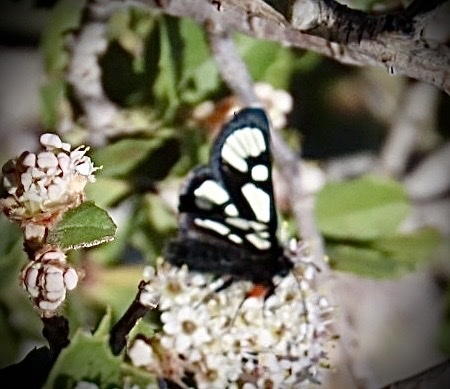
Riding's Forester Moth (Alypia ridingsii) is a medium-sized moth in the family Noctuidae, subfamily Agaristinae. Adults have a wingspan of approximately 25-35 mm (1.0-1.4 inches). The forewings are black with distinctive white or cream-colored patches, creating a contrasting pattern. The hindwings are typically orange-red or yellow-orange with black borders and spots, though coloration can vary geographically. The body is robust and dark, with white markings on the thorax and abdomen that complement the wing pattern. This species ranges from British Columbia south through western North America to California. In California, Riding's Forester Moth occurs primarily in the northern and central portions of the state, with documented populations in the Sierra Nevada, Cascade Range, and coastal mountains. The species extends eastward into Nevada and other western states, but California represents the southern extent of its Pacific Coast distribution. Riding's Forester Moth inhabits montane and subalpine environments, typically occurring at elevations between 1,200-2,800 meters (4,000-9,200 feet). The species is associated with coniferous forests, particularly areas with Douglas fir, white fir, and mixed conifer stands. Adults are found in forest openings, meadow edges, and along riparian corridors where host plants are available. The moth prefers areas with moderate moisture and partial shade. Adults are diurnal, flying actively during daylight hours from late spring through early summer, typically May through July depending on elevation and local climate conditions. This day-flying behavior distinguishes it from many other noctuid moths. Males are often observed patrolling territories and seeking mates along forest edges and clearings. The species exhibits strong site fidelity, with adults rarely dispersing far from breeding areas. Larvae feed on Virginia creeper (Parthenocissus species) and wild grape (Vitis species), which serve as the primary host plants. Females lay eggs on host plant foliage, and caterpillars develop through multiple instars before pupating in the soil or leaf litter. Riding's Forester Moth lacks formal conservation status designations at federal or state levels. Population trends are not well-documented due to limited systematic monitoring, but the species appears to maintain stable populations across much of its range. Potential threats include habitat loss from logging operations, urban development in montane areas, and climate change impacts on high-elevation forest ecosystems. Fire management practices that alter forest structure and composition may also affect local populations. The species' dependence on specific host plants makes it vulnerable to changes in forest understory composition. Conservation efforts focus on maintaining diverse forest habitats and protecting riparian corridors where host plants thrive.
Classification
Class: Insecta · Order: Lepidoptera · Family: Noctuidae
Frequently asked questions
How is Alypia ridingsii classified?
Alypia ridingsii belongs to class Insecta, order Lepidoptera, family Noctuidae.
What family does Alypia ridingsii belong to?
Alypia ridingsii is in the Noctuidae family.
What is Alypia ridingsii?
Riding's Forester Moth (Alypia ridingsii) is a medium-sized moth in the family Noctuidae, subfamily Agaristinae.
Is Alypia ridingsii found in California?
Yes. Alypia ridingsii is recorded in California in The California Species Project's catalogue.
Related species
Other California species in the same genus, family, or bioregion.
Data from The California Species Project — 14,000+ California species with verified data from CNPS, CDFW, USFWS, and more.