Amazona viridigenalis
Red-crowned Parrot
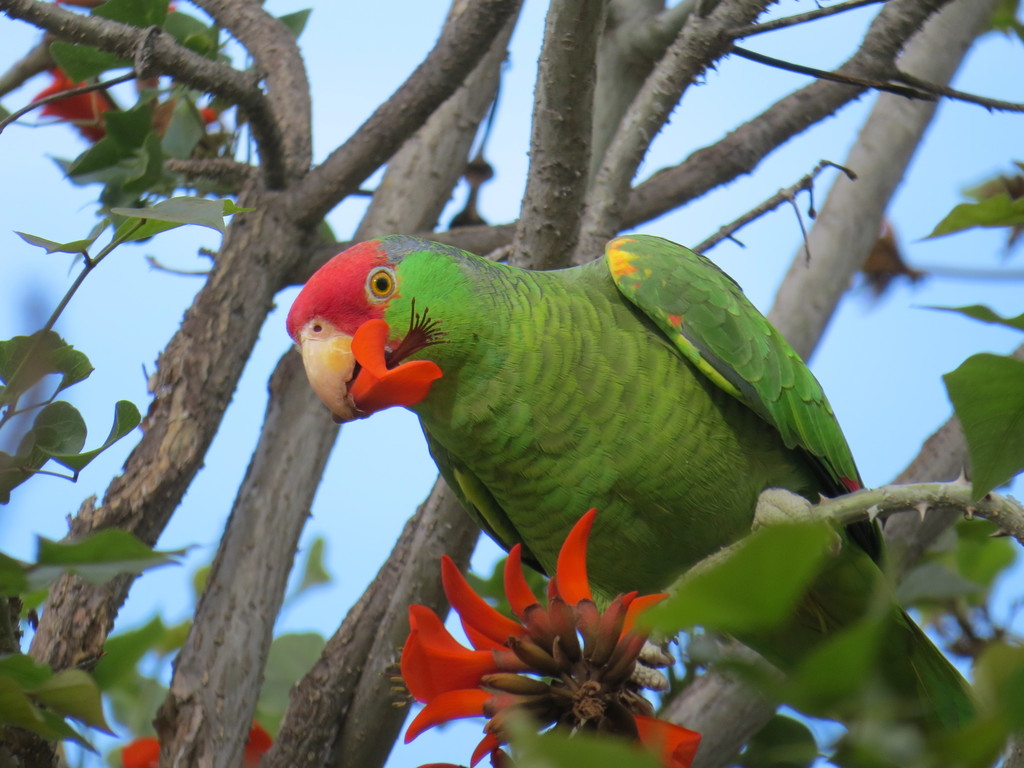
(c) James M. Maley, some rights reserved (CC BY) · licence
Family: Psittacidae · Class: Aves · Order: Psittaciformes
Amazona viridigenalis (Red-crowned Parrot) is a California animal in the Psittacidae family.
The Red-crowned Parrot (Amazona viridigenalis) is a medium-sized neotropical parrot native to northeastern Mexico. Adults measure 32-35 cm (12.6-13.8 inches) in length and weigh 270-295 grams. The species displays predominantly green plumage with a distinctive red crown extending from the forehead to the mid-crown area. Males typically show more extensive red coloration than females. The cheeks and throat are pale green to yellowish-green, while the nape and hindneck display a bluish tinge. Flight feathers are blue-black with red patches visible on the secondaries during flight. The bill is horn-colored with a darker tip, and the iris is orange-red in adults. Historically, Red-crowned Parrots were distributed throughout the lowland tropical forests of northeastern Mexico, primarily in Tamaulipas and southern Texas along the Rio Grande Valley. The species has experienced significant range contraction, with the Texas population extirpated by the 1950s due to habitat loss and capture for the pet trade. Current native range is restricted to fragmented areas in Tamaulipas, Nuevo León, and San Luis Potosí, Mexico. Established non-native populations now occur in southern California, particularly in Los Angeles, Orange, and San Bernardino counties, as well as in south Texas around Brownsville and McAllen. These populations originated from escaped or released captive birds beginning in the 1960s. The species inhabits tropical deciduous forests, gallery forests along rivers, agricultural areas with scattered trees, and urban environments with suitable nesting sites. In their native range, they occupy elevations from sea level to approximately 1,000 meters. Non-native California populations utilize urban and suburban habitats, including parks, golf courses, and residential areas with palm trees and exotic vegetation. They show strong preference for areas with large trees for roosting and nesting. Red-crowned Parrots are highly social, forming flocks of 20-100 individuals outside the breeding season. Their diet consists primarily of fruits, seeds, flowers, and buds. In California, they commonly feed on figs, dates, citrus fruits, and palm fruits. Breeding occurs from March to June, with pairs nesting in tree cavities 8-15 meters above ground. Females typically lay 2-4 white eggs, which are incubated for 26-28 days. Nestlings fledge after approximately 60 days. The species exhibits strong site fidelity, often returning to the same roosting and nesting areas annually. The Red-crowned Parrot is listed as Endangered by the IUCN, with native populations estimated at fewer than 3,000-4,000 individuals. Primary threats include habitat destruction, illegal capture for the pet trade, and fragmentation of remaining forest patches. In Mexico, deforestation for agriculture and urban development continues to reduce suitable habitat. The non-native California population, estimated at 2,000-3,000 birds, represents a significant portion of the global population. While these introduced populations face different conservation considerations, they may serve as important genetic reservoirs for the species' long-term survival.
Classification
Class: Aves · Order: Psittaciformes · Family: Psittacidae
Frequently asked questions
How is Amazona viridigenalis classified?
Amazona viridigenalis belongs to class Aves, order Psittaciformes, family Psittacidae.
What family does Amazona viridigenalis belong to?
Amazona viridigenalis is in the Psittacidae family.
What is Amazona viridigenalis?
The Red-crowned Parrot (Amazona viridigenalis) is a medium-sized neotropical parrot native to northeastern Mexico.
Is Amazona viridigenalis found in California?
Yes. Amazona viridigenalis is recorded in California in The California Species Project's catalogue.
Related species
Other California species in the same genus, family, or bioregion.
Data from The California Species Project — 14,000+ California species with verified data from CNPS, CDFW, USFWS, and more.