Amblonoxia palpalis
Dusty June Beetle
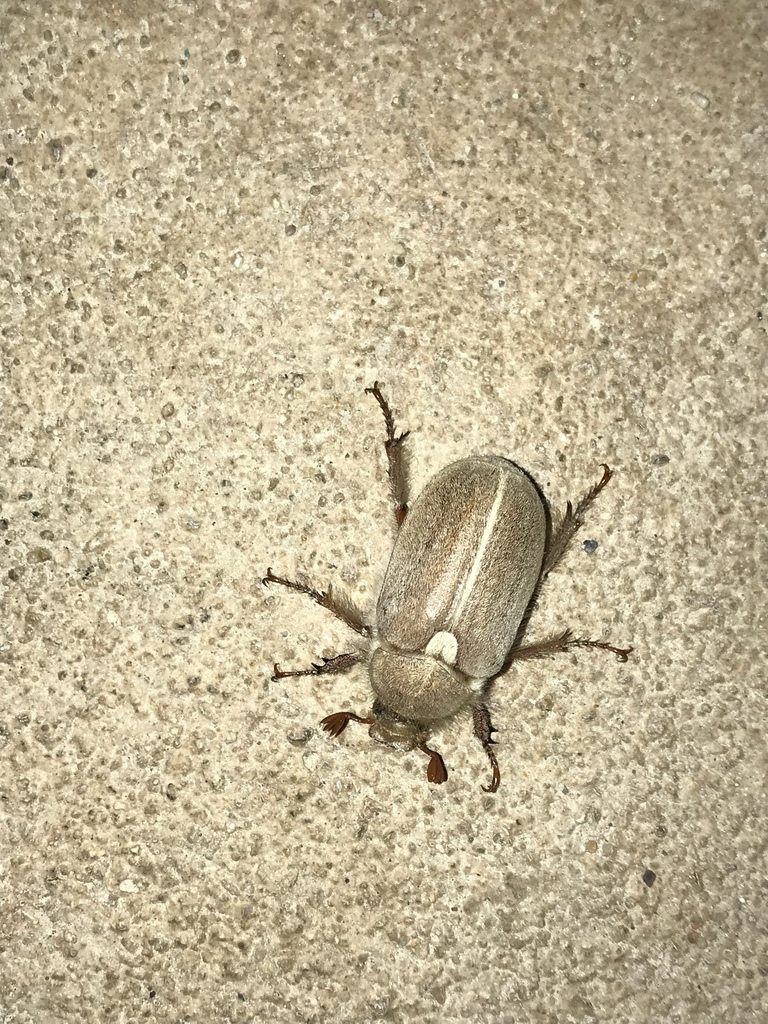
(c) Emily Chebul, some rights reserved (CC BY-SA) · licence
Family: Scarabaeidae · Class: Insecta · Order: Coleoptera
Amblonoxia palpalis (Dusty June Beetle) is a California animal in the Scarabaeidae family.
Amblonoxia palpalis, commonly known as the dusty June beetle, is a species of scarab beetle in the family Scarabaeidae, subfamily Melolonthinae. This beetle is characterized by its relatively large body size compared to other species in its genus, though specific morphological details have not been well documented in scientific literature. The dusty June beetle is native to California's coastal plain region. The species appears to have a restricted distribution within this coastal zone, though precise range boundaries and population centers have not been comprehensively mapped. Historical collection records suggest the species occurs in suitable habitat throughout the California coastal plain, but current distribution patterns may be more fragmented due to habitat modification. Specific habitat requirements for A. palpalis have not been thoroughly studied or documented. As a member of the Melolonthinae subfamily, the species likely follows typical scarab beetle life cycle patterns, with larvae developing in soil and adults emerging during summer months, consistent with the "June beetle" common name designation. However, detailed habitat preferences, soil type requirements, and vegetation associations remain poorly understood. Ecological information for the dusty June beetle is extremely limited. Adult beetles presumably feed on plant material, following general scarab beetle feeding patterns, though specific host plant relationships have not been documented. The species' reproductive behavior, seasonal activity patterns, and larval development requirements have not been studied in detail. Research has indicated that A. palpalis serves as a host for entomophilic nematodes, suggesting the species plays a role in soil ecosystem dynamics (Koneru et al. 2016). The conservation status of the dusty June beetle has not been formally evaluated by state or federal agencies. The species lacks any formal listing status or conservation ranking. Population trends, abundance estimates, and threat assessments have not been conducted. Given the species' apparent restriction to California's coastal plain, an area subject to significant development pressure and habitat modification, population status and conservation needs warrant investigation. The limited scientific documentation for this species reflects the broader challenge of understanding and conserving California's diverse but understudied invertebrate fauna. Scientific documentation for this species remains limited. The information presented here is based on available sources including iNaturalist observations, taxonomic databases, and limited research publications. If you have additional verified information about this species' biology, distribution, or ecology, please contact us to help improve this species account.
Classification
Class: Insecta · Order: Coleoptera · Family: Scarabaeidae
Frequently asked questions
How is Amblonoxia palpalis classified?
Amblonoxia palpalis belongs to class Insecta, order Coleoptera, family Scarabaeidae.
What family does Amblonoxia palpalis belong to?
Amblonoxia palpalis is in the Scarabaeidae family.
What is Amblonoxia palpalis?
Amblonoxia palpalis, commonly known as the dusty June beetle, is a species of scarab beetle in the family Scarabaeidae, subfamily Melolonthinae.
Is Amblonoxia palpalis found in California?
Yes. Amblonoxia palpalis is recorded in California in The California Species Project's catalogue.
Related species
Other California species in the same genus, family, or bioregion.
Data from The California Species Project — 14,000+ California species with verified data from CNPS, CDFW, USFWS, and more.