Amblyscirtes vialis
Common Roadside-Skipper
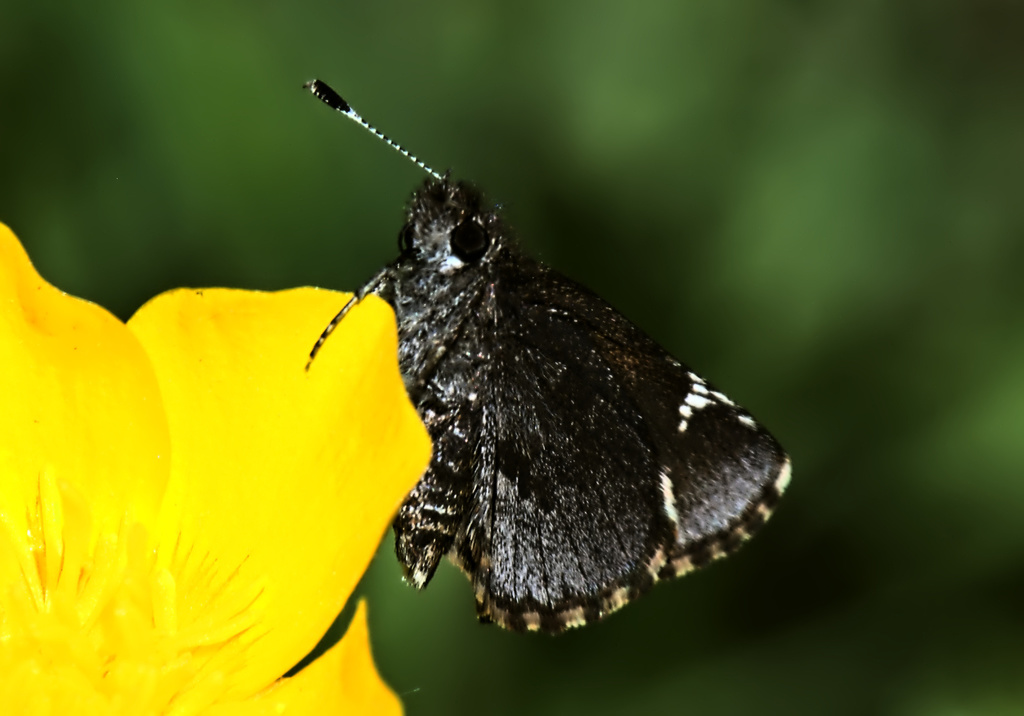
(c) Jimmy Dee, some rights reserved (CC BY-SA) · licence
Family: Hesperiidae · Class: Insecta · Order: Lepidoptera
Amblyscirtes vialis (Common Roadside-Skipper) is a California animal in the Hesperiidae family.
The Common Roadside-Skipper (Amblyscirtes vialis) is a small butterfly with a wingspan of 20 to 30 mm (0.8 to 1.2 inches). The upper surfaces of the wings are dark brown to blackish with small white spots on the forewings. Males display a distinctive dark stigma, or scent patch, on the forewings. The undersides are grayish-brown with pale spotting, often appearing mottled. The hindwings on the underside have a characteristic row of pale spots. The antennae are relatively short with distinct clubs, typical of skipper butterflies. The body is robust and covered with brownish scales, giving it a somewhat fuzzy appearance. The Common Roadside-Skipper has the most extensive range of any skipper butterfly in North America. It occurs from British Columbia east across southern Canada to Maine and Nova Scotia, extending south to central California, northern New Mexico, Texas, the Gulf states, and northern Florida. In California, populations are found primarily in the northern and central regions, with scattered records in mountainous areas of southern California. The species occurs from sea level to elevations of approximately 2,100 meters (6,900 feet). This species inhabits a variety of open and semi-open habitats including roadsides, meadows, prairies, woodland edges, and disturbed areas. Adults are frequently observed along gravel roads and pathways, which gives the species its common name. The butterfly shows a preference for areas with scattered grasses and some bare ground or leaf litter. It is often found in habitats with moderate moisture levels but can tolerate relatively dry conditions. Common Roadside-Skippers have a close association with various grass species. Larvae feed on multiple grass genera including wild oats (Avena), bent grass (Agrostis), bluegrass (Poa), Bermuda grass (Cynodon dactylon), and Indian woodoats grass (Chasmanthium latifolia). Adults exhibit a characteristic low, darting flight pattern and frequently perch on bare ground, rocks, or low vegetation with wings spread horizontally. Males are territorial and establish perching sites where they watch for females and chase away intruders. The species typically produces two broods per year in most of its range, with adults flying from April through October, depending on local climate conditions. Peak flight periods occur in late spring and late summer. The Common Roadside-Skipper is not federally or state listed and appears to maintain stable populations throughout most of its range. The species' widespread distribution and ability to utilize various grass hosts, including non-native species, contribute to its ecological success. Its tolerance for disturbed habitats and human-modified landscapes has likely helped maintain populations in developed areas. However, like many grassland-associated species, local populations may be affected by habitat conversion, intensive agriculture, and herbicide applications that eliminate host plants. Climate change could potentially alter the species' distribution, particularly at the northern and southern extremes of its range.
Classification
Class: Insecta · Order: Lepidoptera · Family: Hesperiidae
Frequently asked questions
How is Amblyscirtes vialis classified?
Amblyscirtes vialis belongs to class Insecta, order Lepidoptera, family Hesperiidae.
What family does Amblyscirtes vialis belong to?
Amblyscirtes vialis is in the Hesperiidae family.
What is Amblyscirtes vialis?
The Common Roadside-Skipper (Amblyscirtes vialis) is a small butterfly with a wingspan of 20 to 30 mm (0.8 to 1.2 inches).
Is Amblyscirtes vialis found in California?
Yes. Amblyscirtes vialis is recorded in California in The California Species Project's catalogue.
Related species
Other California species in the same genus, family, or bioregion.
Data from The California Species Project — 14,000+ California species with verified data from CNPS, CDFW, USFWS, and more.