Ambystoma californiense
California tiger salamander
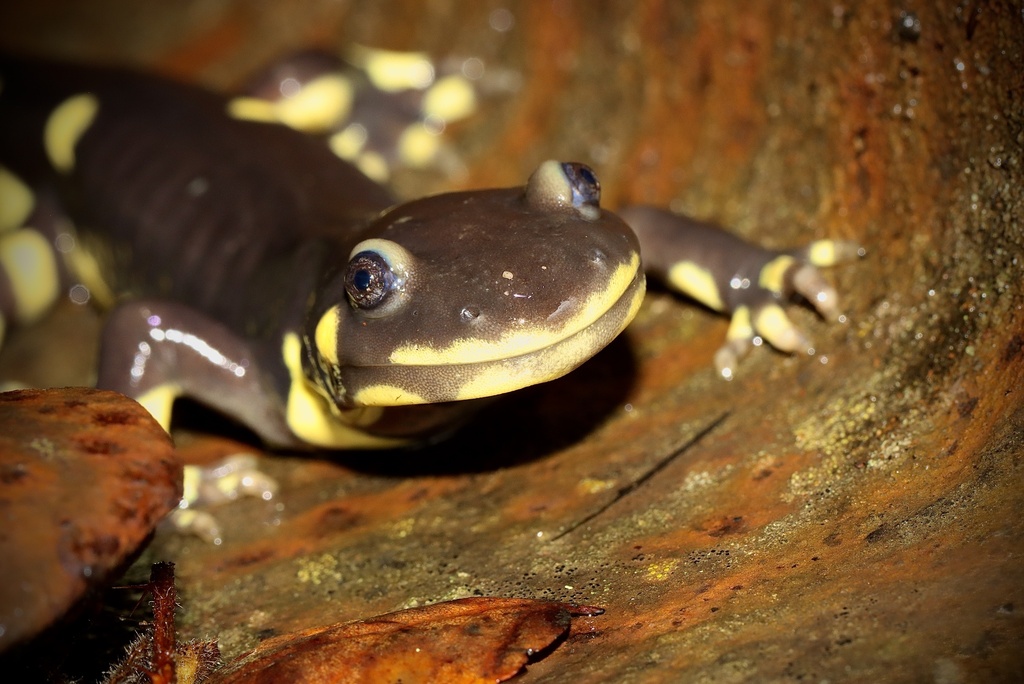
(c) Parsa Fard, some rights reserved (CC BY) · licence
Family: Ambystomatidae · Class: Amphibia · Order: Caudata
Conservation status: ST · Endangered · G2G3 S2S3
Ambystoma californiense (California tiger salamander) is a California animal in the Ambystomatidae family.
The California tiger salamander is a large, terrestrial salamander endemic to California. Adults measure 175 to 230 mm (6.9 to 9.1 inches) in total length, making them one of the largest terrestrial salamanders in North America. The species displays distinctive coloration with a black or dark brown base color marked by irregular yellow, cream, or white bars, spots, and blotches across the dorsal surface. The ventral surface is typically lighter with fewer markings. Adults have a robust build with a broad head, small eyes with pronounced eyelids, and a laterally compressed tail. The skin is smooth and moist, characteristic of the family Ambystomatidae. Historically, California tiger salamanders occurred throughout California's Central Valley and surrounding foothills from sea level to approximately 1,000 meters (3,280 feet) elevation. The species' current range is highly fragmented, with populations documented in 22 counties from Sonoma County in the north to Riverside County in the south. According to the SummitWest Environmental Database, the species maintains populations throughout California, though many have been extirpated from their historical range. The Santa Barbara County population segment is federally listed as endangered, while other distinct population segments receive varying levels of federal protection. California tiger salamanders inhabit grasslands, oak woodlands, and open scrublands with access to breeding ponds. Adults spend most of their lives underground in rodent burrows, particularly those of California ground squirrels and pocket gophers, at depths reaching 1.5 meters (5 feet). They emerge during winter rains to migrate to temporary or permanent ponds for breeding. Breeding habitat requires fishless ponds that retain water for a minimum of 3 to 4 months to allow larval development. Optimal breeding ponds are 0.3 to 3 meters (1 to 10 feet) deep with emergent vegetation. Adults are nocturnal and surface primarily during rainy nights from November through March. The species exhibits a biphasic life cycle with aquatic larvae metamorphosing into terrestrial adults. Breeding occurs from December through May, with peak activity during January and February. Females deposit 600 to 4,000 eggs in gelatinous masses attached to submerged vegetation or debris. Larval development requires 3 to 6 months depending on water temperature and food availability. Adults are opportunistic predators feeding on invertebrates including earthworms, beetles, and spiders. Larvae consume zooplankton, aquatic invertebrates, and occasionally other amphibian larvae. The U.S. Fish and Wildlife Service listed the Santa Barbara County distinct population segment as endangered in 2000, with additional populations receiving threatened status in 2004. According to USFWS estimates, the species has declined by more than 80% from historical levels due to habitat conversion, with less than 5% of original Central Valley habitat remaining. Primary threats include agricultural conversion, urban development, livestock grazing that degrades breeding ponds, predation by introduced fish and bullfrogs, and climate change effects on precipitation patterns. The CDFW notes that state listing applies to the species throughout its entire range, while federal protection varies by distinct population segments based on threat levels and population status.
Classification
Class: Amphibia · Order: Caudata · Family: Ambystomatidae
Conservation status
ST · Endangered · G2G3 S2S3
Frequently asked questions
How is Ambystoma californiense classified?
Ambystoma californiense belongs to class Amphibia, order Caudata, family Ambystomatidae.
What family does Ambystoma californiense belong to?
Ambystoma californiense is in the Ambystomatidae family.
Is Ambystoma californiense protected or of conservation concern?
Ambystoma californiense carries the following status: ST · Endangered · G2G3 S2S3.
What is Ambystoma californiense?
The California tiger salamander is a large, terrestrial salamander endemic to California.
Is Ambystoma californiense found in California?
Yes. Ambystoma californiense is recorded in California in The California Species Project's catalogue.
Related species
Other California species in the same genus, family, or bioregion.
Data from The California Species Project — 14,000+ California species with verified data from CNPS, CDFW, USFWS, and more.