Ambystoma californiense pop. 2
California tiger salamander - Santa Barbara County DPS
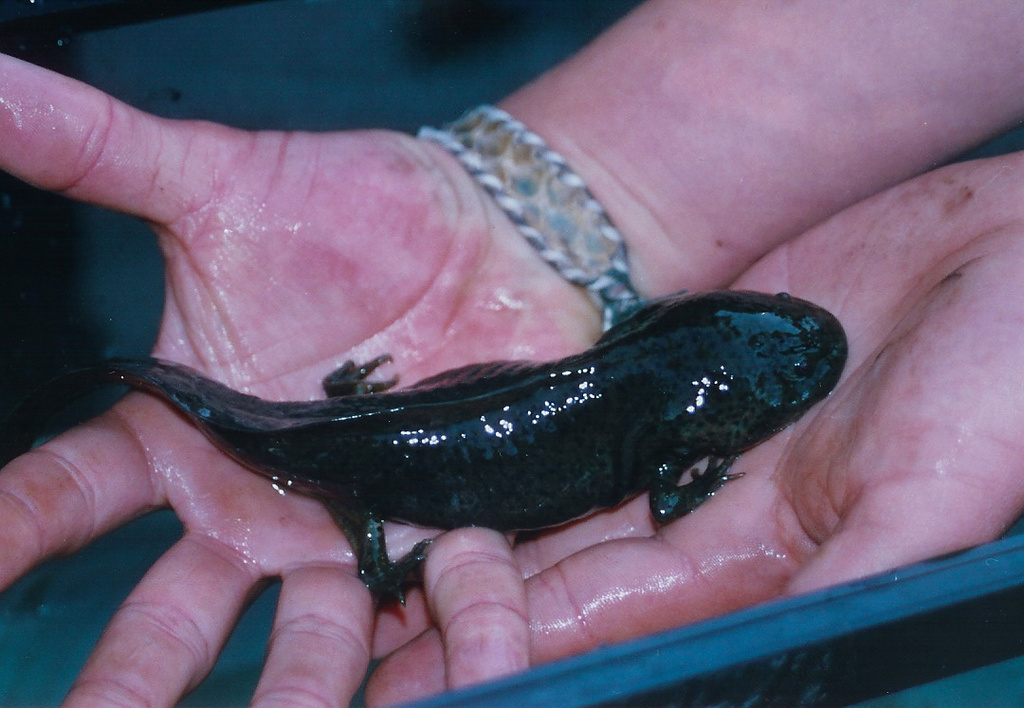
(c) Juan Cruzado Cortés, some rights reserved (CC BY-SA) · licence
Family: Ambystomatidae · Class: Amphibia · Order: Caudata
Conservation status: (ST) · Endangered · G2G3T2 S2
Ambystoma californiense pop. 2 (California tiger salamander - Santa Barbara County DPS) is a California animal in the Ambystomatidae family.
The California tiger salamander - Santa Barbara County Distinct Population Segment (DPS) is a large, stocky terrestrial salamander with a broad, rounded snout. Adults typically measure 15 to 22 centimeters (6 to 8.7 inches) in total length, with males averaging slightly larger than females at approximately 20 centimeters (8 inches) compared to females at less than 18 centimeters (7 inches). The species exhibits distinctive coloration consisting of random white or yellowish spots, bars, or markings against a black dorsal and lateral background. The ventral surface varies from nearly uniform white or pale yellow to a variegated pattern of white, pale yellow, and black. Small eyes with black irises protrude noticeably from the head. The Santa Barbara County DPS represents one of three federally recognized distinct population segments of the California tiger salamander. This population is restricted to Santa Barbara County, California, occurring at elevations up to 1,067 meters (3,500 feet). The species' historical range extended throughout grassland and oak savannah communities in coastal valleys, but current distribution has been significantly fragmented due to habitat loss and development. California tiger salamanders inhabit vernal pools and seasonal ponds, including constructed stock ponds, within grassland and oak savannah plant communities. The species requires both aquatic breeding habitats and surrounding upland terrestrial habitats that provide burrowing sites and foraging areas. Adults spend most of their lives underground in rodent burrows or self-excavated retreats, emerging primarily during winter rains to migrate to breeding ponds. The species depends on interconnected aquatic and terrestrial habitats functioning as metapopulations. Breeding occurs in temporary and permanent water bodies during winter and early spring months, typically following significant rainfall events. Females deposit eggs on submerged vegetation or debris, and larvae develop in the aquatic environment before metamorphosing into terrestrial juveniles. Adults are primarily nocturnal and feed on invertebrates including worms, insects, and other small prey. The species exhibits high site fidelity, often returning to the same breeding ponds annually. The Santa Barbara County DPS is federally listed as Endangered under the Endangered Species Act. According to the California Department of Fish and Wildlife, the species was initially listed as threatened statewide in 2004, but the Santa Barbara County and Sonoma County populations were subsequently reclassified as endangered. In 2005, a U.S. District Court vacated the down-listing, restoring the endangered status for both the Santa Barbara and Sonoma populations. The species is also listed as threatened under California state law. Primary threats include habitat loss due to agricultural conversion and urban development, habitat fragmentation, introduced predatory species in breeding ponds, disease, road mortality during migration, and water management practices that affect breeding pond hydrology. The U.S. Fish and Wildlife Service developed a recovery plan establishing criteria for long-term viability, including maintaining at least four functional metapopulations with adequate breeding and upland habitat connectivity (USFWS 2016).
Classification
Class: Amphibia · Order: Caudata · Family: Ambystomatidae
Conservation status
(ST) · Endangered · G2G3T2 S2
Frequently asked questions
How is Ambystoma californiense pop. 2 classified?
Ambystoma californiense pop. 2 belongs to class Amphibia, order Caudata, family Ambystomatidae.
What family does Ambystoma californiense pop. 2 belong to?
Ambystoma californiense pop. 2 is in the Ambystomatidae family.
Is Ambystoma californiense pop. 2 protected or of conservation concern?
Ambystoma californiense pop. 2 carries the following status: (ST) · Endangered · G2G3T2 S2.
What is Ambystoma californiense pop. 2?
The California tiger salamander - Santa Barbara County Distinct Population Segment (DPS) is a large, stocky terrestrial salamander with a broad, rounded snout.
Is Ambystoma californiense pop. 2 found in California?
Yes. Ambystoma californiense pop. 2 is recorded in California in The California Species Project's catalogue.
Related species
Other California species in the same genus, family, or bioregion.
Data from The California Species Project — 14,000+ California species with verified data from CNPS, CDFW, USFWS, and more.