Ambystoma macrodactylum
Long-Toed Salamander
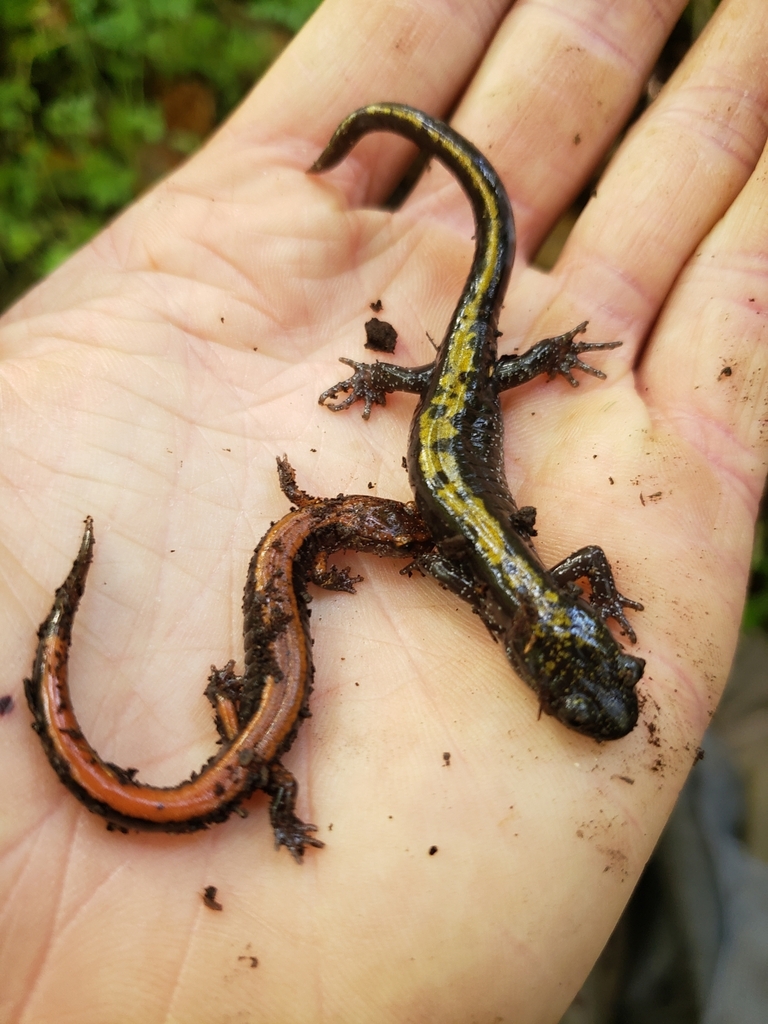
(c) M, some rights reserved (CC BY) · licence
Family: Ambystomatidae · Class: Amphibia · Order: Caudata
Ambystoma macrodactylum (Long-Toed Salamander) is a California animal in the Ambystomatidae family.
The Long-toed Salamander (Ambystoma macrodactylum) is a medium-sized terrestrial salamander belonging to the mole salamander family Ambystomatidae. Adults typically measure 56 to 102 mm (2.2 to 4.0 inches) in total length, with females generally larger than males. The species is characterized by its elongated fourth toe, which extends beyond the other toes when digits are pressed together. The dorsal surface ranges from dark brown to black with a distinctive yellow, tan, or greenish dorsal stripe extending from the head to the tail tip. The ventral surface is typically dark with small light flecks. Long-toed Salamanders have a broad distribution across western North America, extending from southeastern Alaska south to central California, and east to Montana and Colorado. In California, populations are restricted to the northern and eastern portions of the state, including the Cascade Range, Sierra Nevada, and northeastern Modoc Plateau region. The species occurs at elevations from near sea level to approximately 3,050 meters (10,000 feet), with California populations generally found above 1,200 meters (4,000 feet). The species inhabits a diverse range of environments including coniferous forests, mixed woodlands, mountain meadows, and alpine zones. Adults require proximity to breeding sites such as ponds, lakes, slow-moving streams, or temporary pools. Terrestrial habitat consists of areas with adequate cover including logs, rocks, leaf litter, and underground burrows. During dry periods, individuals may retreat several meters underground or utilize rodent burrows and root systems. Suitable habitat requires sufficient moisture retention and stable temperature regimes that prevent desiccation during summer months. Long-toed Salamanders are primarily nocturnal and exhibit complex life cycles involving both aquatic and terrestrial phases. Adults migrate to breeding sites during spring snowmelt, typically between March and July depending on elevation and local conditions. Females deposit 85 to 411 eggs in gelatinous masses attached to submerged vegetation or debris. Larval development occurs entirely in water, lasting 2 to 4 months in lower elevations but potentially extending beyond one year in high-altitude populations. Larvae transform at 15 to 30 mm snout-vent length. Adults feed primarily on small invertebrates including beetles, flies, spiders, and worms, while larvae consume zooplankton, aquatic insects, and other small organisms. The Long-toed Salamander is not federally listed and lacks special status designation in California. However, like many amphibians, populations face threats from habitat loss, introduced fish species in breeding ponds, pollution, and climate change effects on montane ecosystems. Disease, particularly chytrid fungus infections, poses additional risks to some populations. The species' dependence on both aquatic breeding sites and surrounding terrestrial habitat makes it vulnerable to landscape-level changes. In California, habitat modification from logging, development, and altered hydrological patterns represents ongoing conservation concerns, particularly for isolated high-elevation populations. Water diversions and drought conditions can eliminate critical breeding sites, while fragmentation reduces connectivity between suitable habitats.
Classification
Class: Amphibia · Order: Caudata · Family: Ambystomatidae
Frequently asked questions
How is Ambystoma macrodactylum classified?
Ambystoma macrodactylum belongs to class Amphibia, order Caudata, family Ambystomatidae.
What family does Ambystoma macrodactylum belong to?
Ambystoma macrodactylum is in the Ambystomatidae family.
What is Ambystoma macrodactylum?
The Long-toed Salamander (Ambystoma macrodactylum) is a medium-sized terrestrial salamander belonging to the mole salamander family Ambystomatidae.
Is Ambystoma macrodactylum found in California?
Yes. Ambystoma macrodactylum is recorded in California in The California Species Project's catalogue.
Related species
Other California species in the same genus, family, or bioregion.
Data from The California Species Project — 14,000+ California species with verified data from CNPS, CDFW, USFWS, and more.