Ambystoma macrodactylum croceum
Santa Cruz long-toed salamander
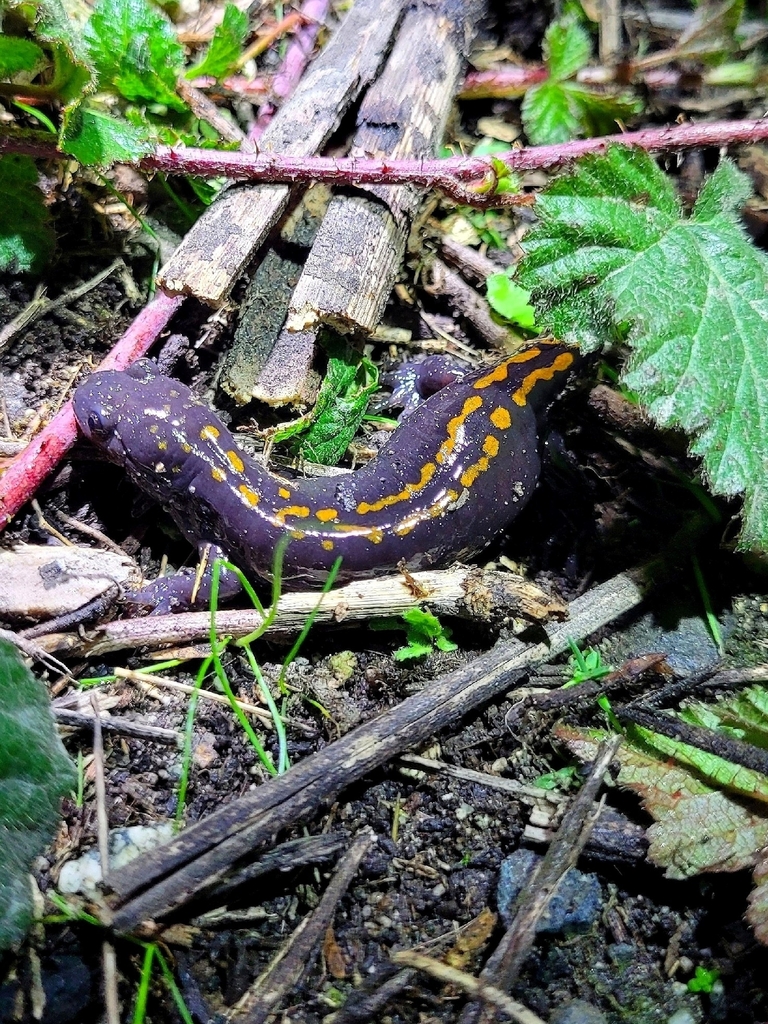
(c) Guillermo Roque, some rights reserved (CC BY) · licence
Family: Ambystomatidae · Class: Amphibia · Order: Caudata
Conservation status: FP · Endangered · G5T1T2 S2
Ambystoma macrodactylum croceum (Santa Cruz long-toed salamander) is a California animal in the Ambystomatidae family.
The Santa Cruz long-toed salamander is a small ambystomatid salamander measuring approximately 70 to 140 mm (2.8 to 5.5 inches) in total length. This subspecies differs from other long-toed salamanders by its distinctive coloration pattern of discrete, irregular patches of dull orange or metallic yellow markings along its dorsal surface. The dorsal head markings are greatly reduced to small scattered dots anterior to the eyes, which are often absent entirely. The ventral surface is sooty black with bluish to whitish flecks on the sides (USFWS Species Profile). The Santa Cruz long-toed salamander has an extremely restricted range, occurring only in southern Santa Cruz County and northern Monterey County, California. The species exists in three metapopulations distributed around the coast of Monterey Bay in approximately 11 documented locations (USFWS 1999). This population is considered a relict, now isolated from other long-toed salamander subspecies. The Ellicott Slough National Wildlife Refuge, including the Buena Vista Unit of the Santa Cruz Long-toed Salamander Ecological Reserve, provides protected habitat for the species. The salamander inhabits the unique interface of oak woodland, coastal chaparral, grassland, willow thickets, and ephemeral ponds in coastal rolling hills. Adults occupy dense riparian vegetation including willows, thick coastal scrub, and oak woodland habitats. The species requires both aquatic breeding sites and adjacent terrestrial upland habitat for its terrestrial adult phase. Breeding occurs in temporary ponds and wetlands, which are critical for larval development. Santa Cruz long-toed salamanders are invertivores throughout their life cycle, feeding on various invertebrates both as larvae and adults. Reproduction occurs in ephemeral wetlands where females deposit eggs. Larvae typically transform in 4 to 5 months in temporary ponds, though some may not transform during their first season. Transformed juveniles remain near pond sites until the first autumn rains trigger dispersal. Recent monitoring by CDFW has revealed a concerning trend where ponds have dried before larvae could successfully metamorphose in most areas over the past three years (CDFW Drought Projects). The Santa Cruz long-toed salamander was listed as federally endangered on March 11, 1967, making it one of the earliest species protected under federal endangered species legislation. It is also state-listed as endangered in California and designated as a fully protected species. The species faces severe threats from habitat loss, with land use changes reducing suitable upland habitat within migration distance of breeding ponds by 35.5% across its range. Urban and agricultural development represent the primary threats, along with habitat fragmentation from roads that further reduces accessible habitat. Climate change exacerbates these threats through altered precipitation patterns affecting the ephemeral ponds essential for reproduction. CDFW, the U.S. Fish and Wildlife Service, and the Resource Conservation District of Santa Cruz County have implemented habitat restoration efforts, including construction of new breeding ponds and deepening existing ones to improve reproductive success. A revised recovery plan focuses on providing sufficient breeding and upland habitat to maintain self-sustaining populations within each metapopulation while minimizing impacts and threats.
Classification
Class: Amphibia · Order: Caudata · Family: Ambystomatidae
Conservation status
FP · Endangered · G5T1T2 S2
Frequently asked questions
How is Ambystoma macrodactylum croceum classified?
Ambystoma macrodactylum croceum belongs to class Amphibia, order Caudata, family Ambystomatidae.
What family does Ambystoma macrodactylum croceum belong to?
Ambystoma macrodactylum croceum is in the Ambystomatidae family.
Is Ambystoma macrodactylum croceum protected or of conservation concern?
Ambystoma macrodactylum croceum carries the following status: FP · Endangered · G5T1T2 S2.
What is Ambystoma macrodactylum croceum?
The Santa Cruz long-toed salamander is a small ambystomatid salamander measuring approximately 70 to 140 mm (2.8 to 5.5 inches) in total length.
Is Ambystoma macrodactylum croceum found in California?
Yes. Ambystoma macrodactylum croceum is recorded in California in The California Species Project's catalogue.
Related species
Other California species in the same genus, family, or bioregion.
Data from The California Species Project — 14,000+ California species with verified data from CNPS, CDFW, USFWS, and more.