Ambystoma macrodactylum sigillatum
Southern Long- Toed Salamander
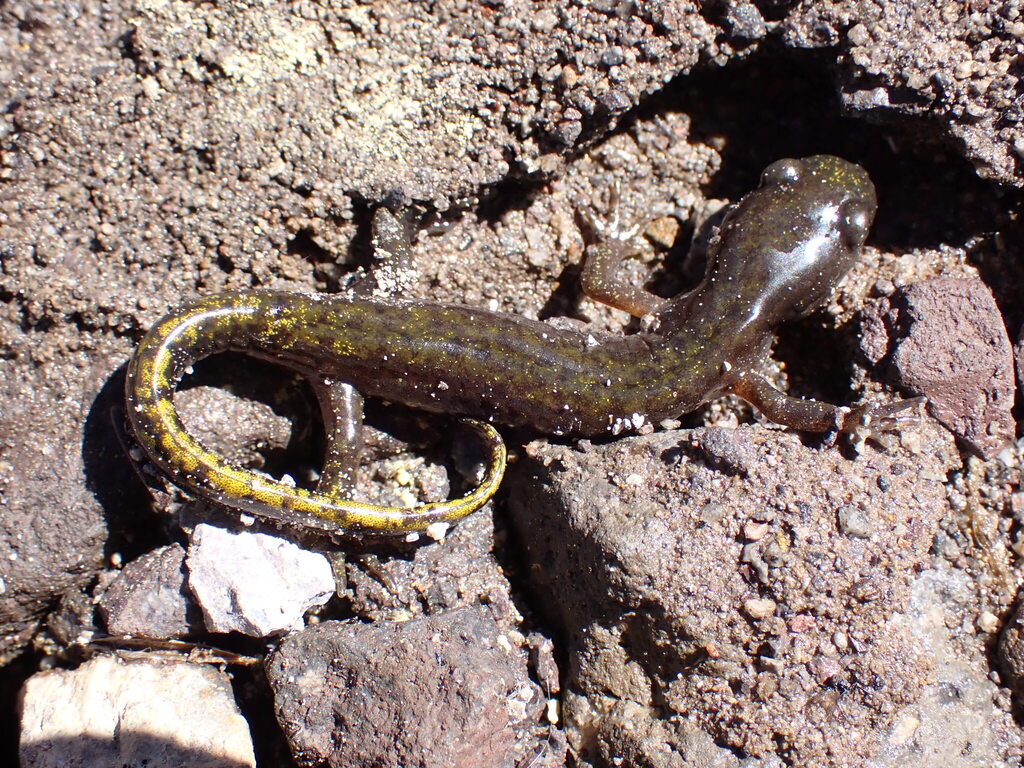
(c) Cricket Raspet, some rights reserved (CC BY) · licence
Family: Ambystomatidae · Class: Amphibia · Order: Caudata
Conservation status: G5T4 S2
Ambystoma macrodactylum sigillatum (Southern Long- Toed Salamander) is a California animal in the Ambystomatidae family.
The Southern Long-toed Salamander is a medium-sized terrestrial amphibian that represents one of five subspecies of the Long-toed Salamander complex. Adults typically measure 60-100 mm (2.4-3.9 inches) in total length, with a relatively slender body and characteristically elongated fourth toe that gives the species its common name. The dorsal coloration is generally dark brown to black with a distinctive light-colored dorsal stripe that may be yellow, tan, or greenish, though this stripe can be broken or absent in some individuals. The ventral surface is typically dark gray to black with small light flecks. The Southern Long-toed Salamander occurs in California's northeastern counties and along the northern Sierra Nevada south to Carson Pass, extending into southwestern Oregon south of the Calapooya Divide (AmphibiaWeb). In California, populations are documented in Trinity and Siskiyou counties near the Trinity Alps, and in the Sierra Nevada including areas around Spicer Reservoir and Garner Meadows. The subspecies also occurs in Nevada, giving it a broader distribution than California's endemic Santa Cruz Long-toed Salamander subspecies. This subspecies inhabits high-elevation environments, occurring at elevations up to approximately 10,000 feet (californiaherps.com). Primary habitat consists of alpine meadows, mountain ponds, and high-elevation lakes, along with adjacent coniferous forests. The species requires both aquatic breeding sites and terrestrial refugia, utilizing areas under logs, rocks, and organic debris during non-breeding periods. Breeding sites are typically seasonal or permanent ponds, mountain lakes, and slow-moving streams. Southern Long-toed Salamanders are primarily nocturnal and emerge during moist conditions to forage on small invertebrates including beetles, flies, spiders, and other arthropods. Breeding occurs in spring following snowmelt, typically from May through July depending on elevation and local conditions. Females deposit 85-270 eggs in gelatinous masses attached to submerged vegetation, rocks, or debris. Larvae are aquatic and feed on zooplankton, aquatic insects, and small crustaceans. At high elevations, larvae may require two or three seasons to complete metamorphosis due to shortened growing seasons. After transformation, juveniles disperse from breeding sites to terrestrial habitats. The Southern Long-toed Salamander currently holds no federal listing status under the U.S. Endangered Species Act. NatureServe assigns it a global subspecies rank of G5T4 (apparently secure) and a California state rank of S2 (imperiled), indicating significant conservation concern within the state despite the subspecies' broader stability range-wide. Primary threats include habitat alteration from recreational activities, water diversions affecting breeding sites, and potential climate change impacts on high-elevation aquatic habitats. Unlike its critically endangered relative the Santa Cruz Long-toed Salamander, the Southern Long-toed Salamander benefits from occurring partially within protected public lands, though specific population monitoring data remains limited.
Classification
Class: Amphibia · Order: Caudata · Family: Ambystomatidae
Conservation status
G5T4 S2
Frequently asked questions
How is Ambystoma macrodactylum sigillatum classified?
Ambystoma macrodactylum sigillatum belongs to class Amphibia, order Caudata, family Ambystomatidae.
What family does Ambystoma macrodactylum sigillatum belong to?
Ambystoma macrodactylum sigillatum is in the Ambystomatidae family.
Is Ambystoma macrodactylum sigillatum protected or of conservation concern?
Ambystoma macrodactylum sigillatum carries the following status: G5T4 S2.
What is Ambystoma macrodactylum sigillatum?
The Southern Long-toed Salamander is a medium-sized terrestrial amphibian that represents one of five subspecies of the Long-toed Salamander complex.
Is Ambystoma macrodactylum sigillatum found in California?
Yes. Ambystoma macrodactylum sigillatum is recorded in California in The California Species Project's catalogue.
Related species
Other California species in the same genus, family, or bioregion.
Data from The California Species Project — 14,000+ California species with verified data from CNPS, CDFW, USFWS, and more.