Ameiurus catus
White catfish
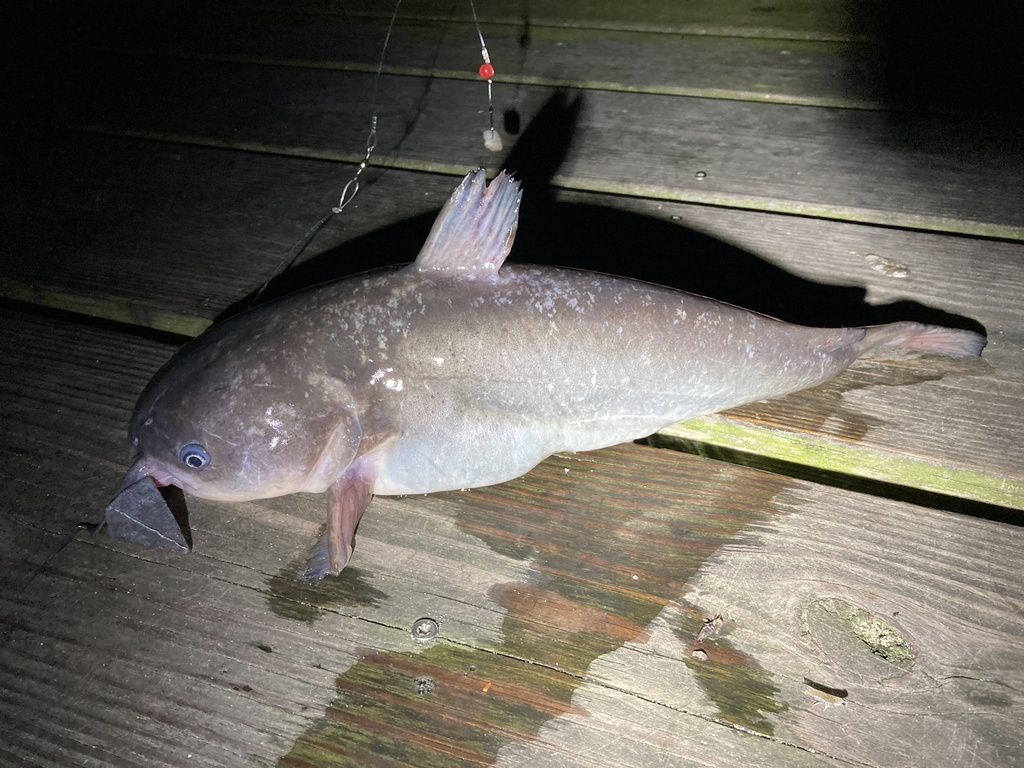
(c) harrier, some rights reserved (CC BY) · licence
Family: Ictaluridae · Class: Actinopterygii · Order: Siluriformes
Ameiurus catus (White catfish) is a California animal in the Ictaluridae family.
The white catfish is a medium-sized freshwater fish native to the eastern United States but now established as a non-native species in California waters. Adults typically reach 25 to 37 cm (10 to 14.5 inches) in total length, though specimens can grow up to 61 cm (24 inches). The body is moderately elongated with a broad, flattened head and a deeply forked tail fin. The species is characterized by its smooth, scaleless skin and four pairs of sensory barbels around the mouth. Coloration ranges from blue-gray to pale yellow on the dorsal surface, fading to white or cream on the ventral side. The adipose fin is free from the caudal fin, and the anal fin contains 19 to 23 rays, distinguishing it from other catfish species. Historically native to Atlantic coastal drainages from New York to Florida and Gulf Coast states westward to Texas, white catfish were introduced to California waters in the early 20th century. The species is now established in numerous reservoirs, lakes, and slow-moving rivers throughout the Central Valley, including the Sacramento-San Joaquin Delta system. Populations occur in water bodies from Shasta Lake in the north to the Colorado River along the southeastern border. The species has also colonized coastal drainages and urban reservoirs in Southern California. White catfish inhabit warm, slow-moving or still waters with soft substrates. They prefer lakes, reservoirs, ponds, and sluggish rivers with temperatures ranging from 21 to 29°C (70 to 84°F) during the growing season. The species tolerates a wide range of water conditions, including moderately turbid environments and areas with low dissolved oxygen levels. Adults typically occupy depths of 1 to 8 meters (3 to 26 feet) but may move to shallower areas during spawning periods. They show preference for areas with submerged vegetation, fallen timber, or other structural cover. White catfish are opportunistic omnivores with a diet consisting of aquatic insects, crustaceans, small fish, mollusks, and plant material. Feeding occurs primarily at night and during crepuscular periods. The species reaches sexual maturity at 2 to 3 years of age. Spawning occurs from April through July when water temperatures reach 21°C (70°F). Males construct circular nests in shallow water, typically 30 to 61 cm (12 to 24 inches) in diameter, where females deposit 2,000 to 4,000 adhesive eggs. Males provide parental care by guarding the nest and fanning eggs until hatching occurs after 5 to 10 days. White catfish are not federally or state-listed in California and are considered a naturalized non-native species. While populations appear stable throughout their introduced range, the species may compete with native fish for habitat and food resources. The California Department of Fish and Wildlife manages white catfish as part of the state's recreational fishery, with no special conservation measures currently in place. Their widespread distribution and adaptability to various aquatic environments suggest continued establishment in suitable California habitats.
Classification
Class: Actinopterygii · Order: Siluriformes · Family: Ictaluridae
Frequently asked questions
How is Ameiurus catus classified?
Ameiurus catus belongs to class Actinopterygii, order Siluriformes, family Ictaluridae.
What family does Ameiurus catus belong to?
Ameiurus catus is in the Ictaluridae family.
What is Ameiurus catus?
The white catfish is a medium-sized freshwater fish native to the eastern United States but now established as a non-native species in California waters.
Is Ameiurus catus found in California?
Yes. Ameiurus catus is recorded in California in The California Species Project's catalogue.
Related species
Other California species in the same genus, family, or bioregion.
Data from The California Species Project — 14,000+ California species with verified data from CNPS, CDFW, USFWS, and more.