Ammodramus savannarum
Grasshopper Sparrow
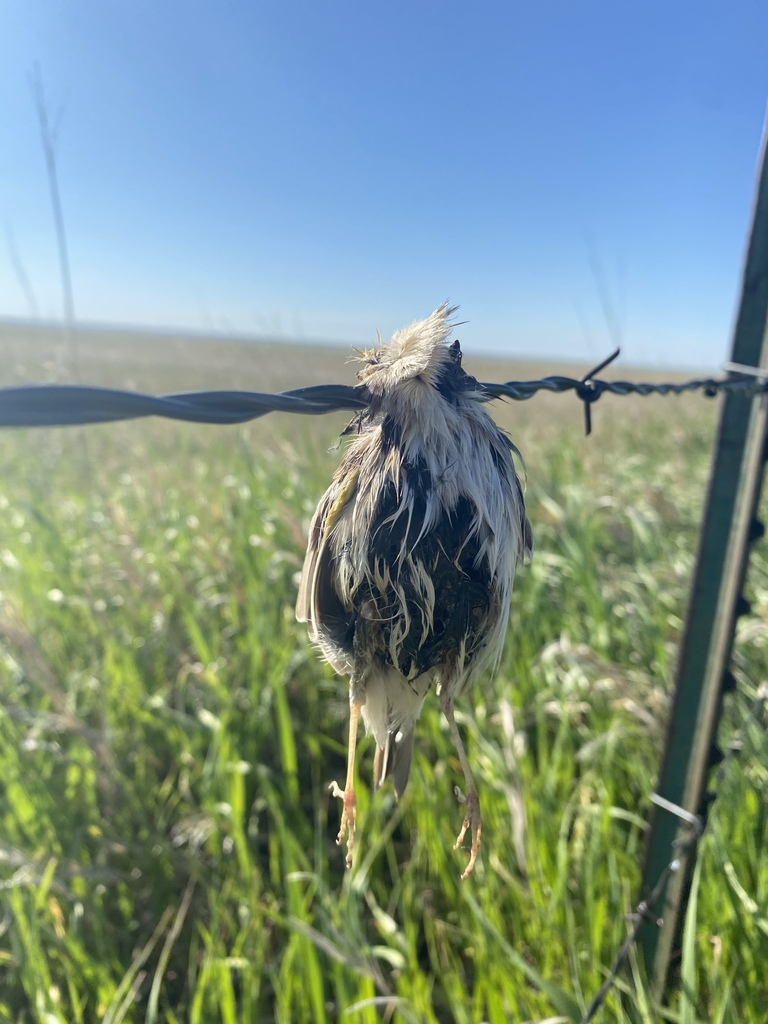
(c) Cole Wolf, some rights reserved (CC BY) · licence
Family: Passerellidae · Class: Aves · Order: Passeriformes
Conservation status: G5 S3
Ammodramus savannarum (Grasshopper Sparrow) is a California animal in the Passerellidae family.
The Grasshopper Sparrow (Ammodramus savannarum) is a small, cryptically colored passerine measuring 10-11 cm (4.0-4.3 inches) in length with a wingspan of 20 cm (7.9 inches). Adults weigh 13-20 grams. The species exhibits a flat-headed profile with a proportionally large, pale bill adapted for seed consumption. The upperparts display a complex pattern of brown, black, and buff streaking, while the underparts are pale buff to whitish with minimal streaking on the breast. A distinctive pale median crown stripe contrasts with darker lateral crown stripes. The species lacks the distinct facial pattern typical of many sparrows, giving it a plain-faced appearance that aids in grassland camouflage. Historically, Grasshopper Sparrows occurred throughout suitable grassland habitats across much of North America. In California, the species' range has contracted significantly since the early 1900s. Current breeding populations are restricted to scattered locations in the Central Valley, coastal ranges from Sonoma County south to San Luis Obispo County, and isolated sites in the Sierra Nevada foothills. The species has been extirpated from much of its former range, including areas in Southern California where it was once common. Grasshopper Sparrows occupy native and non-native grasslands, prairies, hayfields, and lightly grazed pastures. Optimal habitat consists of moderately tall grass (30-60 cm) with 25-60% bare ground and scattered forbs. The species requires areas with low shrub density, typically less than 10% cover. Elevation ranges from sea level to 1,500 meters in California. Breeding territories average 0.8-2.4 hectares, with males selecting areas that provide adequate foraging opportunities and nest sites while maintaining visibility for territorial defense. The species exhibits a mixed diet consisting primarily of insects during the breeding season and seeds during fall and winter. Common prey items include grasshoppers, beetles, caterpillars, and spiders. Seeds from grasses and forbs comprise up to 70% of the diet outside the breeding season. Breeding occurs from April through August, with peak activity in May and June. Females construct cup-shaped nests on the ground, often partially concealed by overhanging vegetation. Clutch size ranges from 3-6 eggs, with incubation lasting 11-12 days. Females may attempt 2-3 broods per season under favorable conditions. Grasshopper Sparrows are not federally listed but are considered a Species of Special Concern in California due to significant population declines. According to the North American Breeding Bird Survey, California populations have declined by approximately 3.8% annually since 1968. The species' Global rank of G5 indicates it is secure rangewide, but the California State rank of S3 reflects vulnerability within the state. Primary threats include habitat conversion to agriculture and urban development, invasive plant species that alter grassland structure, and intensive grazing that reduces vegetation cover. Fire suppression has led to shrub encroachment in many grassland areas, making them unsuitable for nesting. Conservation efforts focus on habitat restoration, prescribed burning to maintain grassland ecosystems, and working with private landowners to implement grassland-friendly management practices.
Classification
Class: Aves · Order: Passeriformes · Family: Passerellidae
Conservation status
G5 S3
Frequently asked questions
How is Ammodramus savannarum classified?
Ammodramus savannarum belongs to class Aves, order Passeriformes, family Passerellidae.
What family does Ammodramus savannarum belong to?
Ammodramus savannarum is in the Passerellidae family.
Is Ammodramus savannarum protected or of conservation concern?
Ammodramus savannarum carries the following status: G5 S3.
What is Ammodramus savannarum?
The Grasshopper Sparrow (Ammodramus savannarum) is a small, cryptically colored passerine measuring 10-11 cm (4.0-4.3 inches) in length with a wingspan of 20 cm (7.9 inches).
Is Ammodramus savannarum found in California?
Yes. Ammodramus savannarum is recorded in California in The California Species Project's catalogue.
Related species
Other California species in the same genus, family, or bioregion.
Data from The California Species Project — 14,000+ California species with verified data from CNPS, CDFW, USFWS, and more.