Ammopelmatus pictus
Pictured Jerusalem Cricket
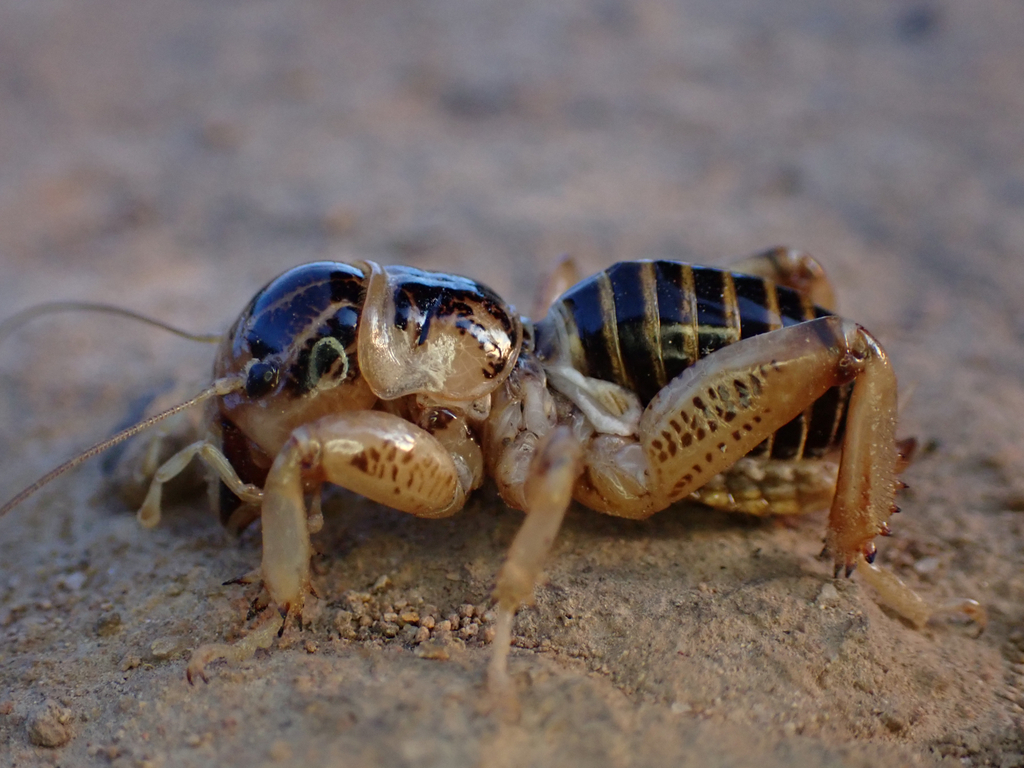
(c) harrii, some rights reserved (CC BY) · licence
Family: Stenopelmatidae · Class: Insecta · Order: Orthoptera
Ammopelmatus pictus (Pictured Jerusalem Cricket) is a California animal in the Stenopelmatidae family.
The Pictured Jerusalem Cricket (Ammopelmatus pictus) is a large, wingless orthopteran in the family Stenopelmatidae. Adults typically measure 15-30 mm (0.6-1.2 inches) in length, with robust, cylindrical bodies and enlarged heads characteristic of Jerusalem crickets. The species displays a pale to medium brown coloration with darker banding patterns across the abdomen, giving it the 'pictured' appearance referenced in its common name. Like other Jerusalem crickets, A. pictus possesses powerful mandibles and enlarged hind legs adapted for digging. The Pictured Jerusalem Cricket occurs in California, though its precise distribution remains poorly documented in the scientific literature. Based on available records, the species appears to inhabit coastal and inland areas of the state, though comprehensive range mapping has not been conducted. The species is part of a complex group of Jerusalem crickets that includes several rare and localized taxa, such as A. kelsoensis from the Kelso Dunes and A. muwu from Point Conception (BugGuide). Habitat requirements for A. pictus have not been thoroughly studied, but the species likely occupies similar niches to related Jerusalem crickets. These insects typically inhabit sandy soils, chaparral, and scrubland environments where they can construct burrows. Jerusalem crickets are commonly found under rocks, logs, and other surface debris during daylight hours. The species likely prefers areas with loose, well-drained soils that facilitate burrowing behavior. Pictured Jerusalem Crickets are primarily nocturnal and fossorial, spending most daylight hours in underground burrows. Like other members of the genus, A. pictus is likely omnivorous, feeding on plant roots, decaying organic matter, and small invertebrates (BugGuide). Jerusalem crickets are opportunistic predators that will consume other insects when available. The species may be attracted to artificial lights at night, as documented for related taxa. Reproductive biology and seasonal activity patterns for this species have not been well documented in the literature. The conservation status of Ammopelmatus pictus remains unclear due to limited scientific study. Unlike some congeners that are recognized as rare and localized, A. pictus does not appear on federal or state endangered species lists as of December 2025. However, the general lack of ecological research on this species makes it difficult to assess population trends or conservation needs. California hosts several Jerusalem cricket species of conservation concern, suggesting that habitat loss and fragmentation may pose threats to A. pictus populations as well. Urban development, agricultural conversion, and other land use changes could potentially impact the sandy soil habitats preferred by Jerusalem crickets. Detailed ecological studies of this species are lacking. The above information synthesizes available observations from taxonomic databases and related species accounts. Scientific documentation regarding specific habitat requirements, population status, and ecological relationships remains limited for A. pictus.
Classification
Class: Insecta · Order: Orthoptera · Family: Stenopelmatidae
Frequently asked questions
How is Ammopelmatus pictus classified?
Ammopelmatus pictus belongs to class Insecta, order Orthoptera, family Stenopelmatidae.
What family does Ammopelmatus pictus belong to?
Ammopelmatus pictus is in the Stenopelmatidae family.
What is Ammopelmatus pictus?
The Pictured Jerusalem Cricket (Ammopelmatus pictus) is a large, wingless orthopteran in the family Stenopelmatidae.
Is Ammopelmatus pictus found in California?
Yes. Ammopelmatus pictus is recorded in California in The California Species Project's catalogue.
Related species
Other California species in the same genus, family, or bioregion.
Data from The California Species Project — 14,000+ California species with verified data from CNPS, CDFW, USFWS, and more.