Ammospermophilus leucurus
White-tailed Antelope Ground Squirrel
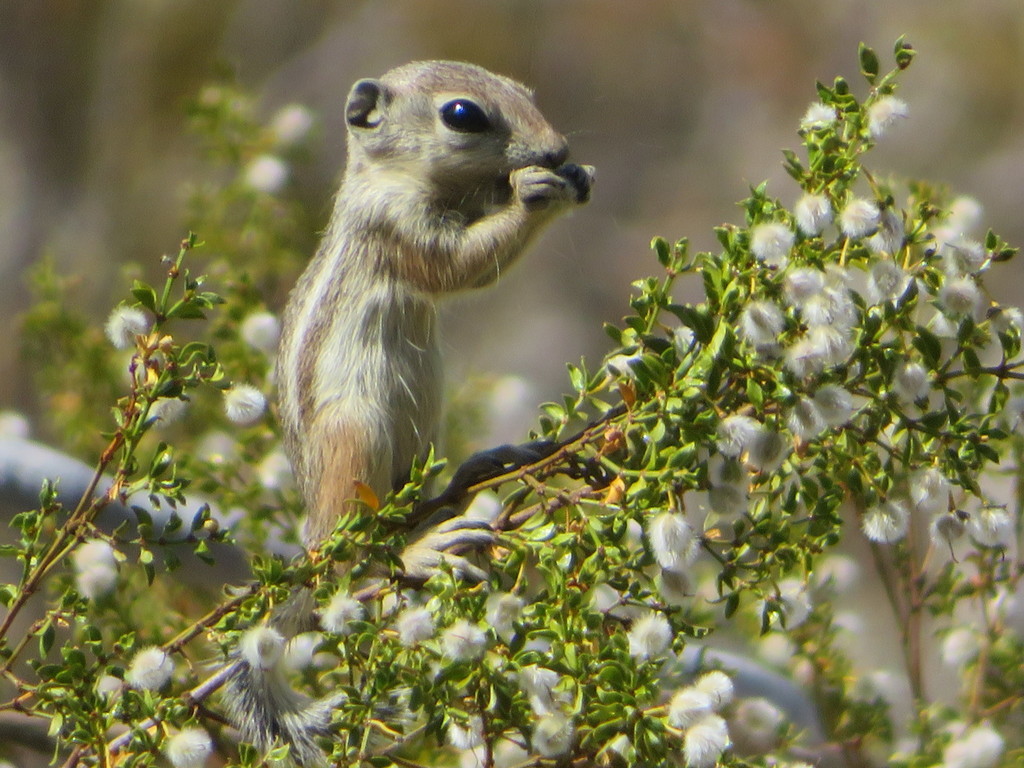
(c) kclarksdnhmorg, some rights reserved (CC BY) · licence
Family: Sciuridae · Class: Mammalia · Order: Rodentia
Ammospermophilus leucurus (White-tailed Antelope Ground Squirrel) is a California animal in the Sciuridae family.
The White-tailed Antelope Ground Squirrel (Ammospermophilus leucurus) is a small, pale-colored ground squirrel characterized by its distinctive white underside of the tail and rapid, jerky movements. Adults measure 140 to 170 mm (5.5 to 6.7 inches) in total length, with the tail comprising approximately one-third of this length at 50 to 70 mm (2.0 to 2.8 inches). Body weight ranges from 96 to 117 grams (3.4 to 4.1 ounces). The dorsal pelage is grayish-buff to cinnamon-buff with fine black and white grizzling, while the ventral surface is white to cream-colored. The species' most diagnostic feature is the pure white underside of the flattened tail, which is held curved over the back when running, creating a distinctive white flash. The species ranges across the southwestern United States and northwestern Mexico. In California, White-tailed Antelope Ground Squirrels occur primarily in the southeastern desert regions, including the Mojave Desert and portions of the Sonoran Desert. Their California range extends through Riverside, San Bernardino, Imperial, Inyo, Mono, and Kern counties. The species is found at elevations from below sea level in Death Valley to approximately 2,000 meters (6,600 feet) in mountainous areas. White-tailed Antelope Ground Squirrels inhabit arid and semi-arid environments characterized by sparse vegetation and well-drained soils. Preferred habitats include desert flats, bajadas, rocky slopes, and areas with scattered shrubs such as creosote bush, Joshua trees, and various cacti species. The species constructs burrow systems in sandy or gravelly substrates, often near the base of shrubs or rocks that provide cover and foraging opportunities. This diurnal species exhibits specialized physiological adaptations to desert conditions, including the ability to withstand body temperatures up to 43°C (109°F) without entering estivation. White-tailed Antelope Ground Squirrels are omnivorous, feeding on green vegetation, seeds, fruits, and occasionally insects and small vertebrates. Their diet varies seasonally, with green plant material consumed primarily during spring months when available. The species can obtain water from its food and rarely drinks free water. Breeding occurs from February through June, with females producing one to two litters annually containing three to ten young after a gestation period of approximately 30 days. The White-tailed Antelope Ground Squirrel is not federally or state listed and appears to maintain stable populations throughout most of its range. The species is classified as Least Concern by the IUCN. Primary threats include habitat conversion for development, particularly in rapidly growing desert communities, and potential impacts from climate change affecting desert ecosystems. However, the species' broad habitat tolerance and ability to persist in disturbed areas provide some resilience to human activities. Populations remain widespread across suitable desert habitats in California, with no immediate conservation concerns identified for the species as of December 2025.
Classification
Class: Mammalia · Order: Rodentia · Family: Sciuridae
Frequently asked questions
How is Ammospermophilus leucurus classified?
Ammospermophilus leucurus belongs to class Mammalia, order Rodentia, family Sciuridae.
What family does Ammospermophilus leucurus belong to?
Ammospermophilus leucurus is in the Sciuridae family.
What is Ammospermophilus leucurus?
The White-tailed Antelope Ground Squirrel (Ammospermophilus leucurus) is a small, pale-colored ground squirrel characterized by its distinctive white underside of the tail and rapid, jerky movements.
Is Ammospermophilus leucurus found in California?
Yes. Ammospermophilus leucurus is recorded in California in The California Species Project's catalogue.
Related species
Other California species in the same genus, family, or bioregion.
Data from The California Species Project — 14,000+ California species with verified data from CNPS, CDFW, USFWS, and more.