Ammospermophilus nelsoni
Nelson’s (=San Joaquin) antelope squirrel
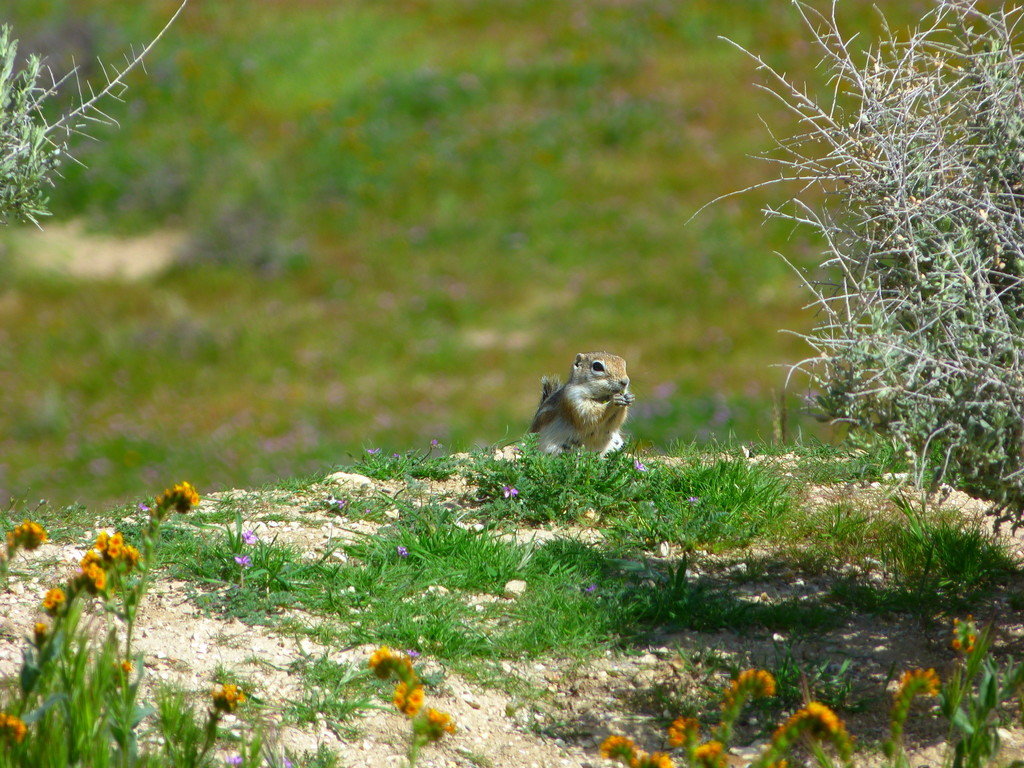
(c) Zack Abbey, some rights reserved (CC BY) · licence
Family: Sciuridae · Class: Mammalia · Order: Rodentia
Conservation status: ST · G2G3 S3
Ammospermophilus nelsoni (Nelson’s (=San Joaquin) antelope squirrel) is a California animal in the Sciuridae family.
Nelson's antelope squirrel (Ammospermophilus nelsoni) is a small ground squirrel endemic to the San Joaquin Valley of California. Adults measure 140 to 170 mm (5.5 to 6.7 inches) in total length, with the tail comprising approximately one-third of this length. Body weight ranges from 95 to 123 grams (3.3 to 4.3 ounces). The species displays typical antelope squirrel characteristics with a grizzled grayish-brown dorsal pelage marked by a distinctive white stripe extending from each shoulder to the hip. The ventral surface is white to pale buff. The moderately bushy tail shows alternating dark and light bands on the underside, which the animal characteristically carries curled over its back while running. Historically, Nelson's antelope squirrel ranged throughout the San Joaquin Valley from Kern County north to southern Stanislaus and Merced counties. The current distribution is severely fragmented, with populations restricted to remnant habitat patches in the western and southwestern San Joaquin Valley. Documented populations persist in Kern, Kings, Fresno, Merced, and western Tulare counties. The largest remaining populations occur in the Carrizo Plain and surrounding foothills of the Temblor Range. This species inhabits arid and semi-arid shrubland communities dominated by saltbush scrub vegetation. Preferred habitat consists of gently rolling terrain with sandy or gravelly soils supporting sparse to moderate shrub cover. Elevations range from 120 to 750 meters (390 to 2,460 feet). Essential habitat components include scattered shrubs for cover, open areas for foraging, and well-drained soils suitable for burrow construction. The species shows strong association with four-wing saltbush (Atriplex canescens), bladderpod (Isomeris arborea), and Mormon tea (Ephedra nevadensis) plant communities. Nelson's antelope squirrel is diurnal and active year-round, though activity decreases during extreme weather. The species constructs extensive burrow systems with multiple entrances, serving for shelter, food storage, and reproduction. Breeding occurs from February through April, with females producing a single annual litter of 6 to 10 young after a 30-day gestation period. The diet consists primarily of seeds from shrubs and forbs, supplemented with green vegetation, fruits, and occasionally insects. Seeds of saltbush, filaree, and various forbs constitute the bulk of the diet, with cached seeds providing sustenance during resource-scarce periods. Nelson's antelope squirrel was listed as threatened by the California Fish and Game Commission in 1980. Population estimates suggest fewer than 3,000 individuals remain across all populations, representing a decline of approximately 95% from historical levels. Primary threats include habitat loss and fragmentation from agricultural conversion, urban development, and energy infrastructure. Over 98% of original San Joaquin Valley shrubland habitat has been eliminated. Additional threats include livestock grazing, invasive plant species, vehicle strikes, and climate change effects on precipitation patterns. Conservation efforts focus on habitat protection, restoration of degraded areas, and establishment of wildlife corridors connecting isolated populations.
Classification
Class: Mammalia · Order: Rodentia · Family: Sciuridae
Conservation status
ST · G2G3 S3
Frequently asked questions
How is Ammospermophilus nelsoni classified?
Ammospermophilus nelsoni belongs to class Mammalia, order Rodentia, family Sciuridae.
What family does Ammospermophilus nelsoni belong to?
Ammospermophilus nelsoni is in the Sciuridae family.
Is Ammospermophilus nelsoni protected or of conservation concern?
Ammospermophilus nelsoni carries the following status: ST · G2G3 S3.
What is Ammospermophilus nelsoni?
Nelson's antelope squirrel (Ammospermophilus nelsoni) is a small ground squirrel endemic to the San Joaquin Valley of California.
Is Ammospermophilus nelsoni found in California?
Yes. Ammospermophilus nelsoni is recorded in California in The California Species Project's catalogue.
Related species
Other California species in the same genus, family, or bioregion.
Data from The California Species Project — 14,000+ California species with verified data from CNPS, CDFW, USFWS, and more.