Ammotragus lervia
Barbary Sheep
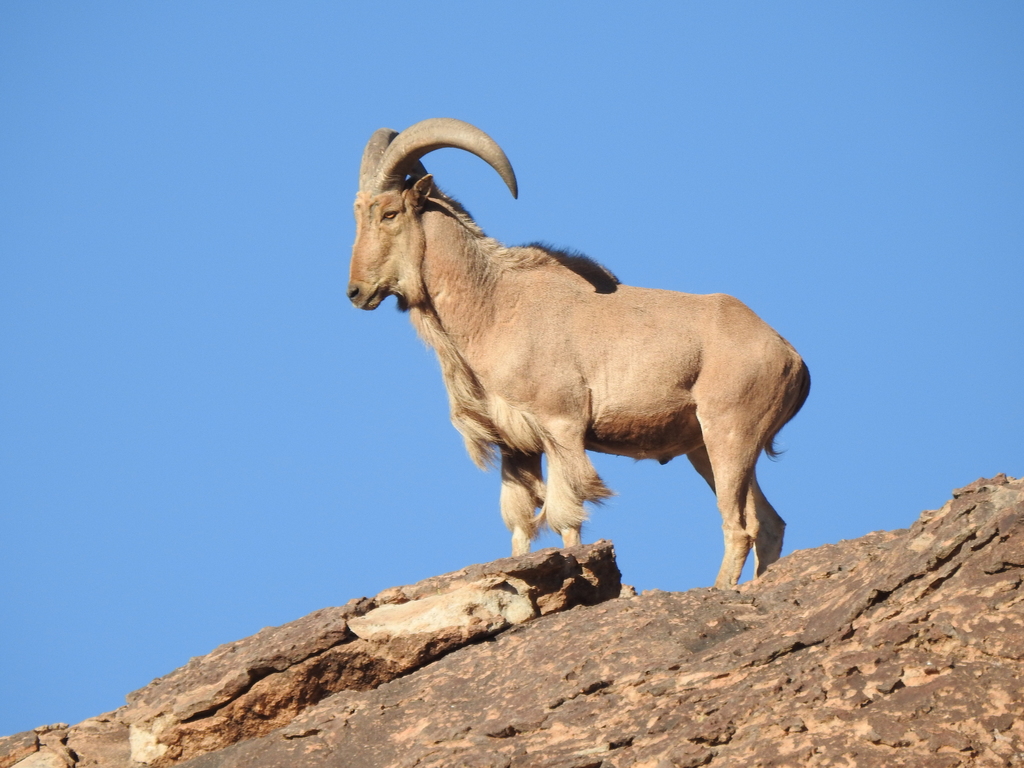
(c) Kevin Floyd, some rights reserved (CC BY) · licence
Family: Bovidae · Class: Mammalia · Order: Artiodactyla
Ammotragus lervia (Barbary Sheep) is a California animal in the Bovidae family.
The Barbary sheep (Ammotragus lervia), also known as aoudad, is a large wild sheep native to North Africa that has been introduced to various locations worldwide, including California. Adult males weigh 100 to 145 kilograms (220 to 320 pounds) and stand 75 to 112 centimeters (30 to 44 inches) at the shoulder, while females are smaller, weighing 40 to 55 kilograms (88 to 121 pounds). The species displays sexual dimorphism, with males developing a distinctive mane of long hair extending from the throat down to the front legs and chest. Both sexes have curved, ridged horns that sweep backward and outward, though males possess larger, more robust horns reaching lengths of 50 centimeters (20 inches). The coat ranges from light tan to reddish-brown, providing camouflage in rocky terrain. Barbary sheep are not native to California but have established populations in several western states following introductions for hunting purposes. In California, small populations exist primarily in the Mojave Desert region, including areas of San Bernardino County. The species originated from the Atlas Mountains and surrounding arid regions of North Africa, including Morocco, Algeria, Tunisia, Libya, Egypt, and Sudan. The species inhabits arid and semi-arid mountainous terrain, preferring rocky slopes, cliffs, and canyon systems with elevations ranging from sea level to 4,200 meters (13,800 feet) in their native range. In California, they occupy desert mountain ranges with sparse vegetation, utilizing steep terrain that provides escape routes from predators and access to scattered water sources. Barbary sheep are well-adapted to harsh, dry conditions and can survive extended periods without free water, obtaining moisture from vegetation. Barbary sheep are primarily browsers, feeding on grasses, forbs, shrubs, and tree bark. Their diet varies seasonally based on availability, with green vegetation preferred when accessible. The species exhibits gregarious behavior, forming small herds of 3 to 8 individuals, though larger aggregations may occur around water sources. Breeding occurs from September through November, with a gestation period of 150 to 165 days. Females typically produce one to three offspring, with twins being common. Young reach sexual maturity at 18 to 24 months. As an introduced species in California, Barbary sheep lack formal conservation status protections. The species is classified as Vulnerable on the IUCN Red List in its native range due to hunting pressure and habitat degradation. In California, populations remain limited and localized. The California Department of Fish and Wildlife manages the species as an exotic ungulate, with hunting regulated through special permits. Concerns exist regarding potential ecological impacts on native desert ecosystems, including competition with native wildlife for limited water and forage resources, and potential habitat modification through browsing pressure on native vegetation.
Classification
Class: Mammalia · Order: Artiodactyla · Family: Bovidae
Frequently asked questions
How is Ammotragus lervia classified?
Ammotragus lervia belongs to class Mammalia, order Artiodactyla, family Bovidae.
What family does Ammotragus lervia belong to?
Ammotragus lervia is in the Bovidae family.
What is Ammotragus lervia?
The Barbary sheep (Ammotragus lervia), also known as aoudad, is a large wild sheep native to North Africa that has been introduced to various locations worldwide, including California.
Is Ammotragus lervia found in California?
Yes. Ammotragus lervia is recorded in California in The California Species Project's catalogue.
Related species
Other California species in the same genus, family, or bioregion.
Data from The California Species Project — 14,000+ California species with verified data from CNPS, CDFW, USFWS, and more.