Amorbia cuneana
Western Avocado Leafroller Moth
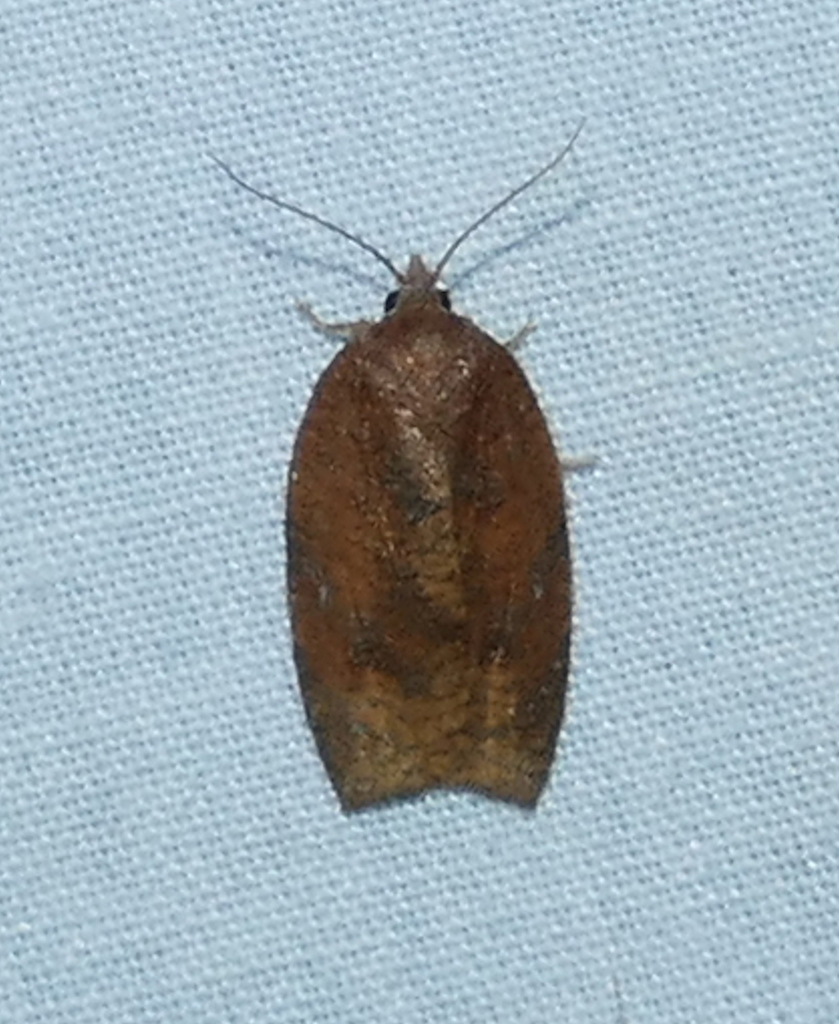
(c) Wendy McCrady, some rights reserved (CC BY) · licence
Family: Tortricidae · Class: Insecta · Order: Lepidoptera
Amorbia cuneana (Western Avocado Leafroller Moth) is a California animal in the Tortricidae family.
The Western Avocado Leafroller Moth (Amorbia cuneana) is a small tortricid moth in the family Tortricidae. Adults typically measure 10-15 mm in wingspan, with forewings that are brownish-gray to orange-brown in coloration. The forewings display distinctive reticulated or net-like patterns with darker cross-lines and pale patches. The hindwings are lighter, typically pale gray to whitish. Males are generally smaller than females and possess feathery antennae, while females have thread-like antennae. The larvae are pale green to yellowish caterpillars measuring up to 20 mm when fully grown, with a brown or black head capsule. This species occurs along the Pacific Coast from British Columbia, Canada, south through California to Baja California, Mexico. In California, the Western Avocado Leafroller Moth is found primarily in coastal and near-coastal regions from sea level to approximately 1,500 meters elevation. The species has been documented in counties including Los Angeles, Orange, Riverside, San Bernardino, Santa Barbara, Ventura, and San Diego, with populations extending inland through suitable habitat corridors. The Western Avocado Leafroller Moth inhabits areas with broadleaf evergreen vegetation, particularly chaparral, oak woodlands, and riparian zones. The species shows strong preference for areas containing its primary host plants, which include avocado (Persea americana), California bay laurel (Umbellularia californica), and various members of the rose family (Rosaceae) including toyon (Heteromeles arbutifolia) and wild cherry species (Prunus). In agricultural settings, the moth is commonly found in avocado groves and ornamental plantings. Larvae are leaf-tiers and leaf-rollers that create shelters by folding or rolling leaves together with silk webbing. They feed within these protective structures, consuming leaf tissue and creating characteristic feeding damage patterns. The species is multivoltine, producing multiple generations per year in favorable climates. Adults are active primarily during evening and nighttime hours and are attracted to artificial lights. Mating occurs shortly after adult emergence, with females depositing eggs singly or in small clusters on host plant foliage. Development from egg to adult typically requires 6-8 weeks under optimal conditions. The Western Avocado Leafroller Moth is considered an agricultural pest species, particularly in commercial avocado production. While not listed under federal or state conservation legislation, the species is economically significant due to larval feeding damage on cultivated avocado trees. Larvae can cause defoliation, reduce fruit quality, and create entry points for plant pathogens. Management strategies include integrated pest management approaches combining biological control agents, pheromone monitoring, and targeted pesticide applications when necessary. Climate change may affect the species' distribution and phenology, potentially expanding its range northward as temperatures increase. Urban development and habitat fragmentation in coastal California may impact wild populations, though the species' association with cultivated plants provides alternative habitat in agricultural and suburban landscapes.
Classification
Class: Insecta · Order: Lepidoptera · Family: Tortricidae
Frequently asked questions
How is Amorbia cuneana classified?
Amorbia cuneana belongs to class Insecta, order Lepidoptera, family Tortricidae.
What family does Amorbia cuneana belong to?
Amorbia cuneana is in the Tortricidae family.
What is Amorbia cuneana?
The Western Avocado Leafroller Moth (Amorbia cuneana) is a small tortricid moth in the family Tortricidae.
Is Amorbia cuneana found in California?
Yes. Amorbia cuneana is recorded in California in The California Species Project's catalogue.
Related species
Other California species in the same genus, family, or bioregion.
Data from The California Species Project — 14,000+ California species with verified data from CNPS, CDFW, USFWS, and more.