Amphiodia occidentalis
Long-armed Brittle Star
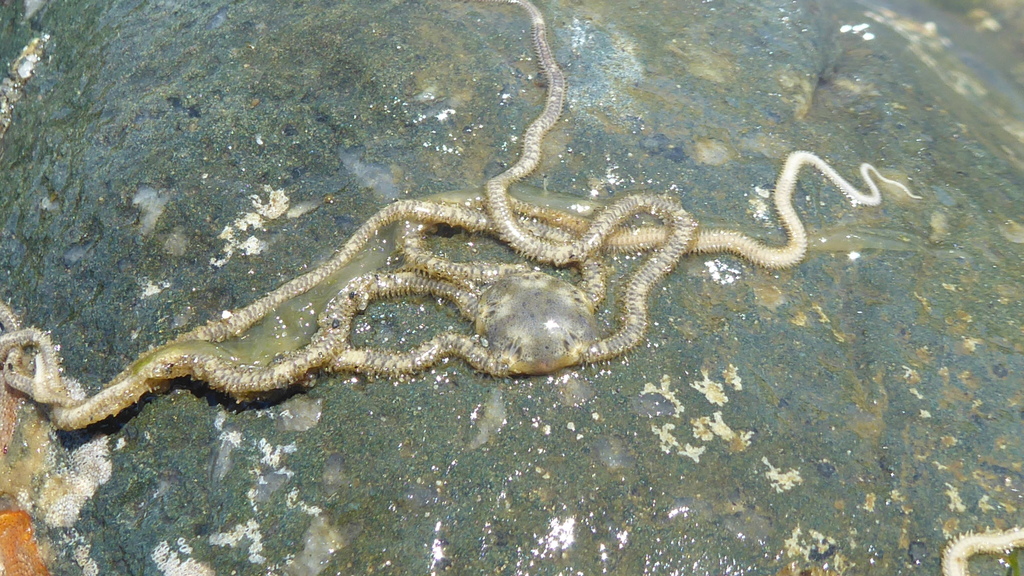
(c) Marilynne Box, some rights reserved (CC BY) · licence
Family: Amphiuridae · Class: Ophiuroidea · Order: Ophiurida
Amphiodia occidentalis (Long-armed Brittle Star) is a California animal in the Amphiuridae family.
Amphiodia occidentalis, the long-armed brittle star, is a marine echinoderm belonging to the family Amphiuridae. Adults have a central disc diameter up to 2 cm (0.8 inches) and disproportionately long, slender arms extending up to 18 cm (7.1 inches) in length, giving the species its characteristic serpentine appearance. The body displays pentaradial symmetry typical of echinoderms, with five flexible arms radiating from the central disc. The disc and arms are typically pale to translucent, allowing the species to blend with sandy substrates. Amphiodia occidentalis is native to the northeastern Pacific Ocean, with a distribution ranging from Alaska south to California. The species occurs along the entire Pacific coast of North America, inhabiting continental shelf waters from British Columbia through Baja California. In California waters, it has been documented in various marine protected areas including Point Vicente and South Point, where it inhabits both rocky reef and soft-bottom environments. This brittle star demonstrates wide depth tolerance, occurring from intertidal zones to depths of at least 367 meters (1,204 feet). The species shows a strong preference for soft-bottom substrates including sand, mud, and fine sediments where it lives infaunally, burrowing into the sediment with only its arm tips exposed for feeding. It also occurs on rocky substrates and in kelp forest environments, adapting to various benthic habitats across its depth range. Amphiodia occidentalis exhibits specialized reproductive biology featuring direct development without a planktonic larval stage. Females are gonochoric and brood embryos within specialized internal pouches called bursae until they develop into miniature juveniles. This brooding strategy enhances offspring survival in stable habitats but limits dispersal capability compared to species with planktonic larvae. The species contributes to benthic community dynamics through its feeding activities and serves as prey for various marine organisms. As a suspension feeder, A. occidentalis extends its arms into the water column or across the sediment surface to capture organic particles and small organisms. The elongated arms are well-adapted for this feeding strategy, allowing the buried body to remain protected while the arms actively forage. The species uses its tube feet and arm movements for both feeding and locomotion across the seafloor. Currently, Amphiodia occidentalis has no specific conservation listing at federal or state levels. The species appears to maintain stable populations throughout its range, though like many marine invertebrates, it may face pressure from habitat modification, sedimentation, and climate change impacts on ocean chemistry. Its presence in California's marine protected areas provides some protection for local populations, and its broad depth range and geographic distribution suggest resilience to localized disturbances.
Classification
Class: Ophiuroidea · Order: Ophiurida · Family: Amphiuridae
Frequently asked questions
How is Amphiodia occidentalis classified?
Amphiodia occidentalis belongs to class Ophiuroidea, order Ophiurida, family Amphiuridae.
What family does Amphiodia occidentalis belong to?
Amphiodia occidentalis is in the Amphiuridae family.
What is Amphiodia occidentalis?
Amphiodia occidentalis, the long-armed brittle star, is a marine echinoderm belonging to the family Amphiuridae.
Is Amphiodia occidentalis found in California?
Yes. Amphiodia occidentalis is recorded in California in The California Species Project's catalogue.
More California species
This species has no close relatives in our California data — here are other species to explore.
Data from The California Species Project — 14,000+ California species with verified data from CNPS, CDFW, USFWS, and more.