Amphispiza bilineata
Black-throated Sparrow
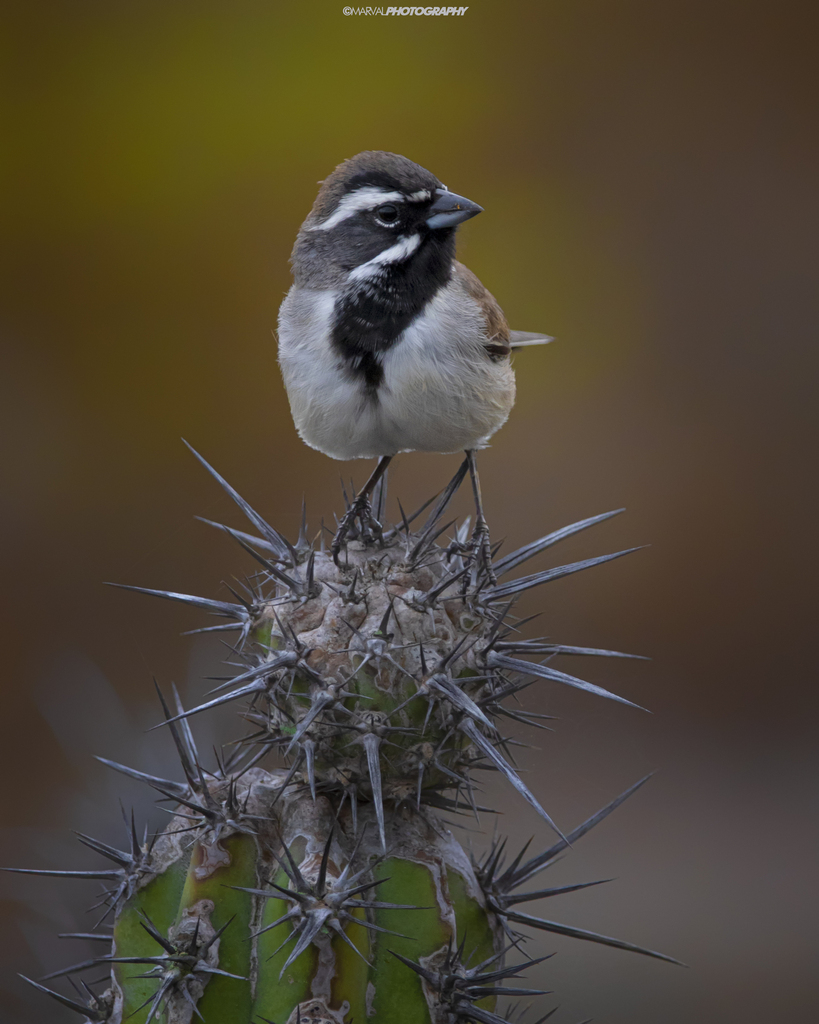
(c) MarvalPhotography19, some rights reserved (CC BY) · licence
Family: Passerellidae · Class: Aves · Order: Passeriformes
Amphispiza bilineata (Black-throated Sparrow) is a California animal in the Passerellidae family.
The Black-throated Sparrow (Amphispiza bilineata) is a small passerine bird measuring 13 to 14 cm (5.1 to 5.5 inches) in length with a wingspan of 19 to 21 cm (7.5 to 8.3 inches). Adults weigh 11 to 15 grams. The species displays distinctive head markings with bold white supercilium stripes extending from above the eye to the nape, contrasting sharply with black lores and auricular patches. The throat patch is black in adults, bordered by white malar stripes. The upperparts are grayish-brown, while the underparts are pale gray to white. The tail is dark with white outer tail feathers visible in flight. Juveniles lack the black throat patch and show streaked underparts. The Black-throated Sparrow occurs throughout the southwestern United States and northwestern Mexico. In California, the species breeds primarily in the Mojave and Sonoran desert regions of southeastern counties, including Imperial, Riverside, San Bernardino, Inyo, and Kern counties. The range extends north along the eastern Sierra Nevada foothills and into portions of the Central Valley. According to breeding bird surveys, populations are most concentrated in desert areas below 1,200 meters (4,000 feet) elevation, though the species occasionally occurs up to 2,100 meters (7,000 feet) in suitable habitat. This species inhabits arid and semi-arid shrublands, particularly areas dominated by creosote bush (Larrea tridentata), Joshua tree (Yucca brevifolia), and various cholla and prickly pear cacti. Black-throated Sparrows also occupy desert washes, rocky slopes with scattered vegetation, and edges of agricultural areas adjacent to desert habitat. The species shows preference for areas with 10 to 40 percent shrub cover and open ground for foraging. During winter, some populations move to lower elevations and may utilize mesquite bosques and desert riparian areas. Black-throated Sparrows are primarily granivorous, feeding on seeds from grasses, forbs, and shrubs including bursage, brittlebush, and various legumes. During breeding season, adults supplement their diet with insects, particularly caterpillars, beetles, and ants, which provide protein for developing young. The breeding season extends from March through August, with peak activity occurring from April to June. Females construct cup-shaped nests in shrubs 0.3 to 2 meters above ground, typically in cholla cacti or dense shrubs. Clutch size ranges from 2 to 4 eggs, with an incubation period of 12 to 13 days. Young fledge after 9 to 11 days. The species may produce two broods per year in favorable conditions. The Black-throated Sparrow is not federally listed and maintains stable populations across much of its range. The North American Breeding Bird Survey indicates relatively stable population trends from 1966 to 2019, though some regional declines have been documented in areas experiencing habitat conversion. Primary threats include urban development, renewable energy projects, invasive plant species such as tamarisk and fountain grass that alter desert plant communities, and climate change effects on precipitation patterns. Conservation efforts focus on maintaining large blocks of intact desert habitat and managing grazing impacts in sensitive areas.
Classification
Class: Aves · Order: Passeriformes · Family: Passerellidae
Frequently asked questions
How is Amphispiza bilineata classified?
Amphispiza bilineata belongs to class Aves, order Passeriformes, family Passerellidae.
What family does Amphispiza bilineata belong to?
Amphispiza bilineata is in the Passerellidae family.
What is Amphispiza bilineata?
The Black-throated Sparrow (Amphispiza bilineata) is a small passerine bird measuring 13 to 14 cm (5.1 to 5.5 inches) in length with a wingspan of 19 to 21 cm (7.5 to 8.3 inches).
Is Amphispiza bilineata found in California?
Yes. Amphispiza bilineata is recorded in California in The California Species Project's catalogue.
Related species
Other California species in the same genus, family, or bioregion.
Data from The California Species Project — 14,000+ California species with verified data from CNPS, CDFW, USFWS, and more.