Anabrus simplex
Mormon Cricket
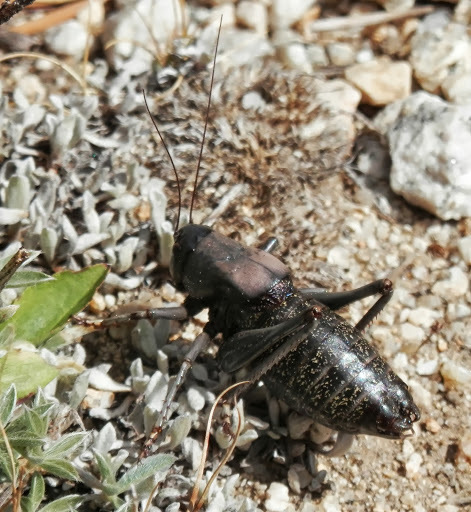
(c) 101595408250610106310, some rights reserved (CC BY) · licence
Family: Tettigoniidae · Class: Insecta · Order: Orthoptera
Anabrus simplex (Mormon Cricket) is a California animal in the Tettigoniidae family.
The Mormon cricket is a large, flightless katydid measuring 38 to 51 mm (1.5 to 2.0 inches) in length. Despite its common name, this insect is not a true cricket but rather belongs to the family Tettigoniidae (katydids and bush crickets). Adults display variable coloration ranging from brown and black to green, often with reddish or yellow markings. The species lacks functional wings, possessing only small wing pads, and has long, robust hind legs adapted for jumping and walking. Mormon crickets are native to western North America, with their range extending across much of the Intermountain West. In California, they occur primarily in the northeastern counties, including areas of the Great Basin and eastern Sierra Nevada regions. The species' broader distribution encompasses Oregon, Washington, Idaho, Nevada, Utah, Colorado, Montana, Wyoming, North Dakota, and parts of western Canada including British Columbia and Alberta. This species inhabits arid and semi-arid shrublands, grasslands, and rangelands, particularly sagebrush steppe and mixed desert scrub communities. Mormon crickets are commonly found in Inter-Mountain Basins Big Sagebrush Shrubland and Inter-Mountain Basins Mixed Salt Desert Scrub ecosystems (NatureServe 2023). They typically occur at elevations ranging from valley floors to montane areas, preferring open areas with sparse to moderate vegetation cover. Mormon crickets are omnivorous, feeding on a diverse array of plant materials including grasses, forbs, shrubs, and occasionally other insects or even dead individuals of their own species. Research indicates that when sharing habitat with livestock, Mormon crickets and cattle show little dietary overlap, with crickets predominantly feeding on sagebrush rather than competing directly for forage grasses (Redak et al. 1992). The species exhibits complex social behavior, particularly during population outbreaks when individuals may form large migratory bands that can travel considerable distances across the landscape. These migrations typically occur when local food resources become depleted. Reproduction occurs in late spring and early summer, with females laying eggs in soil during late summer and fall. Eggs overwinter and hatch the following spring, with nymphs developing through several molts before reaching adulthood. Population dynamics are highly variable, with numbers fluctuating dramatically between years depending on environmental conditions, particularly spring temperature and moisture levels. The Mormon cricket is not federally or state listed as threatened or endangered. As a native species, it plays an important ecological role as both herbivore and prey species, serving as food for various birds, small mammals, and other insects. However, during periodic population outbreaks, the species is often targeted for control by the U.S. Department of Agriculture's Animal and Plant Health Inspection Service through pesticide applications across hundreds of thousands of acres of western rangelands (USDA-APHIS 2010). These control efforts have raised conservation concerns regarding impacts on non-target species in grassland ecosystems. Scientific evidence suggests that Mormon crickets may actually benefit rangeland ecosystems by improving plant community composition and providing essential ecosystem services rather than causing significant damage to rangeland resources.
Classification
Class: Insecta · Order: Orthoptera · Family: Tettigoniidae
Frequently asked questions
How is Anabrus simplex classified?
Anabrus simplex belongs to class Insecta, order Orthoptera, family Tettigoniidae.
What family does Anabrus simplex belong to?
Anabrus simplex is in the Tettigoniidae family.
What is Anabrus simplex?
The Mormon cricket is a large, flightless katydid measuring 38 to 51 mm (1.5 to 2.0 inches) in length.
Is Anabrus simplex found in California?
Yes. Anabrus simplex is recorded in California in The California Species Project's catalogue.
Related species
Other California species in the same genus, family, or bioregion.
Data from The California Species Project — 14,000+ California species with verified data from CNPS, CDFW, USFWS, and more.