Anania funebris
White Spotted Sable Moth
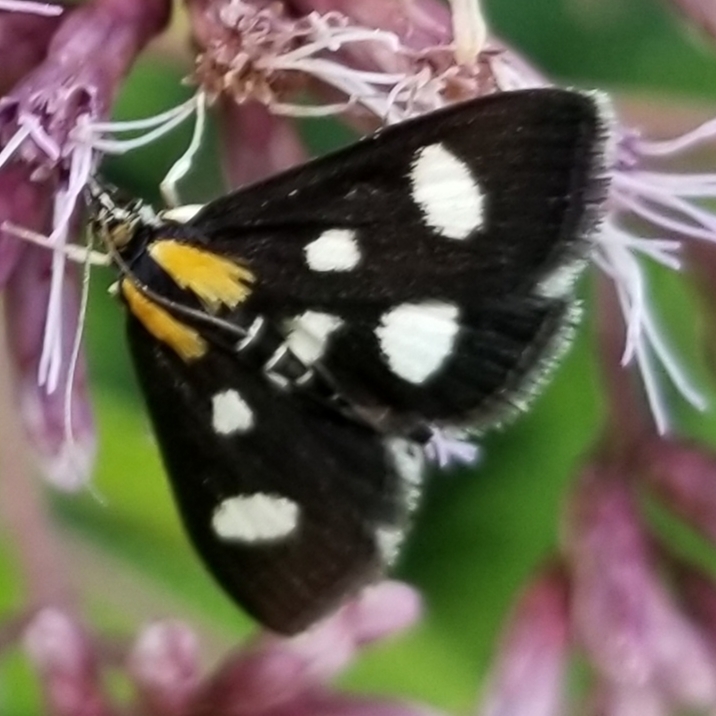
(c) Daniel McClosky, some rights reserved (CC BY) · licence
Family: Crambidae · Class: Insecta · Order: Lepidoptera
Anania funebris (White Spotted Sable Moth) is a California animal in the Crambidae family.
The White Spotted Sable Moth is a small pyralid moth in the family Crambidae, subfamily Pyraustinae. Adults display distinctive dark brown to blackish forewings marked with characteristic white spots, giving the species its common name. The wingspan typically measures 20-25 mm. The hindwings are lighter in coloration, often appearing grayish-brown with less distinct markings. This species has a holarctic distribution, occurring across northern regions of both North America and Eurasia. In North America, the subspecies Anania funebris glomeralis ranges from Newfoundland to southern North Carolina, extending west across Canada and south to Michigan and Minnesota (BugGuide). The species appears to be absent from California and the western United States, with its distribution concentrated in the northern and eastern portions of the continent. White Spotted Sable Moths inhabit diverse terrestrial environments where their host plants occur. The species shows a preference for areas supporting members of the Asteraceae and Fabaceae families. Adults are typically found in meadows, forest edges, and disturbed habitats where goldenrod and other host plants are abundant. The larvae feed on plants in the Asteraceae and Fabaceae families, with documented host genera including Cytisus, Genista, and Solidago (goldenrod) (Moth Photographers Group). Larvae create webs around basal leaves or flowerheads of their host plants, where they feed during development (Munroe 1976). This webbing behavior distinguishes them from many other pyralid species that bore into stems or feed openly on foliage. The species appears to be univoltine in most of its range, with adults flying during late spring and summer months. Flight period observations from Indiana indicate activity in May, though regional variation likely occurs across the species' extensive range. Anania funebris is not federally listed and appears to maintain stable populations throughout much of its range. The species benefits from the widespread distribution of its host plants, particularly goldenrod species which are common across eastern North America. However, like many specialized herbivores, local populations may be affected by habitat modification, pesticide use, and changes in plant community composition. The moth's dependence on specific host plant genera makes it potentially vulnerable to large-scale agricultural practices that eliminate native forb communities. The species was originally described by Strøm in 1768 as Phalaena funebris. The North American subspecies was later described as Ennychia glomeralis by Walker in 1859, though current taxonomy recognizes this as a subspecies of the Palearctic A. funebris (Moth Photographers Group). This taxonomic history reflects the species' transcontinental distribution and the gradual recognition of geographic variation within what was initially considered separate species. The Hodges number 4958 is used for identification purposes in North American lepidopteran literature.
Classification
Class: Insecta · Order: Lepidoptera · Family: Crambidae
Frequently asked questions
How is Anania funebris classified?
Anania funebris belongs to class Insecta, order Lepidoptera, family Crambidae.
What family does Anania funebris belong to?
Anania funebris is in the Crambidae family.
What is Anania funebris?
The White Spotted Sable Moth is a small pyralid moth in the family Crambidae, subfamily Pyraustinae.
Is Anania funebris found in California?
Yes. Anania funebris is recorded in California in The California Species Project's catalogue.
Related species
Other California species in the same genus, family, or bioregion.
Data from The California Species Project — 14,000+ California species with verified data from CNPS, CDFW, USFWS, and more.