Anarhynchus montanus
Mountain Plover
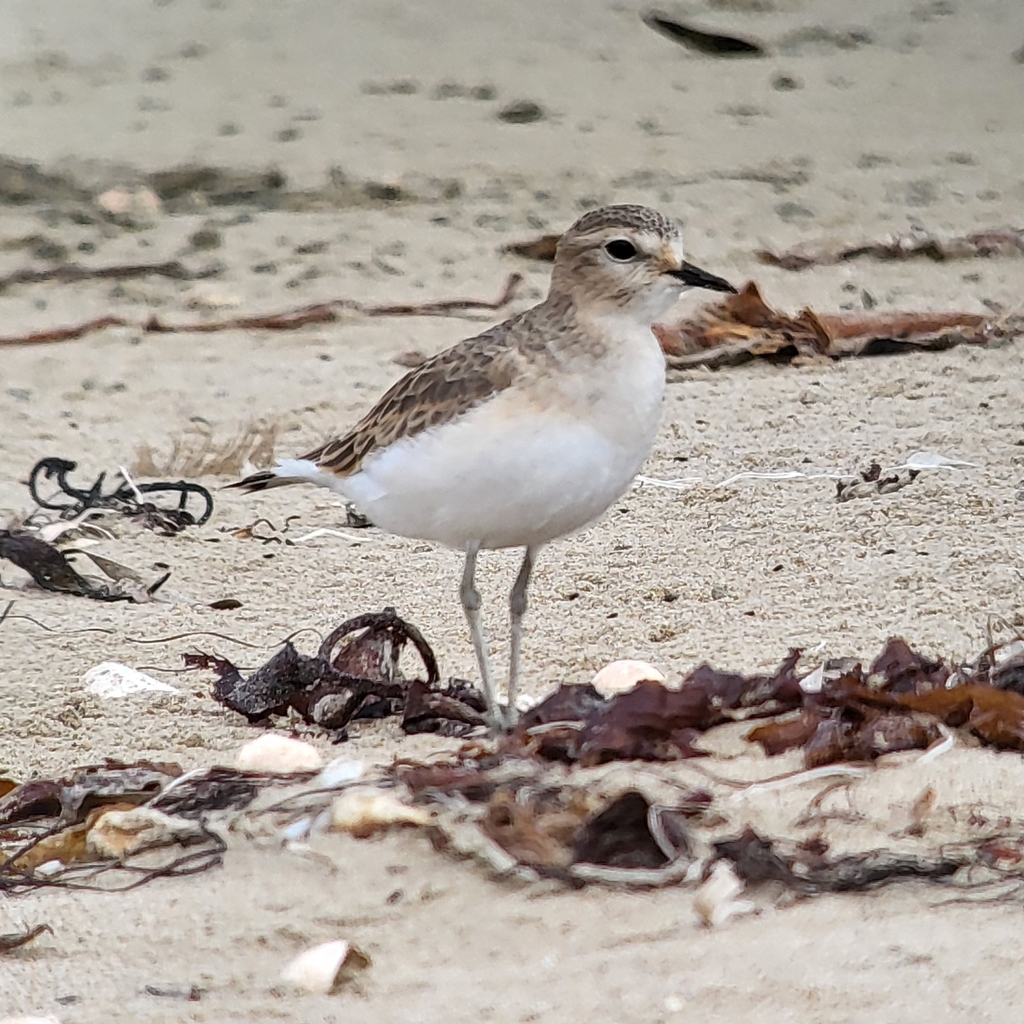
(c) Nicole, some rights reserved (CC BY) · licence
Family: Charadriidae · Class: Aves · Order: Charadriiformes
Conservation status: G3 S2
Anarhynchus montanus (Mountain Plover) is a California animal in the Charadriidae family.
The Mountain Plover is a medium-sized shorebird that, despite its name, inhabits grasslands and prairies rather than mountainous terrain. Adults measure 21 to 23 cm (8.3 to 9.1 inches) in length with a wingspan of 46 to 57 cm (18 to 22 inches) and weigh 95 to 120 grams. During breeding season, adults display a distinctive plumage with a white forehead bordered by a black stripe extending from the bill to above the eye, and another black stripe across the forecrown. The upperparts are grayish-brown with subtle streaking, while underparts are white to pale buff. Non-breeding adults lack the distinctive head markings and appear more uniformly sandy-brown above. The bill is black and relatively short for a shorebird, and the legs are pale yellow to orange. Historically, Mountain Plovers bred across the Great Plains from southern Alberta to northern Mexico. In California, the species occurs primarily as a winter resident and migrant in the Central Valley, Imperial Valley, and southern coastal counties. Small numbers have been documented breeding in northeastern California, particularly in Lassen and Modoc counties. The species' range has contracted significantly from historical levels throughout the western United States. Mountain Plovers inhabit short-grass prairies, agricultural fields, bare ground, and areas with sparse vegetation. During the breeding season, they prefer heavily grazed pastures, prairie dog towns, and recently burned areas where vegetation height typically remains below 10 cm. In California, wintering birds utilize fallow agricultural fields, short-grass areas, and alkali flats. The species shows strong preference for areas with less than 30 percent vegetation cover and often associates with livestock grazing operations. Mountain Plovers are ground-nesters that typically breed from April through July. Females lay 2 to 4 eggs in a shallow scrape lined with small pebbles, vegetation, or debris. Incubation lasts 28 to 31 days, with both sexes participating. The species exhibits a unique breeding strategy where males may tend the first brood while females initiate a second nesting attempt. Chicks are precocial and capable of running shortly after hatching. The diet consists primarily of insects including grasshoppers, beetles, and crickets, supplemented by spiders and occasionally small vertebrates. During winter, the diet expands to include seeds and other plant material. The Mountain Plover has experienced significant population decline throughout its range, with the North American Breeding Bird Survey indicating a 2.9 percent annual decrease since 1966. According to the U.S. Fish and Wildlife Service, the current breeding population is estimated at 15,000 to 18,000 individuals. Primary threats include habitat loss due to conversion of native grasslands to agriculture, altered fire regimes, reduced grazing that results in increased vegetation height, and climate change impacts on precipitation patterns. The species was considered for federal listing under the Endangered Species Act but was determined to be warranted but precluded in 2011. Conservation efforts focus on maintaining appropriate grazing regimes and preserving remaining grassland habitats.
Classification
Class: Aves · Order: Charadriiformes · Family: Charadriidae
Conservation status
G3 S2
Frequently asked questions
How is Anarhynchus montanus classified?
Anarhynchus montanus belongs to class Aves, order Charadriiformes, family Charadriidae.
What family does Anarhynchus montanus belong to?
Anarhynchus montanus is in the Charadriidae family.
Is Anarhynchus montanus protected or of conservation concern?
Anarhynchus montanus carries the following status: G3 S2.
What is Anarhynchus montanus?
The Mountain Plover is a medium-sized shorebird that, despite its name, inhabits grasslands and prairies rather than mountainous terrain.
Is Anarhynchus montanus found in California?
Yes. Anarhynchus montanus is recorded in California in The California Species Project's catalogue.
Related species
Other California species in the same genus, family, or bioregion.
Data from The California Species Project — 14,000+ California species with verified data from CNPS, CDFW, USFWS, and more.