Anarhynchus nivosus
Snowy Plover
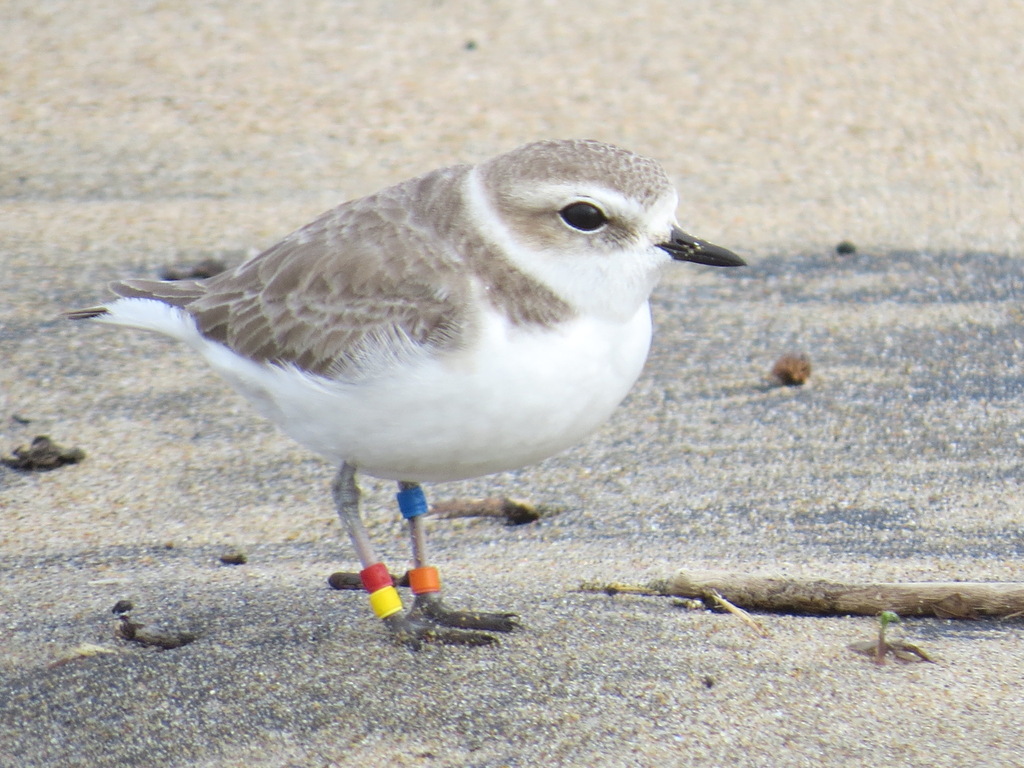
(c) Garth Harwood, some rights reserved (CC BY) · licence
Family: Charadriidae · Class: Aves · Order: Charadriiformes
Anarhynchus nivosus (Snowy Plover) is a California animal in the Charadriidae family.
The Snowy Plover is a small, pale shorebird distinguished by its compact size, moderately long legs, and short neck. Adults measure 15-17 cm (6-7 inches) in length with a wingspan of 35-43 cm (14-17 inches). The upperparts are pale tan to sandy brown, providing excellent camouflage against beach substrates, while the underparts are white. During breeding season, males develop distinctive black patches on the forehead, behind the eye, and on the sides of the neck. The bill is thin, straight, and black, well-adapted for picking small invertebrates from sand and mud. The species has a fragmented global distribution extending from North America to South America. In North America, the Western Snowy Plover subspecies (Anarhynchus nivosus nivosus) breeds along the Pacific Coast from Washington to Baja California, Mexico, and inland at saline and alkaline wetlands throughout the western United States. California populations nest primarily along coastal beaches, lagoons, and salt ponds, with some inland breeding at alkali lakes in the Central Valley and southeastern deserts. The species also occurs along the Gulf Coast and in scattered inland locations across the western United States. Snowy Plovers inhabit a variety of open, sparsely vegetated habitats near water. Along the coast, they utilize sandy beaches, mudflats, lagoon margins, salt ponds, and the edges of estuaries. They forage both above and below the mean high-water line on beaches (Birds of the World). Inland populations occupy saline and alkaline lakes, sewage ponds, and other ephemeral wetlands. The species prefers areas with minimal vegetation and human disturbance for nesting, often selecting sites on flat, open ground near water. Snowy Plovers are primarily visual foragers, employing a characteristic stop-and-go feeding technique. They run quickly across substrates, then pause to probe or pick prey from the surface. Their diet consists mainly of small invertebrates including marine worms, crustaceans, insects, and mollusks. Breeding occurs from March through September, with peak activity from April to July. Males create multiple shallow scrapes in sand or on alkali flats, and females select one for egg laying. Clutches typically contain 2-3 eggs, and both parents share incubation duties over 24-32 days. Chicks are precocial and leave the nest within hours of hatching. The Western Snowy Plover subspecies is federally listed as threatened, having been designated in 1993 due to significant population declines (USFWS). Primary threats include habitat loss from coastal development, increased recreational use of beaches, and predation by both native and introduced species. Human disturbance during the breeding season can cause nest abandonment and reduced reproductive success. Additional threats include habitat alteration, sea level rise, and stochastic events (USFWS ECOS). Conservation efforts focus on habitat protection, predator management, and reducing human disturbance through seasonal beach closures and public education programs.
Classification
Class: Aves · Order: Charadriiformes · Family: Charadriidae
Frequently asked questions
How is Anarhynchus nivosus classified?
Anarhynchus nivosus belongs to class Aves, order Charadriiformes, family Charadriidae.
What family does Anarhynchus nivosus belong to?
Anarhynchus nivosus is in the Charadriidae family.
What is Anarhynchus nivosus?
The Snowy Plover is a small, pale shorebird distinguished by its compact size, moderately long legs, and short neck.
Is Anarhynchus nivosus found in California?
Yes. Anarhynchus nivosus is recorded in California in The California Species Project's catalogue.
Related species
Other California species in the same genus, family, or bioregion.
Data from The California Species Project — 14,000+ California species with verified data from CNPS, CDFW, USFWS, and more.