Anarrhichthys ocellatus
Wolf Eel
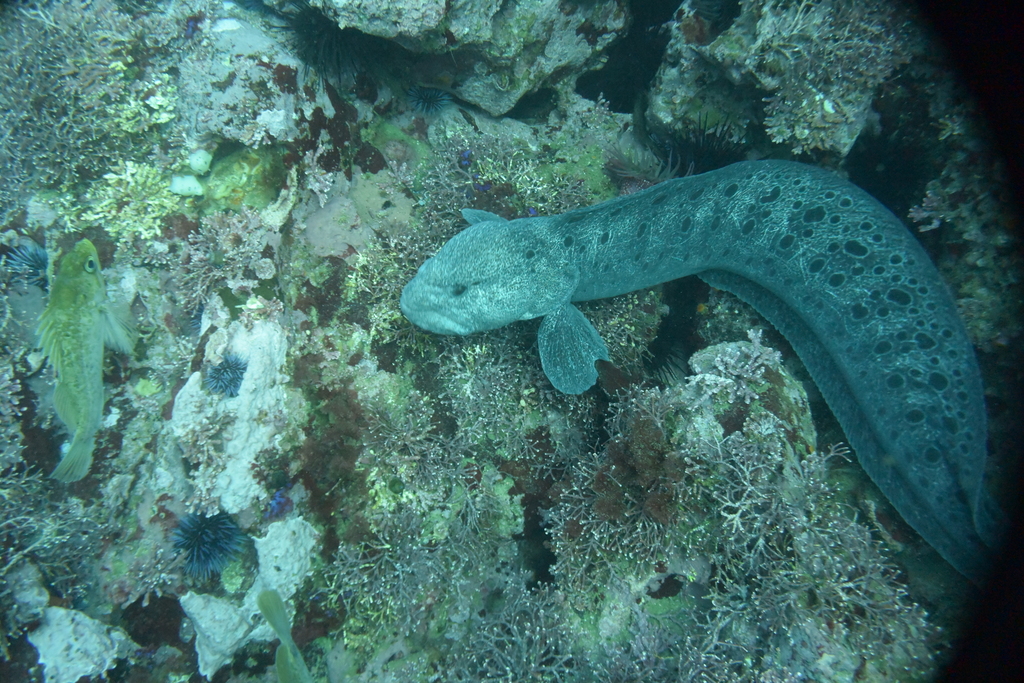
(c) J.R.Frey, some rights reserved (CC BY) · licence
Family: Anarhichadidae · Class: Actinopterygii · Order: Perciformes
Anarrhichthys ocellatus (Wolf Eel) is a California animal in the Anarhichadidae family.
The wolf eel is a large, elongated marine fish reaching lengths of up to 2.4 meters (8 feet) and weights exceeding 18 kilograms (40 pounds). Despite its common name and eel-like appearance, this species is not a true eel but belongs to the family Anarhichadidae (wolffishes). Adults display a robust head with powerful jaws containing prominent canine and molar teeth adapted for crushing hard-shelled prey. The body tapers from a thick anterior section to a compressed tail, with continuous dorsal and anal fins that merge with the caudal fin. Coloration varies from gray to brown with darker mottling and irregular patterns that provide effective camouflage among rocky substrates. Wolf eels occur along the Pacific coast from the Sea of Japan to Southern California, with the southernmost confirmed populations in California waters extending to Point Conception in Santa Barbara County. The species inhabits both nearshore and offshore environments, with documented occurrences from intertidal zones to depths exceeding 200 meters (656 feet). In California, wolf eels are regularly observed in marine protected areas including Southeast Farallon Island State Marine Reserve, Point Buchon State Marine Reserve, and Portuguese Ledge State Marine Conservation Area, where they occupy rocky reef systems and kelp forest habitats. This species demonstrates strong site fidelity, typically establishing permanent residence in rocky crevices, caves, or artificial reef structures. Wolf eels prefer hard substrate environments including boulder fields, rocky outcrops, and kelp forest understory areas. They occur across a broad depth range but are most commonly encountered between 20 and 100 meters depth in California waters. The species requires shelter sites large enough to accommodate their substantial body size, often occupying the same den for extended periods. Wolf eels are opportunistic predators specializing in hard-shelled invertebrates including sea urchins, crabs, mollusks, and barnacles. Their powerful jaws and specialized dentition allow them to crush heavily armored prey that other fish cannot access. The species exhibits monogamous pair bonding, with breeding pairs often sharing the same den site for multiple years. Spawning occurs during winter months, with females depositing large masses of eggs in protected crevices. Both parents provide extended parental care, with males typically guarding the egg mass while females may forage nearby. Juveniles undergo a pelagic larval stage before settling to benthic habitats. Wolf eels currently hold no federal or state conservation listing status in California. However, their dependence on rocky reef habitats makes them vulnerable to coastal development impacts, bottom trawling in deeper waters, and climate-induced changes to marine ecosystems. The species benefits from California's network of marine protected areas, which provide refuge habitat and restrict extractive activities in key portions of their range. Population trends remain poorly documented due to the species' cryptic nature and preference for complex rocky habitats that challenge traditional fisheries survey methods.
Classification
Class: Actinopterygii · Order: Perciformes · Family: Anarhichadidae
Frequently asked questions
How is Anarrhichthys ocellatus classified?
Anarrhichthys ocellatus belongs to class Actinopterygii, order Perciformes, family Anarhichadidae.
What family does Anarrhichthys ocellatus belong to?
Anarrhichthys ocellatus is in the Anarhichadidae family.
What is Anarrhichthys ocellatus?
The wolf eel is a large, elongated marine fish reaching lengths of up to 2.4 meters (8 feet) and weights exceeding 18 kilograms (40 pounds).
Is Anarrhichthys ocellatus found in California?
Yes. Anarrhichthys ocellatus is recorded in California in The California Species Project's catalogue.
More California species
This species has no close relatives in our California data — here are other species to explore.
Data from The California Species Project — 14,000+ California species with verified data from CNPS, CDFW, USFWS, and more.