Anas rubripes
American Black Duck
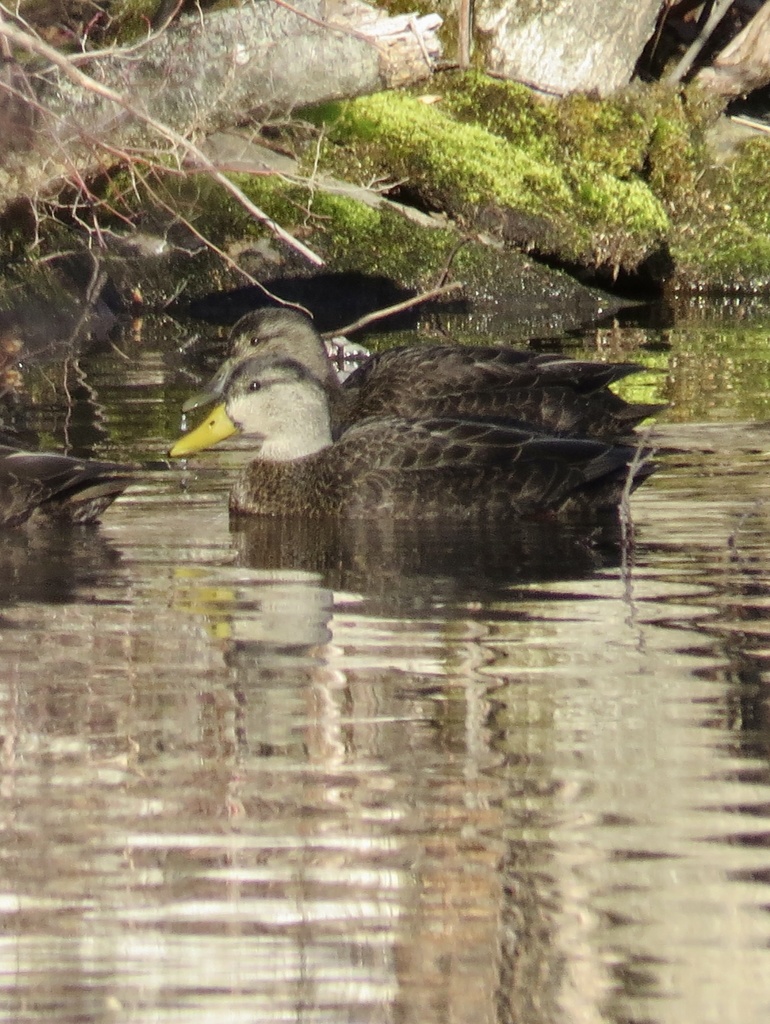
(c) Sandy Wolkenberg, some rights reserved (CC BY) · licence
Family: Anatidae · Class: Aves · Order: Anseriformes
Anas rubripes (American Black Duck) is a California animal in the Anatidae family.
The American black duck is a large dabbling duck closely related to the mallard, with adults measuring 54-59 cm (21-23 inches) in length and weighing 720-1,640 grams (1.6-3.6 pounds). Both sexes display predominantly dark brown to blackish-brown plumage with lighter brown edges on body feathers, creating a scaled appearance. The head and neck are typically paler brown than the body. Males exhibit a yellow bill during breeding season, while females maintain olive-colored bills year-round. In flight, both sexes show distinctive white underwing linings contrasting sharply with dark wing coverts. The violet-blue speculum lacks white borders, distinguishing this species from female mallards. Historically, American black ducks bred across northeastern North America from Manitoba east to the Maritime Provinces and south to North Carolina. In California, the species occurs primarily as a vagrant or rare winter visitor along the coast and in the Central Valley. The California Department of Fish and Wildlife reports occasional sightings during fall and winter months, particularly in San Francisco Bay area wetlands and coastal estuaries. Most California records occur between October and March, coinciding with the species' continental migration patterns. American black ducks inhabit freshwater and brackish wetlands, including marshes, ponds, streams, and coastal estuaries. During breeding season, they prefer shallow wetlands with emergent vegetation, beaver ponds, and wooded swamps. The species shows strong affinity for areas with 25-75% emergent cover and water depths of 15-60 cm (6-24 inches). In winter, birds utilize larger water bodies including coastal bays, tidal marshes, and flooded agricultural fields. California birds typically frequent similar habitats to those used by mallards and pintails. American black ducks are omnivorous, consuming aquatic invertebrates, seeds, and plant matter through dabbling and tip-up feeding behaviors. During breeding season, females require protein-rich invertebrates including chironomid larvae, amphipods, and mollusks. Plant foods include seeds of sedges, pondweeds, and agricultural grains. Nesting occurs from April through July, with females constructing ground nests in dense vegetation near water. Clutch size averages 8-10 eggs, with incubation lasting 26-28 days. Ducklings fledge at approximately 58-63 days. The American black duck is not federally listed but has experienced significant population declines since the 1950s. North American Breeding Bird Survey data indicate a 2.4% annual decline from 1966-2019. The continental population, estimated at 640,000 birds by Waterfowl Breeding Population and Habitat Survey, represents less than 40% of 1950s levels. Primary threats include habitat loss, hybridization with mallards, and overharvest in some regions. The North American Waterfowl Management Plan identifies black duck habitat conservation as a priority. Climate change may further impact breeding range through altered precipitation patterns and increased storm frequency affecting coastal wintering areas.
Classification
Class: Aves · Order: Anseriformes · Family: Anatidae
Frequently asked questions
How is Anas rubripes classified?
Anas rubripes belongs to class Aves, order Anseriformes, family Anatidae.
What family does Anas rubripes belong to?
Anas rubripes is in the Anatidae family.
What is Anas rubripes?
The American black duck is a large dabbling duck closely related to the mallard, with adults measuring 54-59 cm (21-23 inches) in length and weighing 720-1,640 grams (1.6-3.6 pounds).
Is Anas rubripes found in California?
Yes. Anas rubripes is recorded in California in The California Species Project's catalogue.
Related species
Other California species in the same genus, family, or bioregion.
Data from The California Species Project — 14,000+ California species with verified data from CNPS, CDFW, USFWS, and more.