Anax junius
Common Green Darner
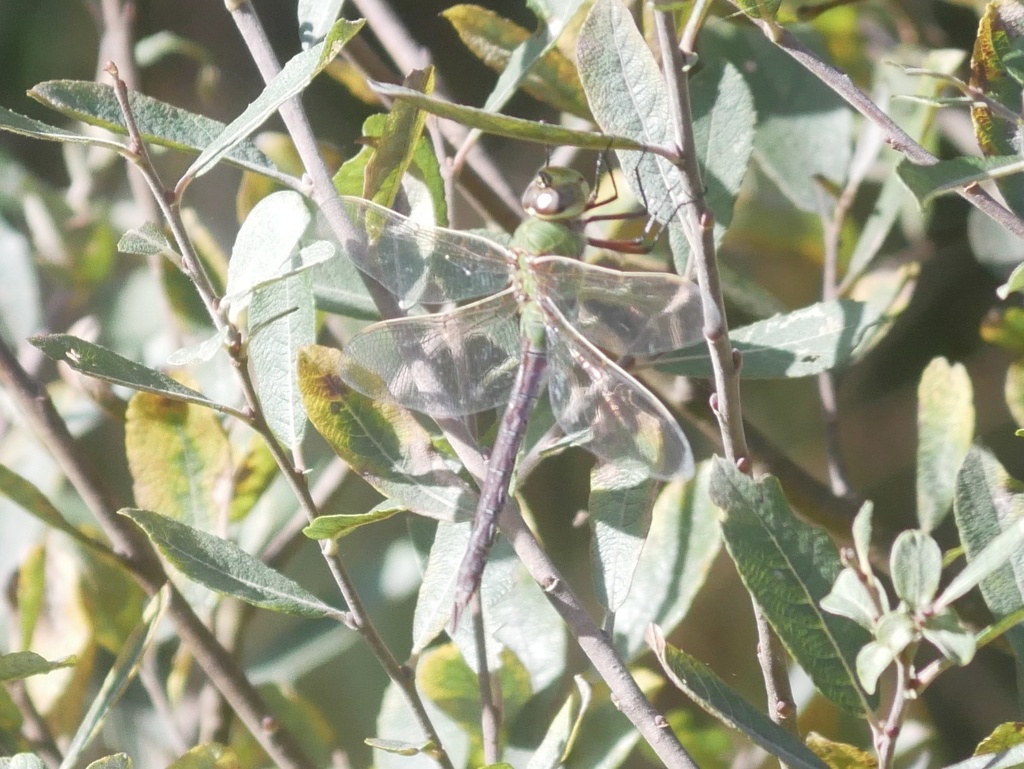
(c) Sylvain Eichhorn, some rights reserved (CC BY) · licence
Family: Aeshnidae · Class: Insecta · Order: Odonata
Anax junius (Common Green Darner) is a California animal in the Aeshnidae family.
The Common Green Darner is a large dragonfly and one of North America's most recognizable and widespread species. Adults measure 68 to 80 mm (2.7 to 3.1 inches) in length with a wingspan reaching 104 mm (4.1 inches). Males display bright green thoraxes and blue abdomens, while females exhibit similar coloration but may appear more brownish. Both sexes have distinctive bull's-eye patterns on their foreheads and large compound eyes that meet at the top of the head. The species occurs across an extensive range from southern Canada to Central America, including throughout California. Common Green Darners are found from sea level to elevations exceeding 2,000 meters (6,500 feet), inhabiting virtually every county in California. Their distribution extends from the Yucatan Peninsula of Mexico northward through the continental United States and into southern Canada. Common Green Darners occupy diverse aquatic habitats including lakes, ponds, marshes, slow-moving streams, and constructed wetlands. They prefer areas with abundant emergent, submerged, and floating vegetation that provides perching sites and oviposition substrates. The species demonstrates notable habitat flexibility, utilizing both permanent and temporary water bodies. Shallow water margins are particularly important for larval development and adult emergence activities. This species exhibits one of the most extensive migration patterns among North American insects. According to the Migratory Dragonfly Partnership, Common Green Darners undertake multi-generational migrations involving at least three generations completing the annual circuit. Research using stable isotope analysis has revealed that individuals captured in northern United States may have originated from Florida, the Caribbean, or Mexico (Xerces Society 2022). Adults are aggressive aerial predators, capturing flying insects including mosquitoes, midges, and smaller dragonflies. Aquatic nymphs are equally voracious, feeding on tadpoles, small fish, and various aquatic invertebrates using their extendable labium to capture prey. Reproductive behavior involves males establishing territories over suitable water bodies, where they engage in aerial courtship displays. Females lay eggs by inserting them into aquatic vegetation or soft substrates while often guarded by males. Larval development typically requires one to two years, with nymphs undergoing multiple molts before emerging as adults. Emergence patterns vary geographically, with southern populations potentially producing multiple generations annually. The Common Green Darner currently maintains stable populations and faces no immediate conservation threats. However, the Migratory Dragonfly Partnership notes that climate change and wetland habitat loss could potentially disrupt migration patterns, affect larval development timing, or render overwintering habitats unsuitable. The species serves as an important indicator of wetland ecosystem health and plays a significant ecological role as both predator and prey in aquatic food webs. Continued monitoring through citizen science programs helps track population trends and migration timing across the species' extensive range.
Classification
Class: Insecta · Order: Odonata · Family: Aeshnidae
Frequently asked questions
How is Anax junius classified?
Anax junius belongs to class Insecta, order Odonata, family Aeshnidae.
What family does Anax junius belong to?
Anax junius is in the Aeshnidae family.
What is Anax junius?
The Common Green Darner is a large dragonfly and one of North America's most recognizable and widespread species.
Is Anax junius found in California?
Yes. Anax junius is recorded in California in The California Species Project's catalogue.
Related species
Other California species in the same genus, family, or bioregion.
Data from The California Species Project — 14,000+ California species with verified data from CNPS, CDFW, USFWS, and more.