Anaxyrus exsul
Black toad
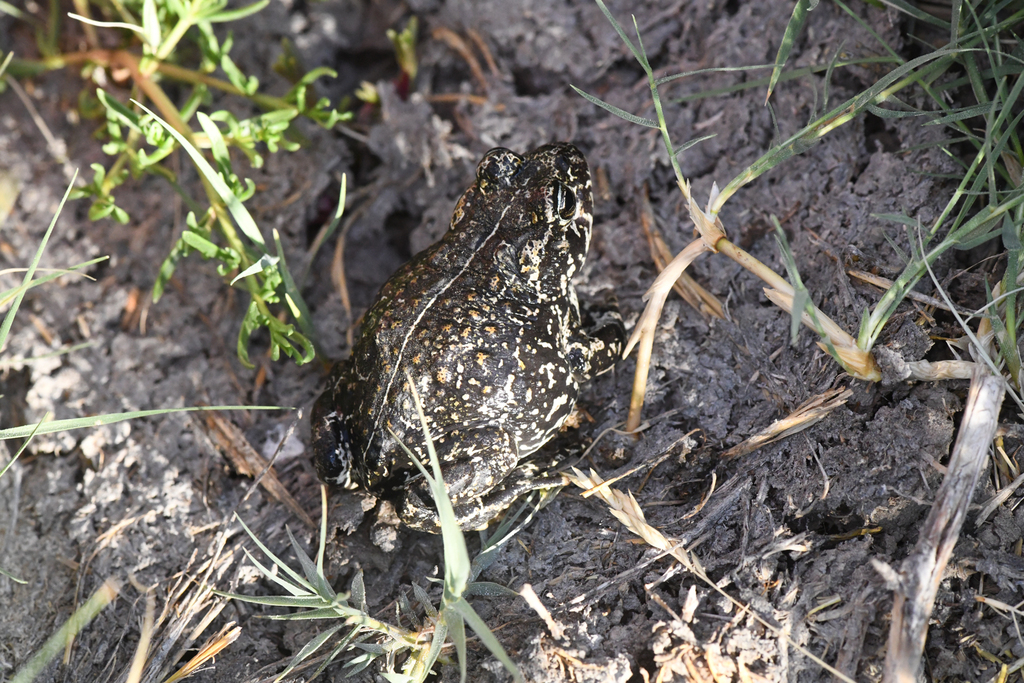
(c) Trevor Van Loon, some rights reserved (CC BY) · licence
Family: Bufonidae · Class: Amphibia · Order: Anura
Conservation status: FP · G1 S1
Anaxyrus exsul (Black toad) is a California animal in the Bufonidae family.
The Black toad (Anaxyrus exsul) is a small, endemic amphibian species found only in the Deep Springs Valley of eastern California. Adults measure 40 to 55 mm (1.6 to 2.2 inches) in snout-vent length, with females typically larger than males. The dorsal coloration ranges from dark olive-green to nearly black, often with small darker spots or mottling. The ventral surface is cream to pale yellow, frequently with dark stippling. The skin is relatively smooth for a toad, with small, scattered tubercles. During breeding season, males develop dark nuptial pads on their thumbs and may exhibit a yellowish throat coloration. The Black toad has an extremely restricted range, occurring only in the Deep Springs Valley at approximately 1,525 meters (5,000 feet) elevation in Inyo County, California, along the California-Nevada border. This represents one of the smallest ranges of any North American amphibian, encompassing less than 10 square kilometers. The species is found nowhere else in the world, making it a California endemic with global significance. The species inhabits desert spring-fed marshes, pools, and slow-moving streams within the Great Basin desert ecosystem. These aquatic habitats are surrounded by alkali meadows dominated by saltgrass (Distichlis spicata) and Baltic rush (Juncus arcticus). The toads require permanent water sources for breeding and larval development, but adults may be found considerable distances from water during non-breeding periods. The habitat is characterized by high mineral content in the water, including elevated levels of boron and other salts that would be toxic to most amphibians. Black toads are primarily nocturnal, becoming active after sunset to forage for insects, spiders, and other small arthropods. Breeding typically occurs from April through June, triggered by increasing water temperatures and photoperiod. Males call from shallow water areas, producing a soft trill lasting 8 to 20 seconds. Females deposit strings of 150 to 500 eggs attached to vegetation or debris in shallow water. Tadpoles develop rapidly, typically metamorphosing within 45 to 60 days. The species exhibits specialized physiological adaptations to its harsh desert environment, including tolerance to high water salinity and extreme temperature fluctuations. The Black toad is listed as Threatened under the California Endangered Species Act and designated as Fully Protected by the California Department of Fish and Wildlife. The global rank of G1 indicates the species is critically imperiled. Primary threats include groundwater pumping that reduces spring flows, livestock grazing that degrades riparian habitat, and potential impacts from geothermal development. Climate change poses additional risks through altered precipitation patterns and increased temperatures. The small population size, estimated at fewer than 2,000 breeding adults, makes the species vulnerable to stochastic events and genetic bottlenecks. Conservation efforts focus on habitat protection, water rights management, and monitoring population trends through annual surveys conducted by CDFW and academic researchers.
Classification
Class: Amphibia · Order: Anura · Family: Bufonidae
Conservation status
FP · G1 S1
Frequently asked questions
How is Anaxyrus exsul classified?
Anaxyrus exsul belongs to class Amphibia, order Anura, family Bufonidae.
What family does Anaxyrus exsul belong to?
Anaxyrus exsul is in the Bufonidae family.
Is Anaxyrus exsul protected or of conservation concern?
Anaxyrus exsul carries the following status: FP · G1 S1.
What is Anaxyrus exsul?
The Black toad (Anaxyrus exsul) is a small, endemic amphibian species found only in the Deep Springs Valley of eastern California.
Is Anaxyrus exsul found in California?
Yes. Anaxyrus exsul is recorded in California in The California Species Project's catalogue.
Related species
Other California species in the same genus, family, or bioregion.
Data from The California Species Project — 14,000+ California species with verified data from CNPS, CDFW, USFWS, and more.