Anaxyrus woodhousii
Woodhouse's Toad
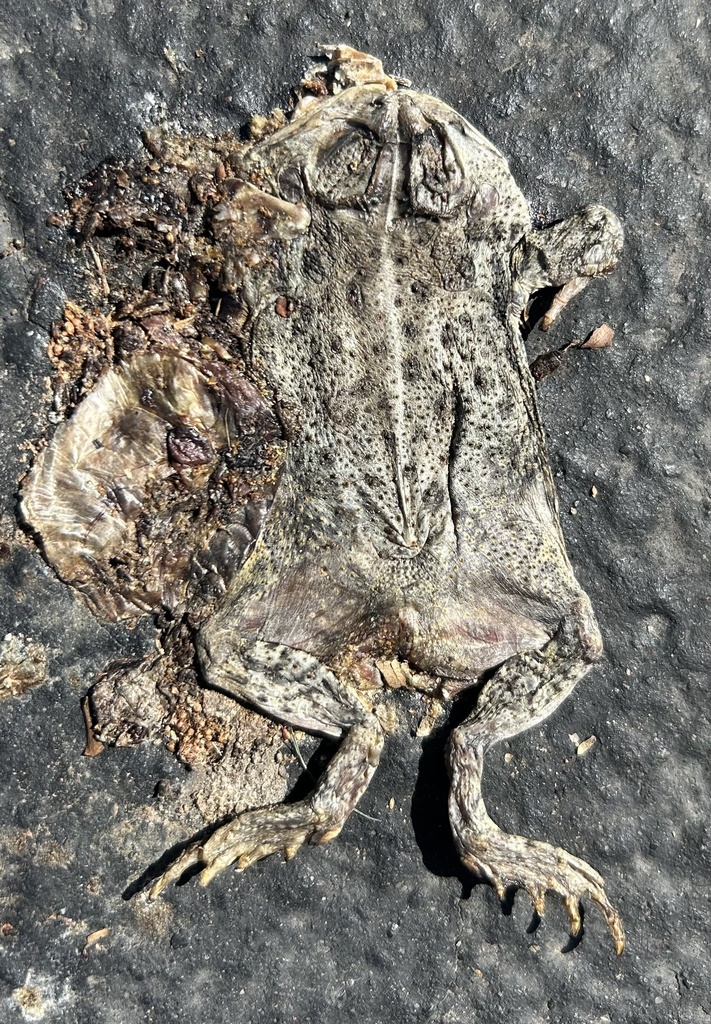
(c) John G. Phillips, some rights reserved (CC BY) · licence
Family: Bufonidae · Class: Amphibia · Order: Anura
Anaxyrus woodhousii (Woodhouse's Toad) is a California animal in the Bufonidae family.
Woodhouse's Toad (Anaxyrus woodhousii) is a medium-sized bufonid amphibian measuring 51 to 127 mm (2.0 to 5.0 inches) in snout-vent length. The species exhibits sexual dimorphism, with females typically larger than males. The dorsal surface displays a gray to brown base coloration with darker spots or blotches, each containing one or more warts. A distinctive light-colored dorsal stripe extends from the snout to the vent, though this feature may be faint or absent in some individuals. The ventral surface is cream to white with dark spotting on the chest and throat. Parotoid glands behind the eyes are prominent and oval-shaped, connected to or nearly touching the postorbital ridges. The skin texture is warty and dry, characteristic of true toads. Woodhouse's Toad occurs across a broad range in western North America, extending from southeastern Washington and southern Idaho south through Nevada, Utah, Arizona, New Mexico, and into northwestern Mexico. The species' range extends eastward across the Great Plains to parts of Texas, Oklahoma, Kansas, Nebraska, and southeastern Wyoming. In California, this species has limited distribution, primarily documented in the southeastern desert regions bordering Arizona and Nevada, including portions of San Bernardino County and potentially eastern Riverside County. The species inhabits a variety of arid and semi-arid environments, including desert scrublands, grasslands, agricultural areas, and riparian zones. Elevation range extends from near sea level to approximately 2,500 meters (8,200 feet). Woodhouse's Toads require permanent or semi-permanent water sources for reproduction, utilizing stock tanks, irrigation ditches, temporary pools, streams, and lake margins. Adults are terrestrial, seeking shelter during daylight hours under rocks, logs, vegetation, or in burrows they excavate in sandy or loose soil. Woodhouse's Toads are primarily nocturnal, becoming active after sunset to forage for insects, spiders, worms, and other small invertebrates. The species exhibits opportunistic feeding behavior, using a sit-and-wait predation strategy supplemented by active foraging. Breeding occurs from March through September, depending on temperature and moisture conditions, with peak activity following warm rains. Males produce a nasal trill lasting 1 to 4 seconds to attract females. Females deposit 2,500 to 25,000 eggs in long, double strands attached to vegetation or debris in shallow water. Tadpoles metamorphose in 6 to 10 weeks, depending on water temperature and food availability. Woodhouse's Toad is not federally listed and appears to maintain stable populations across much of its range. However, local populations face threats from habitat loss due to urban development, agricultural intensification, and water diversions that eliminate breeding sites. Pollution from pesticides and herbicides may impact both adults and aquatic larvae. Climate change poses potential long-term risks through altered precipitation patterns and increased temperatures in already arid habitats. The species' adaptability to human-modified landscapes, including agricultural areas and suburban environments with artificial water sources, has helped maintain populations in some regions.
Classification
Class: Amphibia · Order: Anura · Family: Bufonidae
Frequently asked questions
How is Anaxyrus woodhousii classified?
Anaxyrus woodhousii belongs to class Amphibia, order Anura, family Bufonidae.
What family does Anaxyrus woodhousii belong to?
Anaxyrus woodhousii is in the Bufonidae family.
What is Anaxyrus woodhousii?
Woodhouse's Toad (Anaxyrus woodhousii) is a medium-sized bufonid amphibian measuring 51 to 127 mm (2.0 to 5.0 inches) in snout-vent length.
Is Anaxyrus woodhousii found in California?
Yes. Anaxyrus woodhousii is recorded in California in The California Species Project's catalogue.
Related species
Other California species in the same genus, family, or bioregion.
Data from The California Species Project — 14,000+ California species with verified data from CNPS, CDFW, USFWS, and more.