Ancistrocerus bustamente
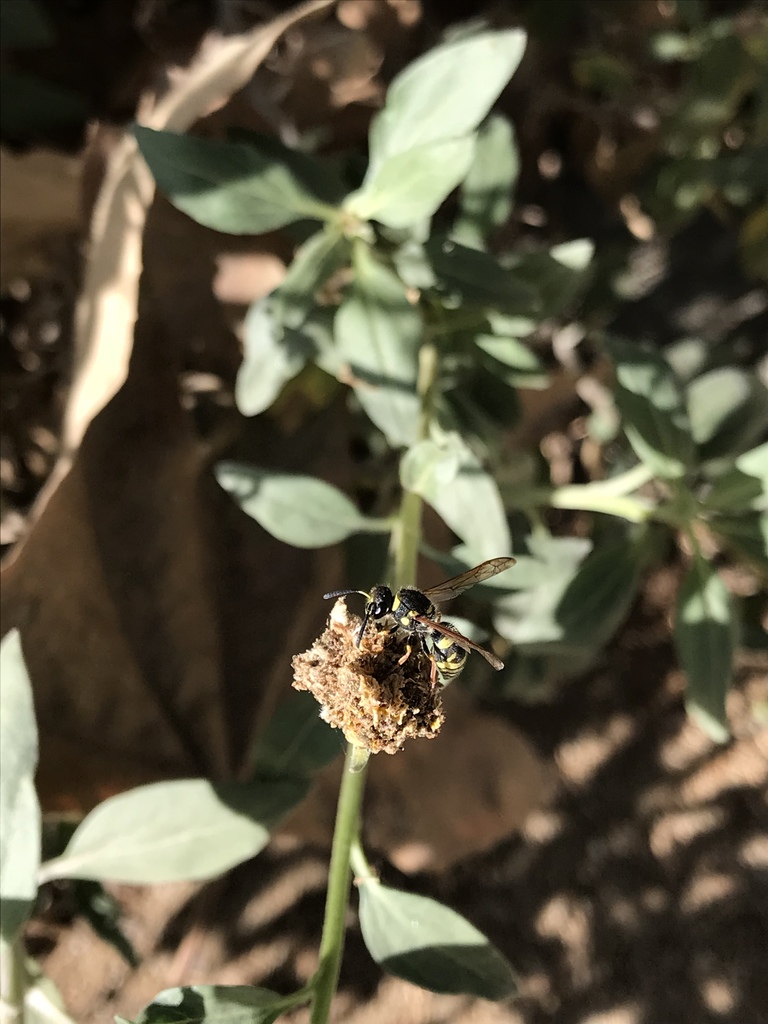
(c) Emily Chebul, some rights reserved (CC BY-SA) · licence
Family: Vespidae · Class: Insecta · Order: Hymenoptera
Ancistrocerus bustamente is a California animal in the Vespidae family.
Ancistrocerus bustamente is a solitary wasp in the family Vespidae, subfamily Eumeninae, commonly known as potter wasps or mason wasps. Like other members of this subfamily, this species constructs mud nests and provisions them with paralyzed caterpillars for their developing larvae. The taxonomic classification places this species within the order Hymenoptera, which includes all wasps, bees, and ants. Physical characteristics of A. bustamente follow the typical potter wasp body plan, with a constricted waist between the thorax and abdomen, and likely displaying the characteristic black and yellow coloration common to many Ancistrocerus species. Adult wasps in this genus typically measure 8-15 millimeters in length, though specific measurements for A. bustamente have not been documented in available literature. The geographic range and distribution of Ancistrocerus bustamente remain poorly documented in current scientific literature. The species appears to be part of the diverse North American Ancistrocerus fauna, but specific locality records and range maps are not available in standard taxonomic databases or field guides. This knowledge gap reflects the broader challenge of documenting the full diversity of solitary wasp species, many of which remain understudied compared to social Hymenoptera. Habitat preferences for A. bustamente have not been specifically documented, though members of the genus Ancistrocerus typically inhabit areas with suitable nesting sites such as exposed soil banks, wooden structures, or pre-existing cavities. These wasps generally require access to mud or clay for nest construction, as well as vegetation that supports their caterpillar prey. Most Ancistrocerus species show preferences for edge habitats where open areas meet woodland or shrubland. The behavioral ecology of A. bustamente likely follows the pattern typical of potter wasps. Adult females construct individual brood cells from mud, which they provision with paralyzed lepidopteran larvae before depositing a single egg and sealing the cell. Males typically emerge before females and may engage in territorial behavior around emergence sites. Adults feed on nectar and other carbohydrate sources, while larvae develop as specialized predators of caterpillars. Conservation status information for Ancistrocerus bustamente is not available in major databases including the IUCN Red List, NatureServe, or state wildlife agencies as of December 2025. The species lacks federal or state conservation rankings, which is typical for many invertebrate species that have received limited scientific attention. This absence of status information does not necessarily indicate security, but rather reflects insufficient data to assess population trends or conservation needs. Scientific documentation for this species remains extremely limited. The information presented here synthesizes general knowledge of Ancistrocerus biology with available taxonomic records. Detailed ecological studies, distribution surveys, and population assessments are needed to better understand this species' biology, habitat requirements, and conservation status. We welcome contributions of verified scientific data, photographs, or field observations to enhance this species account.
Classification
Class: Insecta · Order: Hymenoptera · Family: Vespidae
Frequently asked questions
How is Ancistrocerus bustamente classified?
Ancistrocerus bustamente belongs to class Insecta, order Hymenoptera, family Vespidae.
What family does Ancistrocerus bustamente belong to?
Ancistrocerus bustamente is in the Vespidae family.
What is Ancistrocerus bustamente?
Ancistrocerus bustamente is a solitary wasp in the family Vespidae, subfamily Eumeninae, commonly known as potter wasps or mason wasps.
Is Ancistrocerus bustamente found in California?
Yes. Ancistrocerus bustamente is recorded in California in The California Species Project's catalogue.
Related species
Other California species in the same genus, family, or bioregion.
Data from The California Species Project — 14,000+ California species with verified data from CNPS, CDFW, USFWS, and more.