Ancistrocerus tuberculocephalus
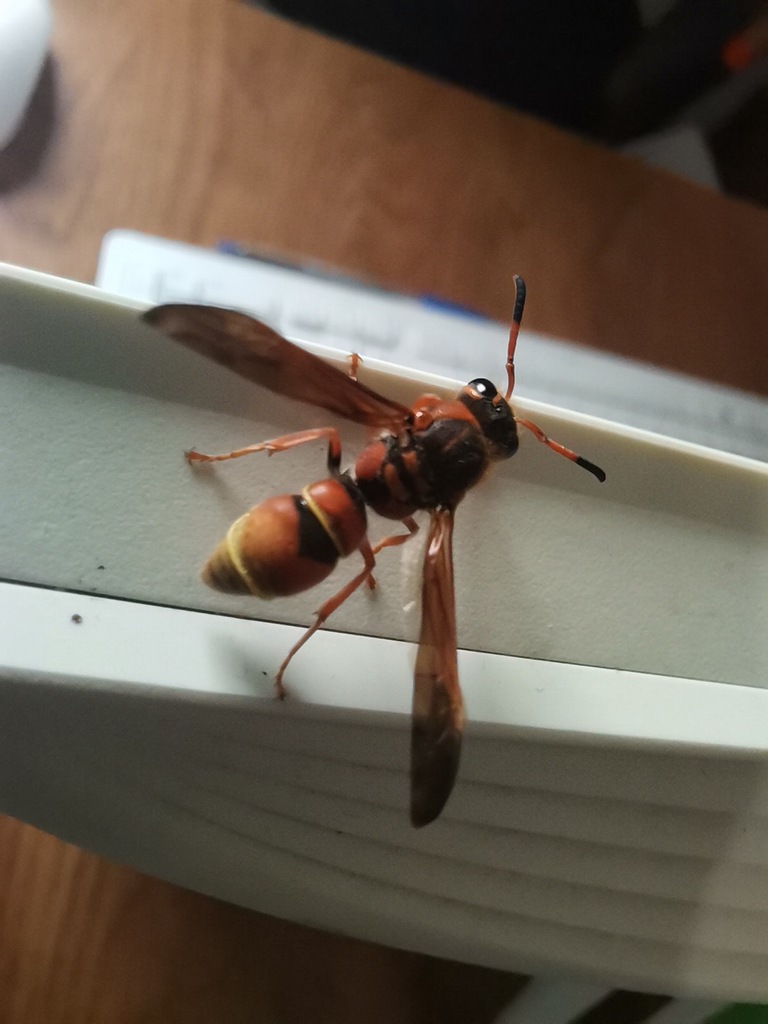
(c) Oscar Alejandro Morales Juárez, some rights reserved (CC BY-SA) · licence
Family: Vespidae · Class: Insecta · Order: Hymenoptera
Ancistrocerus tuberculocephalus is a California animal in the Vespidae family.
Ancistrocerus tuberculocephalus is a solitary wasp in the family Vespidae, subfamily Eumeninae. This species belongs to a group commonly known as mason wasps or potter wasps, characterized by their nest-building behavior using mud or clay. Adult females typically measure 8-12 mm in length, with males being slightly smaller at 6-10 mm. The species exhibits the typical eumenine wasp morphology with a constricted waist between the thorax and abdomen, and a distinctive tubercle or protrusion on the head that gives the species its name "tuberculocephalus," meaning "tubercle-headed." The range and distribution of A. tuberculocephalus in California remains poorly documented in the scientific literature. Like many solitary wasps, this species likely has a patchy distribution based on suitable nesting sites and prey availability. Most eumenine wasps have relatively localized distributions tied to specific habitat requirements and host insect populations. Habitat preferences for this species have not been thoroughly studied, though related Ancistrocerus species typically inhabit areas with exposed soil or clay banks suitable for nest construction. These wasps generally prefer semi-arid to mesic environments with access to both nesting substrates and abundant prey populations. Elevation ranges and specific vegetation associations for A. tuberculocephalus require further documentation. As a solitary wasp, females construct individual nests rather than forming colonies. The species likely provisions its nests with paralyzed caterpillars, following the typical eumenine pattern of hunting lepidopteran larvae to feed developing young. Females create mud or clay cells, stock each with several paralyzed prey items, deposit a single egg, and seal the chamber. Development proceeds through egg, larval, pupal, and adult stages within the protected nest cell. Flight periods and seasonal activity patterns for this species have not been well documented. Conservation status information for A. tuberculocephalus is not available from standard databases, and the species does not appear on federal or state listing rosters. Like many native solitary wasps, potential threats may include habitat modification, pesticide use, and changes in prey availability. The species' conservation needs cannot be properly assessed without basic ecological studies documenting population status, habitat requirements, and distribution patterns. Detailed ecological studies of this species are lacking. The information presented here synthesizes general knowledge of eumenine wasp biology with limited available observations. Scientific documentation for specific aspects of A. tuberculocephalus biology, including host preferences, phenology, and distribution patterns, remains incomplete. Additional field studies and taxonomic work are needed to better understand this species' role in California's insect communities and assess any conservation concerns.
Classification
Class: Insecta · Order: Hymenoptera · Family: Vespidae
Frequently asked questions
How is Ancistrocerus tuberculocephalus classified?
Ancistrocerus tuberculocephalus belongs to class Insecta, order Hymenoptera, family Vespidae.
What family does Ancistrocerus tuberculocephalus belong to?
Ancistrocerus tuberculocephalus is in the Vespidae family.
What is Ancistrocerus tuberculocephalus?
Ancistrocerus tuberculocephalus is a solitary wasp in the family Vespidae, subfamily Eumeninae.
Is Ancistrocerus tuberculocephalus found in California?
Yes. Ancistrocerus tuberculocephalus is recorded in California in The California Species Project's catalogue.
Related species
Other California species in the same genus, family, or bioregion.
Data from The California Species Project — 14,000+ California species with verified data from CNPS, CDFW, USFWS, and more.