Ancylis simuloides
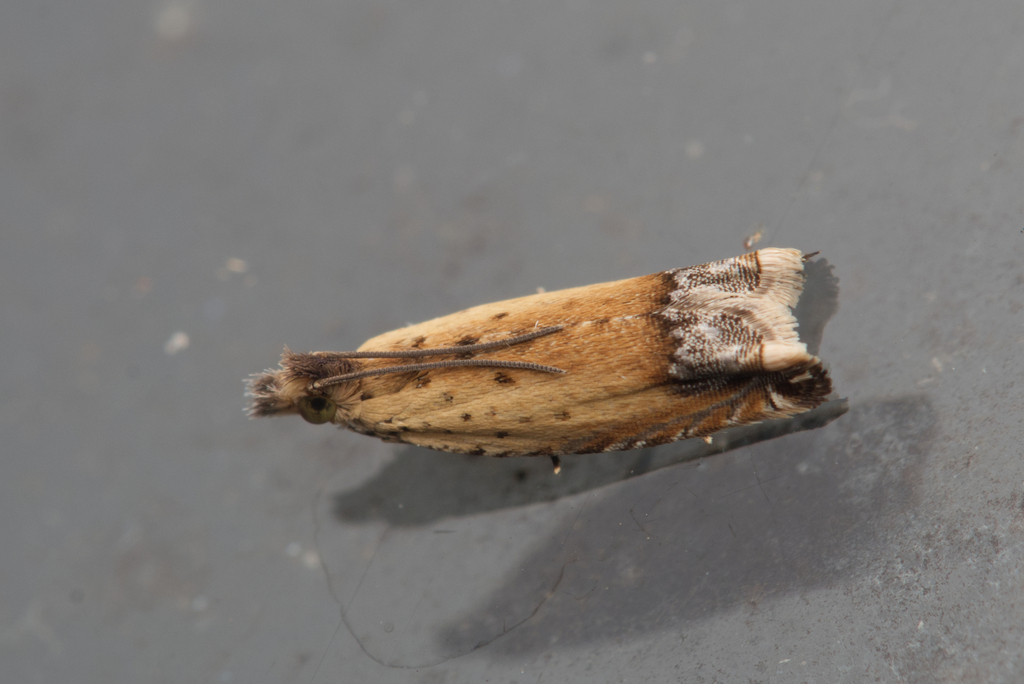
(c) Nigel Main, some rights reserved (CC BY) · licence
Family: Tortricidae · Class: Insecta · Order: Lepidoptera
Ancylis simuloides is a California animal in the Tortricidae family.
Ancylis simuloides is a small moth in the family Tortricidae, a diverse group commonly known as leafroller moths. This species exhibits the typical tortricid body plan with narrow forewings and reduced hindwings. Like other members of the genus Ancylis, adults likely display earth-toned coloration patterns that provide camouflage against bark and vegetation, though specific morphological details for this species have not been extensively documented in the scientific literature. The species ranges from California to British Columbia along the Pacific Coast region. Within California, Ancylis simuloides has been recorded from multiple counties spanning considerable elevational and ecological gradients. Documented collection localities include the Laguna Mountains in San Diego County at 5,800 feet elevation, and near Yuba Pass in the Sierra Nevada of Sierra County (Powell et al. 1998, 2005). Additional records exist from Nevada County locations, indicating the species occurs across both coastal and montane regions of the state. Habitat associations for Ancylis simuloides appear to encompass mixed coniferous forests and mountainous areas. The documented elevation range from approximately 5,800 feet suggests the species inhabits montane forest zones, though it may occur across a broader elevational spectrum. The collection from Laguna Mountains indicates adaptation to chaparral-forest transition zones, while Sierra Nevada records suggest association with mixed conifer habitats typical of that mountain range. Specific microhabitat requirements and host plant relationships have not been well documented. As with most Tortricidae, larvae of Ancylis simuloides likely feed within rolled or folded leaves, giving the family its common name of leafroller moths. However, specific host plants for this species remain unknown. Adult flight periods appear to include spring and early summer months, based on collection records from April through June (Powell et al. 1998, 2005). The species' life cycle duration, overwintering stage, and detailed reproductive biology have not been studied. Ancylis simuloides lacks formal conservation status at federal or state levels. Population trends and threats are unknown due to limited ecological research. The species' apparent distribution across multiple mountain ranges and elevation zones may provide some resilience to localized habitat changes, though climate change impacts on montane forest ecosystems could affect suitable habitat availability. The documented occurrence in both southern California mountains and the Sierra Nevada suggests the species may have reasonable dispersal capabilities and habitat flexibility. Detailed ecological studies of Ancylis simuloides are lacking. The above information synthesizes available collection records and taxonomic data from lepidopterological surveys. Scientific documentation for this species remains limited compared to more thoroughly studied tortricid moths. Further research is needed to determine host plant associations, detailed life history characteristics, and population status across the species' range.
Classification
Class: Insecta · Order: Lepidoptera · Family: Tortricidae
Frequently asked questions
How is Ancylis simuloides classified?
Ancylis simuloides belongs to class Insecta, order Lepidoptera, family Tortricidae.
What family does Ancylis simuloides belong to?
Ancylis simuloides is in the Tortricidae family.
What is Ancylis simuloides?
Ancylis simuloides is a small moth in the family Tortricidae, a diverse group commonly known as leafroller moths.
Is Ancylis simuloides found in California?
Yes. Ancylis simuloides is recorded in California in The California Species Project's catalogue.
Related species
Other California species in the same genus, family, or bioregion.
Data from The California Species Project — 14,000+ California species with verified data from CNPS, CDFW, USFWS, and more.