Andrena labiata
Red-girdled Mining Bee
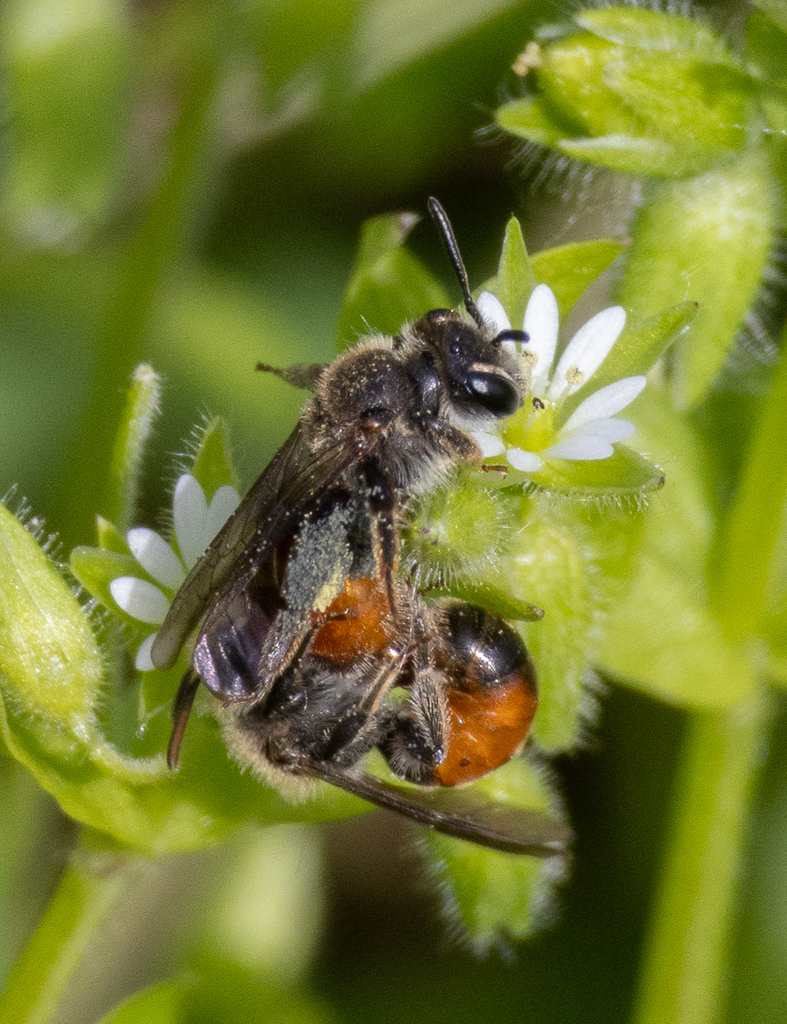
(c) Victor Heng, some rights reserved (CC BY-SA) · licence
Family: Andrenidae · Class: Insecta · Order: Hymenoptera
Andrena labiata (Red-girdled Mining Bee) is a California animal in the Andrenidae family.
The Red-girdled Mining Bee (Andrena labiata) is a solitary bee species within the family Andrenidae, one of North America's most diverse groups of native bees. This species exhibits the typical mining bee morphology, with females measuring approximately 10-12 mm in length and males slightly smaller at 8-10 mm. The common name derives from distinctive reddish banding patterns on the abdomen, though detailed morphological descriptions for this species remain limited in the scientific literature. The range and distribution of Andrena labiata in California has not been comprehensively documented in available databases. Like many Andrena species, this mining bee likely occurs in areas with suitable nesting substrate and appropriate floral resources. The genus Andrena contains over 1,400 described species globally, with more than 400 species recorded from North America, making it one of the largest bee genera. Mining bees typically require well-drained soils for nest construction, preferring sandy or loamy substrates where females can excavate underground burrows. Most Andrena species are ground-nesting, with females creating individual nests consisting of a main shaft with lateral brood cells. The specific habitat preferences and elevation range for A. labiata have not been well documented in the available scientific literature. As a member of the Andrenidae, this species likely exhibits typical mining bee behavior patterns. Females are presumed to be solitary nesters, constructing individual underground burrows where they provision brood cells with pollen and nectar for developing larvae. Most Andrena species are active during specific seasonal windows, often synchronized with the bloom periods of preferred host plants. The flight period, host plant associations, and specific foraging behaviors of A. labiata require further scientific investigation. Andrena labiata currently lacks formal conservation status designations at federal or state levels. The species does not appear on the U.S. Fish and Wildlife Service's list of threatened or endangered species, nor does it hold special status under California's endangered species regulations. However, the absence of comprehensive population data and limited ecological research makes it difficult to assess the species' true conservation needs. Many native bee species face threats from habitat loss, pesticide exposure, and climate change, though the specific impacts on A. labiata populations remain unknown. The taxonomic stability and species boundaries within the Andrena genus continue to evolve as researchers apply molecular techniques to resolve complex species groups. Like many specialized native bees, A. labiata may have specific ecological requirements that make it vulnerable to environmental changes, but detailed studies are needed to understand its biology and conservation status. Scientific documentation for this species remains limited, highlighting the need for additional research into the ecology, distribution, and conservation requirements of California's diverse native bee fauna.
Classification
Class: Insecta · Order: Hymenoptera · Family: Andrenidae
Frequently asked questions
How is Andrena labiata classified?
Andrena labiata belongs to class Insecta, order Hymenoptera, family Andrenidae.
What family does Andrena labiata belong to?
Andrena labiata is in the Andrenidae family.
What is Andrena labiata?
The Red-girdled Mining Bee (Andrena labiata) is a solitary bee species within the family Andrenidae, one of North America's most diverse groups of native bees.
Is Andrena labiata found in California?
Yes. Andrena labiata is recorded in California in The California Species Project's catalogue.
Related species
Other California species in the same genus, family, or bioregion.
Data from The California Species Project — 14,000+ California species with verified data from CNPS, CDFW, USFWS, and more.