Andrena macswaini
An Andrenid Bee
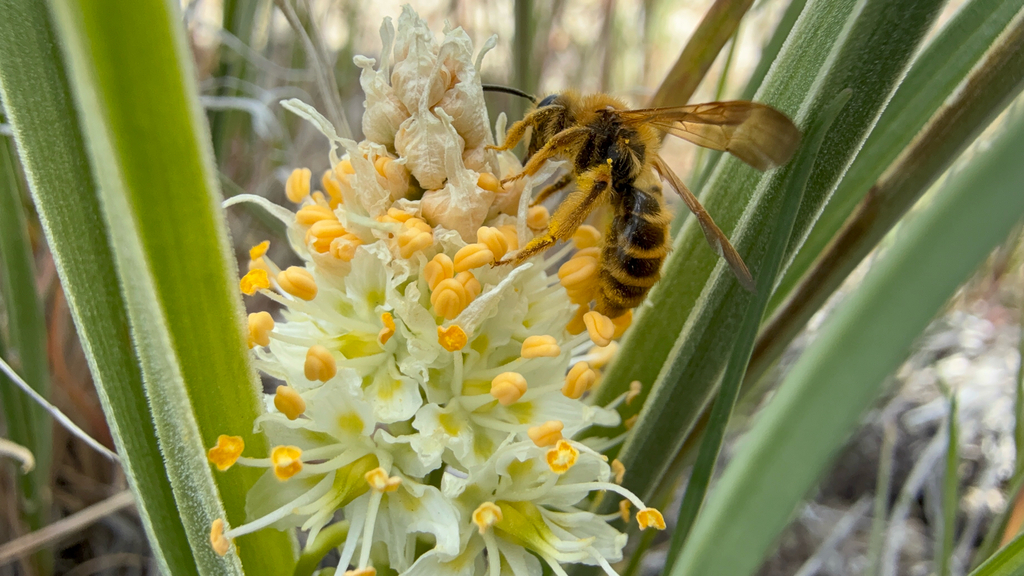
(c) Zach Earl, some rights reserved (CC BY) · licence
Family: Andrenidae · Class: Insecta · Order: Hymenoptera
Conservation status: G2 S2
Andrena macswaini (An Andrenid Bee) is a California animal in the Andrenidae family.
Andrena macswaini is a small solitary bee in the family Andrenidae, one of California's specialized native pollinators. This species exhibits the typical andrenid bee morphology with a compact, moderately hairy body adapted for ground-nesting behavior. Like other members of the genus Andrena, females possess specialized branched hairs (plumose setae) for collecting pollen and robust legs for excavating underground nests. Andrena macswaini has a highly restricted distribution within California, representing one of the state's rarer native bee species. The species is known from limited localities, primarily in the central and northern portions of the state. Specific county records and detailed range information remain poorly documented in the scientific literature, contributing to uncertainty about the species' current distribution patterns. This bee inhabits areas that support its specialized foraging and nesting requirements. As a ground-nesting species, A. macswaini requires suitable soil conditions for excavating burrows, typically in sandy or well-drained substrates. The species likely occurs in habitats that support diverse native plant communities, as andrenid bees generally require access to multiple flower species throughout their active season. California's chaparral and oak woodland communities have been identified as particularly valuable habitat for native bee diversity, potentially including specialized species like A. macswaini. Like other Andrena species, A. macswaini is a solitary bee with females constructing individual underground nests. The nesting biology follows the typical andrenid pattern, with females excavating branched tunnel systems in soil and provisioning individual cells with pollen masses for developing larvae. The species likely exhibits seasonal activity patterns synchronized with the bloom periods of its preferred host plants. Andrenid bees are generally short-tongued pollinators that forage primarily on annuals and early-blooming perennials, suggesting A. macswaini may specialize on specific native California flora. Andrena macswaini holds a conservation status of G2 S2, indicating the species is imperiled both globally and within California (NatureServe). This ranking reflects the species' restricted range, small population size, and vulnerability to threats. The bee is not currently listed under federal or state endangered species legislation, but its conservation status suggests it warrants monitoring and protection. Primary threats likely include habitat loss from urban development, agricultural conversion, and fragmentation of native plant communities. Climate change may pose additional challenges by altering the timing of plant bloom periods relative to bee activity seasons. Limited scientific documentation exists for this species, reflecting the broader challenge of studying California's diverse but poorly known native bee fauna. Enhanced surveys and taxonomic research are needed to better understand the distribution, ecology, and conservation needs of A. macswaini and similar specialist pollinators that may be experiencing population declines across their restricted ranges.
Classification
Class: Insecta · Order: Hymenoptera · Family: Andrenidae
Conservation status
G2 S2
Frequently asked questions
How is Andrena macswaini classified?
Andrena macswaini belongs to class Insecta, order Hymenoptera, family Andrenidae.
What family does Andrena macswaini belong to?
Andrena macswaini is in the Andrenidae family.
Is Andrena macswaini protected or of conservation concern?
Andrena macswaini carries the following status: G2 S2.
What is Andrena macswaini?
Andrena macswaini is a small solitary bee in the family Andrenidae, one of California's specialized native pollinators.
Is Andrena macswaini found in California?
Yes. Andrena macswaini is recorded in California in The California Species Project's catalogue.
Related species
Other California species in the same genus, family, or bioregion.
Data from The California Species Project — 14,000+ California species with verified data from CNPS, CDFW, USFWS, and more.