Andrena winnemuccana
Mining bees
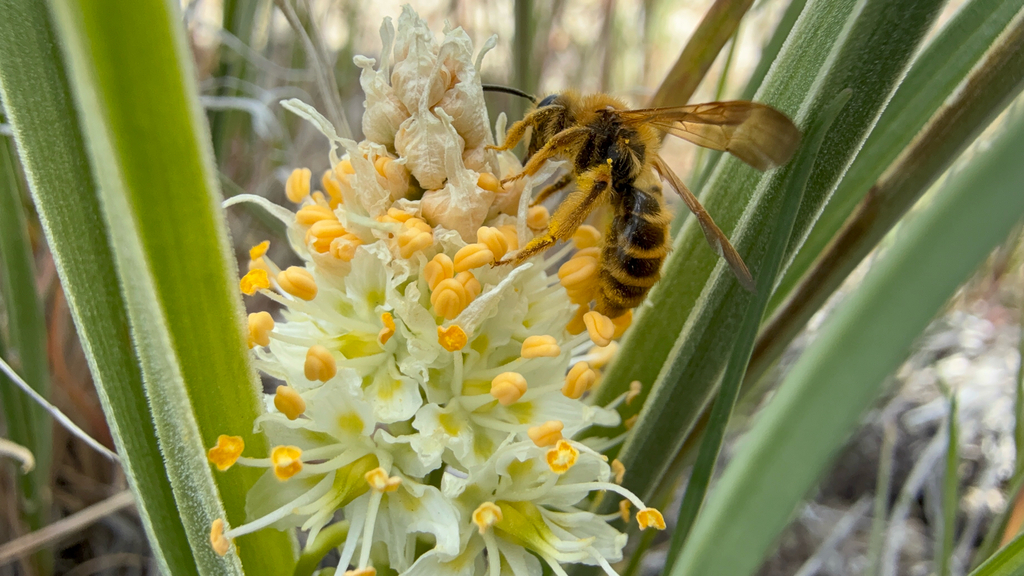
(c) Zach Earl, some rights reserved (CC BY) · licence
Family: Andrenidae · Class: Insecta · Order: Hymenoptera
Andrena winnemuccana (Mining bees) is a California animal in the Andrenidae family.
Andrena winnemuccana is a solitary mining bee endemic to the northern Great Basin and Owyhee Uplands region of western North America. This rare species belongs to the large genus Andrena, commonly known as mining bees due to their ground-nesting behavior. The taxonomic classification is Andrena (Andrena) winnemuccana LaBerge 1973, placing it within the subgenus Andrena of the family Andrenidae. Physical characteristics of A. winnemuccana have not been thoroughly documented in the scientific literature. Like other members of the genus Andrena, this species is likely a medium-sized bee with the typical robust body plan of ground-nesting bees. Mining bees generally measure 6-17 millimeters (0.2-0.7 inches) in length, though specific measurements for A. winnemuccana are not available. The species presumably exhibits the dark coloration and sparse branched hairs characteristic of many Andrena species. The known range of A. winnemuccana is extremely restricted. According to the Xerces Society, this species has been collected only once, at Owyhee Dam in Malheur County, Oregon (Xerces Society 2005). The collection locality places it within the northern Great Basin ecoregion, specifically in the Owyhee Uplands. No additional populations have been documented despite surveys in potentially suitable habitat. Habitat requirements for A. winnemuccana remain poorly understood due to the limited collection data. The single known collection site at Owyhee Dam suggests the species may be associated with riparian or semi-arid environments typical of the northern Great Basin. Like other Andrena species, A. winnemuccana likely requires suitable ground-nesting sites with well-drained soils for excavating burrows. Behavioral and ecological information for this species is largely unknown. As a member of the mining bee genus, A. winnemuccana presumably constructs individual nest burrows in the ground, where females provision cells with pollen and nectar for developing larvae. Most Andrena species are active during specific flowering periods and may exhibit oligolectic foraging behavior, specializing on particular plant families or genera. However, the specific host plants and foraging preferences of A. winnemuccana have not been documented. Flight period and seasonal activity patterns remain unknown. Andrena winnemuccana is not protected under federal or state endangered species legislation, though it is classified as Vulnerable (Data Deficient) on the Xerces Red List of Pollinator Insects (Xerces Society 2005). The species' conservation status reflects both its apparent rarity and the substantial knowledge gaps regarding its distribution, population size, and ecological requirements. The fact that only a single collection exists despite decades of bee surveys in the region suggests either extreme rarity or highly specific habitat requirements that have not been identified. Climate change and habitat alteration in the Great Basin region may pose threats to this endemic species, though specific conservation challenges cannot be assessed without better understanding of its biology and current distribution.
Classification
Class: Insecta · Order: Hymenoptera · Family: Andrenidae
Frequently asked questions
How is Andrena winnemuccana classified?
Andrena winnemuccana belongs to class Insecta, order Hymenoptera, family Andrenidae.
What family does Andrena winnemuccana belong to?
Andrena winnemuccana is in the Andrenidae family.
What is Andrena winnemuccana?
Andrena winnemuccana is a solitary mining bee endemic to the northern Great Basin and Owyhee Uplands region of western North America.
Is Andrena winnemuccana found in California?
Yes. Andrena winnemuccana is recorded in California in The California Species Project's catalogue.
Related species
Other California species in the same genus, family, or bioregion.
Data from The California Species Project — 14,000+ California species with verified data from CNPS, CDFW, USFWS, and more.