Aneides ferreus
Clouded Salamander
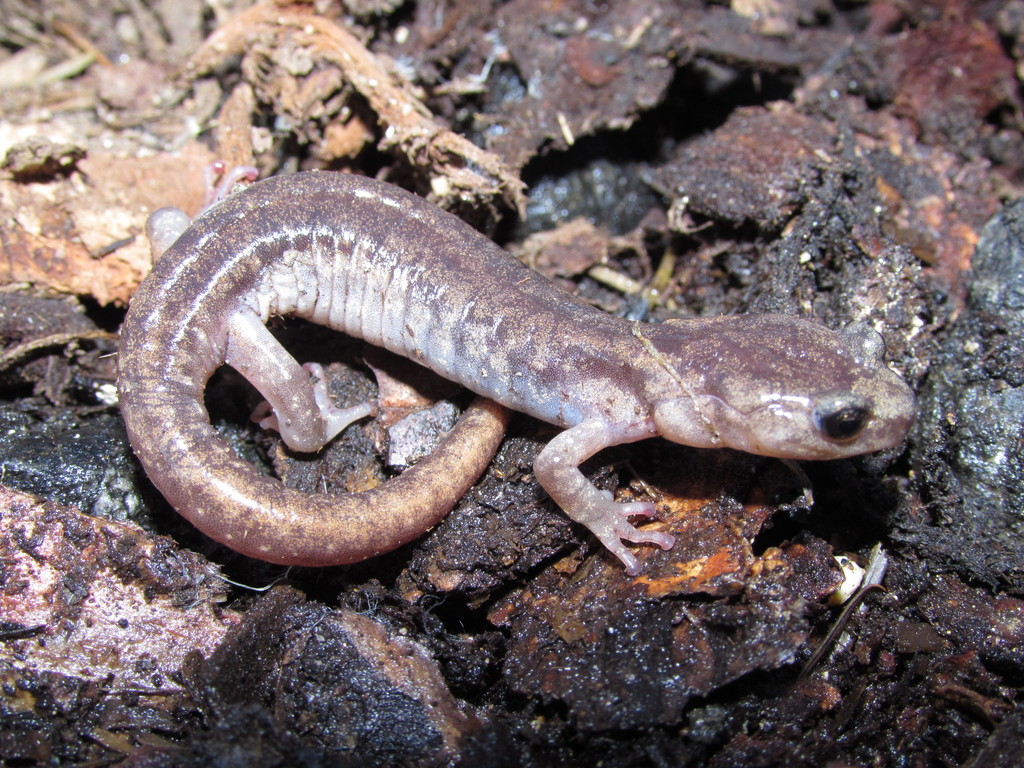
(c) Matt D'Agrosa, some rights reserved (CC BY) · licence
Family: Plethodontidae · Class: Amphibia · Order: Caudata
Aneides ferreus (Clouded Salamander) is a California animal in the Plethodontidae family.
The Clouded Salamander (Aneides ferreus) is a medium-sized terrestrial salamander reaching 89 to 140 mm (3.5 to 5.5 inches) in total length. Adults typically measure 44 to 64 mm (1.7 to 2.5 inches) from snout to vent. The dorsal coloration varies from light gray to dark brown or black, with distinctive mottled patterns of lighter gray, brown, or bronze patches that create the characteristic "clouded" appearance. The ventral surface is typically lighter, ranging from pale gray to yellowish. Adults possess a moderately long tail, well-developed limbs with squared toe tips, and prominent nasolabial grooves extending from the nostrils to the upper lip. The Clouded Salamander occurs along the Pacific Coast from southwestern Washington through western Oregon and into northwestern California. In California, the species is documented in Humboldt, Del Norte, Mendocino, Lake, Sonoma, and Napa counties. The range extends from sea level to approximately 2,135 meters (7,000 feet) elevation in the Klamath Mountains and Coast Ranges. Historical records indicate the species was more widely distributed but has experienced range contractions in some areas due to habitat loss. This species inhabits old-growth and mature second-growth coniferous forests, particularly those dominated by Douglas fir, redwood, and mixed conifer associations. Clouded Salamanders are strongly arboreal, spending most of their time in tree cavities, under bark, and in the forest canopy. They require high humidity levels and are typically found in areas with substantial canopy cover that maintains cool, moist microclimatic conditions. The species also utilizes fallen logs, rock crevices, and talus slopes, particularly during dry periods or winter months. Clouded Salamanders are lungless, breathing through their skin and mouth lining, which requires consistently moist conditions. Adults are primarily nocturnal and feed on small arthropods including ants, beetles, flies, spiders, and mites. Reproduction is terrestrial, with females depositing 9 to 17 eggs in moist cavities within trees or under logs during spring and early summer. Development is direct, with no aquatic larval stage; juveniles hatch as miniature adults after approximately 4 to 5 months. Females provide parental care, remaining with eggs throughout the incubation period and defending them from predators and desiccation. The Clouded Salamander is not federally listed but faces conservation challenges from timber harvest practices that remove large trees and reduce canopy cover. Old-growth forest logging has eliminated much of the species' preferred habitat throughout its range. Climate change poses additional threats through increased temperatures and altered precipitation patterns that may reduce suitable microhabitat conditions. The species' dependence on mature forest structure and limited dispersal ability make populations particularly vulnerable to habitat fragmentation. Current conservation efforts focus on protecting remaining old-growth stands and maintaining structural diversity in managed forests through extended rotation periods and retention of large trees and snags.
Classification
Class: Amphibia · Order: Caudata · Family: Plethodontidae
Frequently asked questions
How is Aneides ferreus classified?
Aneides ferreus belongs to class Amphibia, order Caudata, family Plethodontidae.
What family does Aneides ferreus belong to?
Aneides ferreus is in the Plethodontidae family.
What is Aneides ferreus?
The Clouded Salamander (Aneides ferreus) is a medium-sized terrestrial salamander reaching 89 to 140 mm (3.5 to 5.5 inches) in total length.
Is Aneides ferreus found in California?
Yes. Aneides ferreus is recorded in California in The California Species Project's catalogue.
Related species
Other California species in the same genus, family, or bioregion.
Data from The California Species Project — 14,000+ California species with verified data from CNPS, CDFW, USFWS, and more.