Aneides flavipunctatus
Speckled Black Salamander
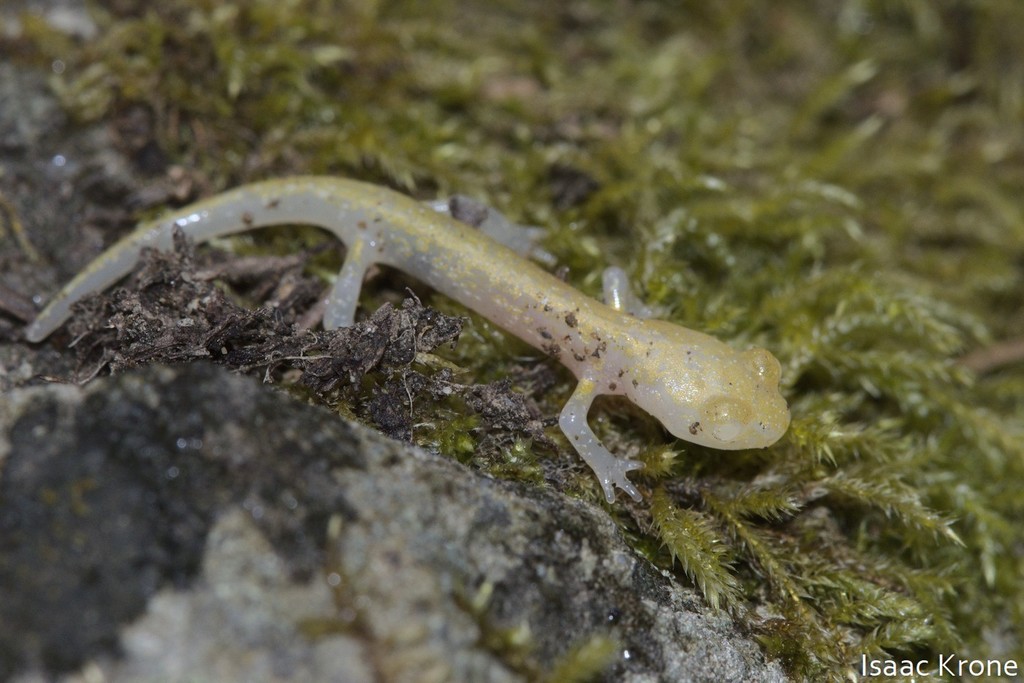
(c) Isaac Krone, some rights reserved (CC BY) · licence
Family: Plethodontidae · Class: Amphibia · Order: Caudata
Aneides flavipunctatus (Speckled Black Salamander) is a California animal in the Plethodontidae family.
The Speckled Black Salamander (Aneides flavipunctatus), also known as the Black Salamander, is a medium-sized terrestrial salamander endemic to California's coastal mountains. Adults typically measure 75 to 127 mm (3.0 to 5.0 inches) in total length, with females generally larger than males. The dorsal surface ranges from dark brown to black, with characteristic yellow, white, or cream-colored flecks scattered across the back and sides, giving the species its common name. The ventral surface is lighter, typically gray to brown. Adults have a robust build with a relatively broad head and prominent eyes. The tail is well-developed and comprises approximately 45-50% of the total body length. Speckled Black Salamanders occur along California's coastal ranges from Humboldt County south to Santa Barbara County. The species is found primarily in the Coast Ranges, with populations documented in the Santa Cruz Mountains, Santa Lucia Range, and mountains of the Central Coast. Elevational distribution ranges from near sea level to approximately 1,500 meters (4,900 feet), though most populations occur below 1,000 meters. According to NatureServe, the species shows patchy distribution within its range, often occurring in isolated populations separated by unsuitable habitat. The species inhabits mixed coniferous and hardwood forests, particularly those dominated by Douglas fir, redwood, oak, and madrone. Speckled Black Salamanders require cool, moist microhabitats and are commonly found under logs, rocks, bark, and in rock crevices. They show strong associations with coarse woody debris and talus slopes. The species demonstrates arboreal tendencies, frequently found in tree hollows, under loose bark, and in canopy refugia up to several meters above ground. Suitable habitat typically maintains consistent moisture levels and moderate temperatures year-round. Speckled Black Salamanders are nocturnal and exhibit seasonal activity patterns, with peak surface activity occurring during fall and winter months when moisture levels are highest. They are completely terrestrial, lacking an aquatic larval stage. Females deposit 9 to 17 large, unpigmented eggs in protected sites such as rotting logs or rock crevices during late spring and summer. Eggs undergo direct development, hatching as miniature adults after 3 to 4 months. Adults are opportunistic predators, feeding on small arthropods including beetles, spiders, centipedes, and springtails. The species can live 15 to 20 years in the wild. Currently, the Speckled Black Salamander has no federal or state conservation listing. However, populations face threats from habitat fragmentation due to logging, urban development, and fire management practices that remove coarse woody debris. Climate change poses additional concerns through altered precipitation patterns and increased fire frequency. Some populations may be vulnerable to chytrid fungus, though impacts appear less severe than for other salamander species. Habitat conservation efforts focus on maintaining mature forest structure and protecting migration corridors between fragmented populations.
Classification
Class: Amphibia · Order: Caudata · Family: Plethodontidae
Frequently asked questions
How is Aneides flavipunctatus classified?
Aneides flavipunctatus belongs to class Amphibia, order Caudata, family Plethodontidae.
What family does Aneides flavipunctatus belong to?
Aneides flavipunctatus is in the Plethodontidae family.
What is Aneides flavipunctatus?
The Speckled Black Salamander (Aneides flavipunctatus), also known as the Black Salamander, is a medium-sized terrestrial salamander endemic to California's coastal mountains.
Is Aneides flavipunctatus found in California?
Yes. Aneides flavipunctatus is recorded in California in The California Species Project's catalogue.
Related species
Other California species in the same genus, family, or bioregion.
Data from The California Species Project — 14,000+ California species with verified data from CNPS, CDFW, USFWS, and more.