Aneides lugubris
Arboreal Salamander
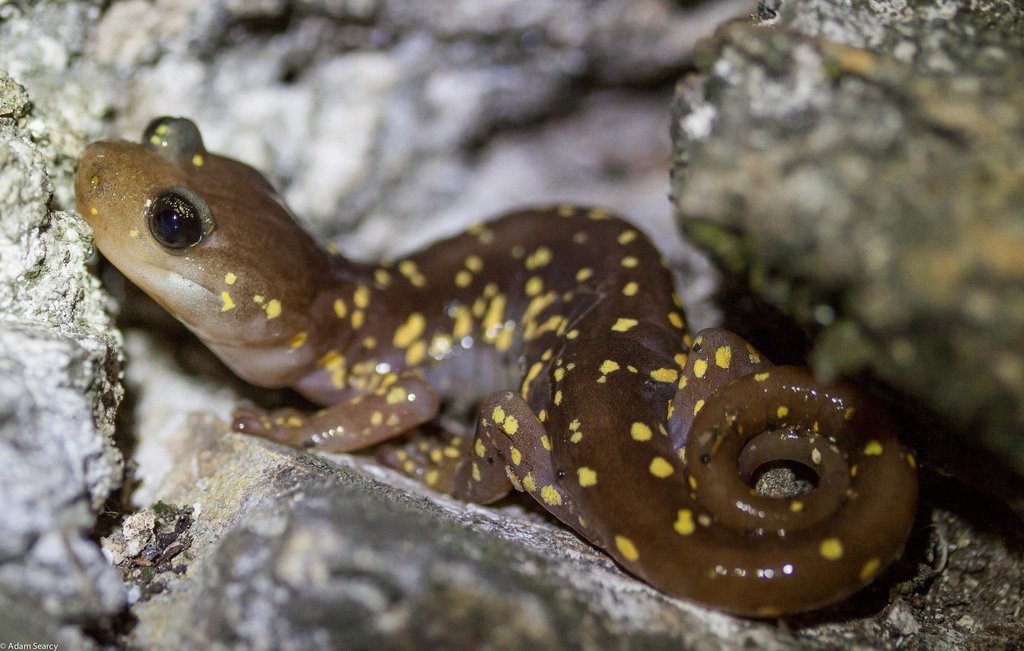
(c) Adam J. Searcy, some rights reserved (CC BY) · licence
Family: Plethodontidae · Class: Amphibia · Order: Caudata
Aneides lugubris (Arboreal Salamander) is a California animal in the Plethodontidae family.
The Arboreal Salamander (Aneides lugubris) is a medium-sized lungless salamander endemic to the western United States. Adults measure 55-100 mm (2.2-3.9 inches) in snout-vent length, with a total length including tail of 140-200 mm (5.5-7.9 inches). The species exhibits a robust build with a relatively large head and prominent jaw muscles. Dorsal coloration ranges from brown to yellowish-brown with darker brown or black mottling. The ventral surface is typically lighter, ranging from cream to pale yellow. Males can be distinguished by enlarged premaxillary teeth that protrude from the mouth, particularly during breeding season. The Arboreal Salamander occurs along the Pacific Coast from northern California to Baja California, Mexico. In California, the species ranges from Humboldt County south to the Mexican border, extending inland through the Coast Ranges and into the foothills of the Sierra Nevada. Populations are documented from sea level to elevations of approximately 1,500 meters (4,900 feet). The species is absent from the Central Valley and desert regions of California. Arboreal Salamanders inhabit oak woodlands, mixed evergreen forests, and chaparral communities. The species shows a strong association with oak trees, particularly coast live oak (Quercus agrifolia), valley oak (Q. lobata), and blue oak (Q. douglasii). They utilize tree cavities, bark crevices, and spaces under loose bark for shelter and nesting. Unlike most salamanders, this species is well-adapted to arboreal life and can be found 20 meters (65 feet) or more above ground. They also occupy terrestrial habitats including rock crevices, talus slopes, and spaces under logs and debris. This species is primarily nocturnal and exhibits direct development, with eggs laid in terrestrial locations rather than aquatic environments. Females deposit 12-24 unpigmented eggs in tree hollows or rock crevices during late spring and summer. The eggs are attended by the female and hatch directly into miniature adults after 3-4 months, bypassing an aquatic larval stage. Arboreal Salamanders are opportunistic predators, feeding on insects, spiders, centipedes, and other small invertebrates. They are capable climbers, using their prehensile tail for balance and support while moving through vegetation. During dry periods, individuals may enter estivation in protected microhabitats to conserve moisture. The Arboreal Salamander is not federally or state-listed as threatened or endangered. However, local populations may face pressure from habitat loss due to urban development, oak woodland conversion, and wildfire. The species' dependence on mature oak trees makes it vulnerable to forest management practices that remove large trees or alter woodland structure. Climate change may affect the species through increased drought stress and altered precipitation patterns that impact oak woodland ecosystems. The California Department of Fish and Wildlife considers the species secure overall but notes that habitat protection for oak woodland ecosystems benefits this and other endemic species.
Classification
Class: Amphibia · Order: Caudata · Family: Plethodontidae
Frequently asked questions
How is Aneides lugubris classified?
Aneides lugubris belongs to class Amphibia, order Caudata, family Plethodontidae.
What family does Aneides lugubris belong to?
Aneides lugubris is in the Plethodontidae family.
What is Aneides lugubris?
The Arboreal Salamander (Aneides lugubris) is a medium-sized lungless salamander endemic to the western United States.
Is Aneides lugubris found in California?
Yes. Aneides lugubris is recorded in California in The California Species Project's catalogue.
Related species
Other California species in the same genus, family, or bioregion.
Data from The California Species Project — 14,000+ California species with verified data from CNPS, CDFW, USFWS, and more.