Aneides niger
Santa Cruz Black Salamander
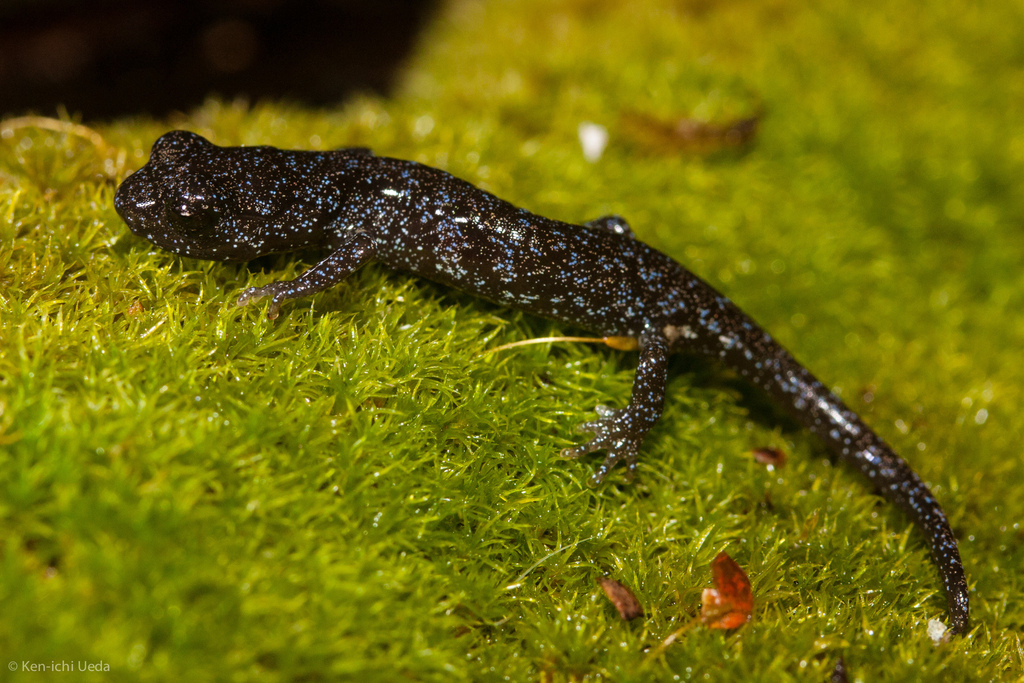
(c) Ken-ichi Ueda, some rights reserved (CC BY) · licence
Family: Plethodontidae · Class: Amphibia · Order: Caudata
Conservation status: G3 S3
Aneides niger (Santa Cruz Black Salamander) is a California animal in the Plethodontidae family.
The Santa Cruz Black Salamander (Aneides niger) is a moderately sized, robust salamander endemic to the Santa Cruz Mountains of California. Males reach snout-vent lengths of 68.8 to 85.7 mm, while females are slightly smaller at 58.3 to 73.7 mm (AmphibiaWeb). The species is characterized by its solid black coloration, which distinguishes it from other members of the Aneides genus. Adults have a stocky build typical of climbing salamanders, with well-developed limbs and digits adapted for arboreal locomotion. This species has an extremely limited range, occurring only in the Santa Cruz Mountains of central California, primarily in Santa Cruz County. The species' distribution is highly fragmented and restricted to specific microhabitats within this narrow geographic area. The Santa Cruz Black Salamander represents one of the most geographically restricted salamander species in North America. The species inhabits old-growth and mature second-growth redwood forests, typically favoring areas with dense canopy cover and high humidity. These salamanders are found in association with fallen logs, tree cavities, and beneath bark of living and dead trees. The cool, moist microclimate provided by the redwood forest ecosystem is essential for their survival, as they require consistent moisture levels and stable temperatures. Elevation ranges are typically within the fog belt of the Santa Cruz Mountains, where marine layer influence maintains optimal humidity conditions. Santa Cruz Black Salamanders are primarily arboreal, spending much of their time in trees and fallen logs. Their diet consists of various small invertebrates, including millipedes, ants, and termites (California Herps). As individuals grow larger, they consume fewer but larger prey items, indicating ontogenetic dietary shifts common among plethodontid salamanders. The species exhibits terrestrial reproduction, laying eggs in moist terrestrial sites rather than in water. Courtship and breeding behavior remain poorly documented, though breeding likely occurs during the wet season when moisture conditions are optimal. The Santa Cruz Black Salamander holds a Global and State rank of G3 S3, indicating it is vulnerable to extirpation. The species faces significant conservation challenges due to its extremely limited range and specific habitat requirements. Primary threats include habitat loss and fragmentation from residential and commercial development in the Santa Cruz Mountains. Logging activities, particularly those that alter forest structure and microclimate, pose additional risks. Climate change represents an emerging threat, as altered precipitation patterns and increased temperatures could disrupt the delicate moisture balance required by this species. The marine fog that characterizes this region and maintains suitable habitat conditions may be affected by changing climate patterns. Conservation efforts should focus on protecting remaining old-growth and mature forest habitats within the species' range, maintaining forest connectivity, and monitoring population trends. The restricted distribution of this salamander makes it particularly vulnerable to localized disturbances and environmental changes.
Classification
Class: Amphibia · Order: Caudata · Family: Plethodontidae
Conservation status
G3 S3
Frequently asked questions
How is Aneides niger classified?
Aneides niger belongs to class Amphibia, order Caudata, family Plethodontidae.
What family does Aneides niger belong to?
Aneides niger is in the Plethodontidae family.
Is Aneides niger protected or of conservation concern?
Aneides niger carries the following status: G3 S3.
What is Aneides niger?
The Santa Cruz Black Salamander (Aneides niger) is a moderately sized, robust salamander endemic to the Santa Cruz Mountains of California.
Is Aneides niger found in California?
Yes. Aneides niger is recorded in California in The California Species Project's catalogue.
Related species
Other California species in the same genus, family, or bioregion.
Data from The California Species Project — 14,000+ California species with verified data from CNPS, CDFW, USFWS, and more.