Aneides vagrans
Wandering Salamander
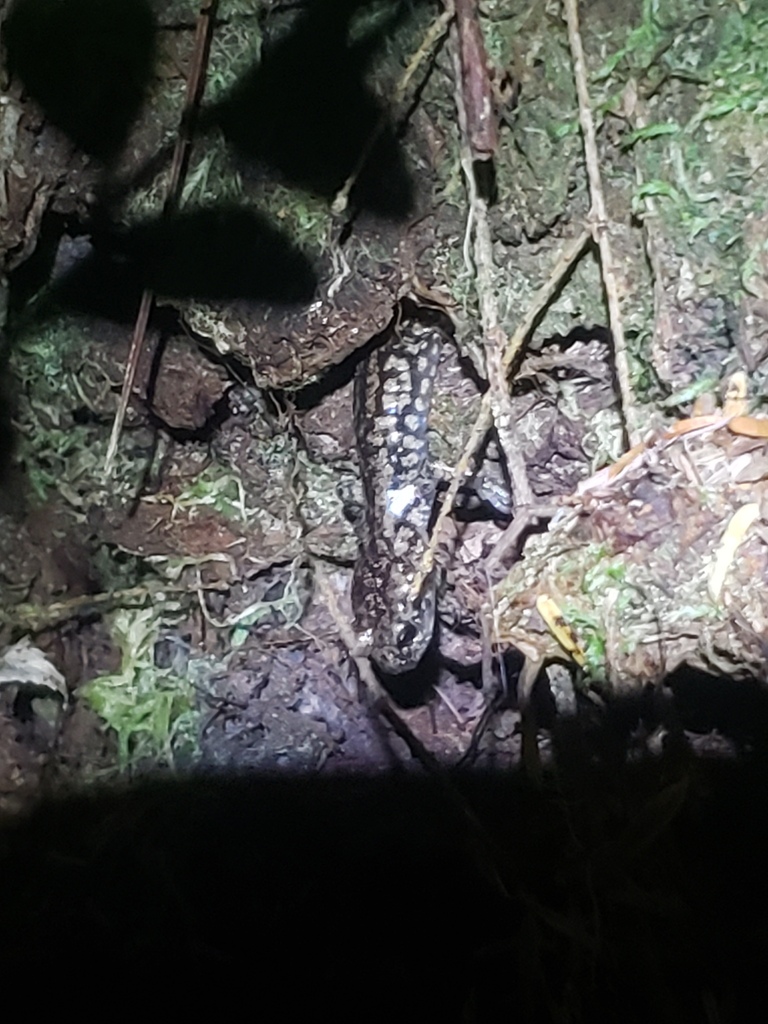
(c) Shaan Aroeste, some rights reserved (CC BY) · licence
Family: Plethodontidae · Class: Amphibia · Order: Caudata
Aneides vagrans (Wandering Salamander) is a California animal in the Plethodontidae family.
The wandering salamander (Aneides vagrans) is a medium-sized terrestrial salamander belonging to the lungless salamander family Plethodontidae. Adults typically measure 89 to 140 mm (3.5 to 5.5 inches) in total length, with a relatively robust body and long tail that accounts for approximately half of the total length. The dorsal coloration ranges from reddish-brown to dark brown or black, often with lighter brown or tan mottling. The ventral surface is typically lighter, ranging from pale yellow to gray. Adults possess a distinctive squared snout and relatively large eyes compared to other Aneides species. The skin texture is smooth and moist, characteristic of lungless salamanders. Historically, the wandering salamander was known from a limited range in the Klamath Mountains of northwestern California and southwestern Oregon. In California, the species occurs primarily in Humboldt, Del Norte, and Siskiyou counties, with elevations ranging from near sea level to approximately 1,520 meters (5,000 feet). The current distribution appears fragmented compared to historical records, with documented populations concentrated in the Smith River drainage and scattered locations in the Klamath River system. Wandering salamanders inhabit mature and old-growth coniferous forests, particularly those dominated by Douglas fir, redwood, and mixed conifer assemblages. The species requires cool, moist microhabitats with abundant coarse woody debris, including fallen logs, bark crevices, and rock talus slopes. They are frequently found under bark of standing dead trees and within rotting logs that maintain consistent moisture levels. The species demonstrates a preference for north-facing slopes and areas with dense canopy cover that moderate temperature and humidity fluctuations. As a lungless salamander, Aneides vagrans respires entirely through its skin and requires consistently moist conditions for gas exchange. The species is primarily nocturnal and exhibits terrestrial and arboreal behavior, climbing on trees and shrubs to heights of several meters. Diet consists primarily of small arthropods including beetles, ants, flies, and spiders, which are captured using a projectile tongue. Reproduction occurs through direct development, with females depositing eggs in moist terrestrial sites during late spring and early summer. Clutch sizes typically range from 9 to 20 eggs, which undergo complete development within the egg capsule, emerging as miniature adults after approximately 3 to 4 months. The wandering salamander is not currently listed under the federal Endangered Species Act or California Endangered Species Act. However, according to NatureServe, the species is ranked as G3 (vulnerable globally) and S3 in California (vulnerable in state), indicating concerns about population stability. The species faces significant threats from habitat loss due to timber harvest, particularly clear-cutting practices that eliminate the cool, moist microhabitats essential for survival. Forest fragmentation disrupts movement patterns and reduces genetic connectivity between populations. Climate change poses additional risks through increased temperatures and altered precipitation patterns that may exceed the species' physiological tolerance limits. Fire suppression and subsequent high-intensity wildfires have also impacted suitable habitat areas.
Classification
Class: Amphibia · Order: Caudata · Family: Plethodontidae
Frequently asked questions
How is Aneides vagrans classified?
Aneides vagrans belongs to class Amphibia, order Caudata, family Plethodontidae.
What family does Aneides vagrans belong to?
Aneides vagrans is in the Plethodontidae family.
What is Aneides vagrans?
The wandering salamander (Aneides vagrans) is a medium-sized terrestrial salamander belonging to the lungless salamander family Plethodontidae.
Is Aneides vagrans found in California?
Yes. Aneides vagrans is recorded in California in The California Species Project's catalogue.
Related species
Other California species in the same genus, family, or bioregion.
Data from The California Species Project — 14,000+ California species with verified data from CNPS, CDFW, USFWS, and more.