Anhimella perbrunnea
Brown-lined Anhimella
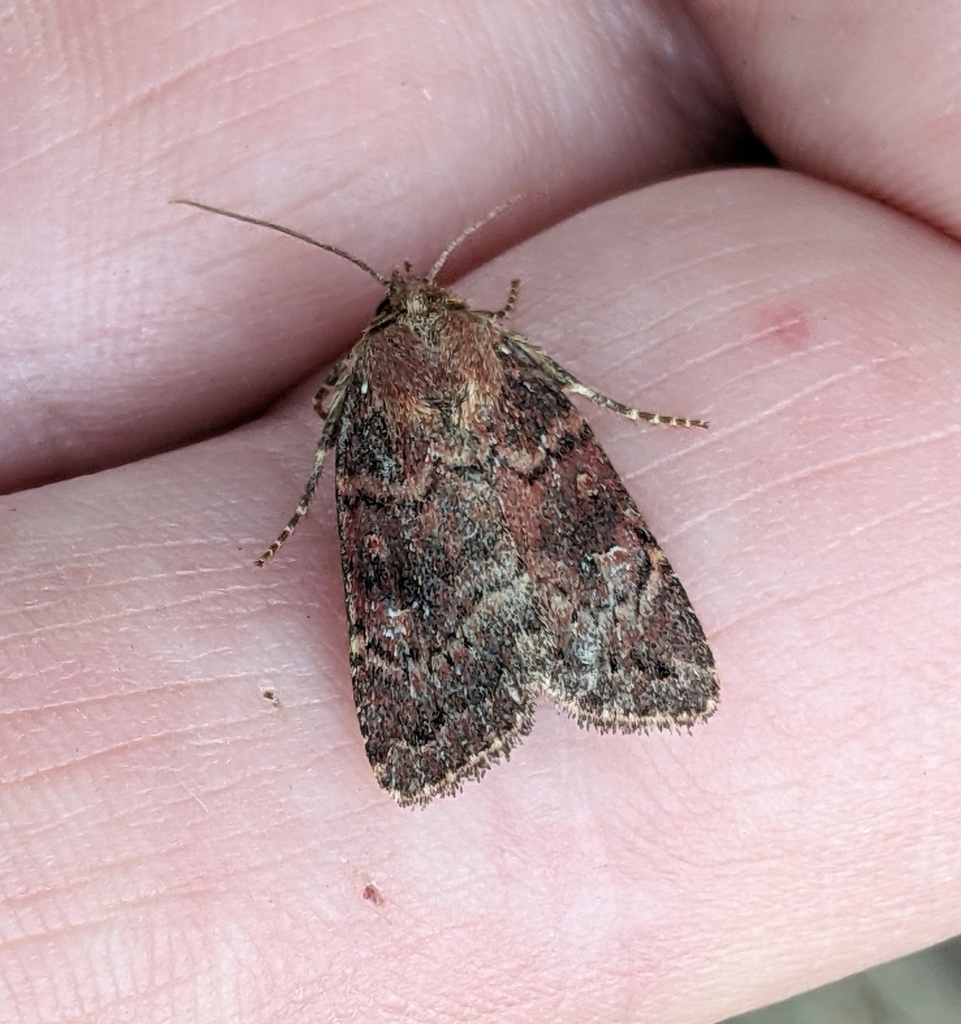
no rights reserved · CC0
Family: Noctuidae · Class: Insecta · Order: Lepidoptera
Anhimella perbrunnea (Brown-lined Anhimella) is a California animal in the Noctuidae family.
The Brown-lined Anhimella (Anhimella perbrunnea) is a small noctuid moth in the family Noctuidae, subfamily Noctuinae, tribe Eriopygini. This species represents one of the lesser-documented members of the genus Anhimella, with limited published research on its specific characteristics and ecology. Detailed morphological descriptions for A. perbrunnea are not well documented in current literature. Like other members of the genus Anhimella, this species likely exhibits the typical small size and dull coloration characteristic of the group. The related species A. contrahens can be recognized by its small size, dull color, toothed lines with pale filling and smooth courses across the wing, and pale spots with dark filling (BugGuide), suggesting A. perbrunnea may share similar features. The range of A. perbrunnea appears to be primarily in western North America, though specific distributional data for this species remains limited. The genus Anhimella has representatives across North America, with A. contrahens documented from the Northwest Territories and British Columbia across Canada to Nova Scotia and south to California, Arizona, Colorado, and New Jersey (BugGuide). California records for A. perbrunnea exist but require further documentation to establish precise county-level distributions. Habitat preferences for A. perbrunnea have not been thoroughly studied. Related species in the genus occur in forest and riparian habitats (BugGuide), suggesting this species may utilize similar environments. The broader Noctuinae subfamily includes species that occupy diverse habitats from grasslands to forest edges, often associated with herbaceous plants that serve as larval hosts. The life history and behavioral ecology of A. perbrunnea remain poorly documented. Flight period data for this species is limited, though related Anhimella species are active during summer months. A. contrahens flies from late June to early August (BugGuide), which may indicate a similar activity period for A. perbrunnea. Larval host plants have not been identified for this species. Captive larvae of A. contrahens will feed on dandelion (Taraxacum officinale), though the preferred wild host remains unknown (BugGuide). Conservation status information for A. perbrunnea is extremely limited. The species does not appear on federal endangered species lists, nor does it have a designated conservation status in California as of December 2025. However, A. perbrunnea has been identified as a Species of Greatest Conservation Need (SGCN) in Arkansas and New Mexico state wildlife action plans, suggesting some conservation concern exists for this species in parts of its range (BugGuide). The inclusion on SGCN lists may reflect limited knowledge about population status rather than documented decline. Scientific documentation for this species remains limited. The information presented here is based on available taxonomic databases and related species accounts. Research gaps include detailed morphological descriptions, precise habitat requirements, host plant relationships, population status, and specific threats. Additional field studies and taxonomic research are needed to better understand this species' biology, distribution, and conservation needs.
Classification
Class: Insecta · Order: Lepidoptera · Family: Noctuidae
Frequently asked questions
How is Anhimella perbrunnea classified?
Anhimella perbrunnea belongs to class Insecta, order Lepidoptera, family Noctuidae.
What family does Anhimella perbrunnea belong to?
Anhimella perbrunnea is in the Noctuidae family.
What is Anhimella perbrunnea?
The Brown-lined Anhimella (Anhimella perbrunnea) is a small noctuid moth in the family Noctuidae, subfamily Noctuinae, tribe Eriopygini.
Is Anhimella perbrunnea found in California?
Yes. Anhimella perbrunnea is recorded in California in The California Species Project's catalogue.
Related species
Other California species in the same genus, family, or bioregion.
Data from The California Species Project — 14,000+ California species with verified data from CNPS, CDFW, USFWS, and more.