Anhinga anhinga
Anhinga
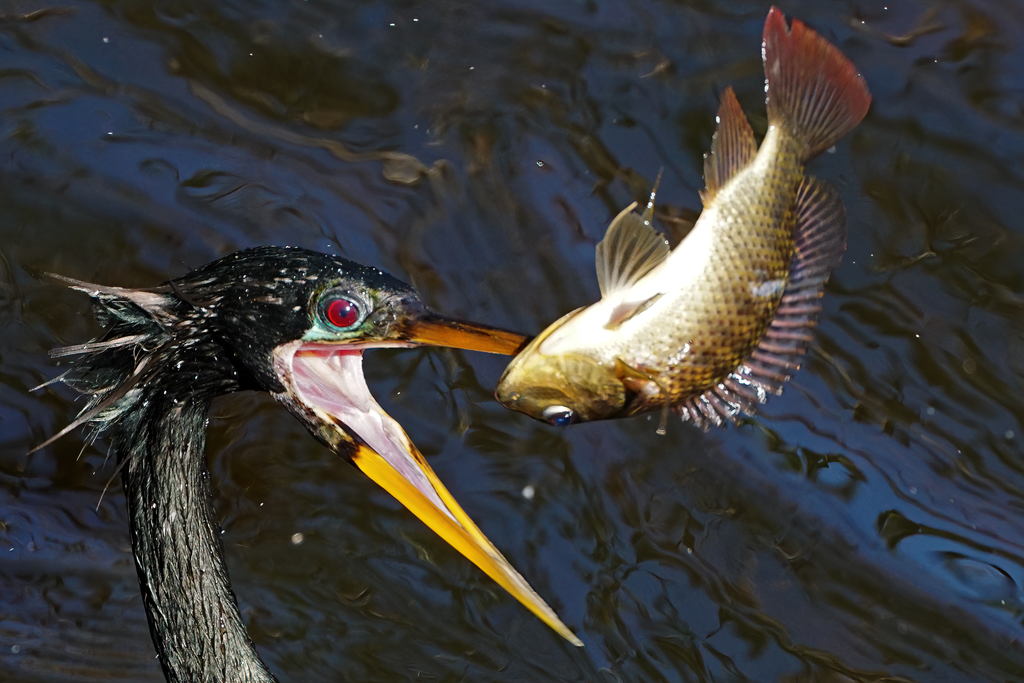
(c) Eridan Xharahi, some rights reserved (CC BY) · licence
Family: Anhingidae · Class: Aves · Order: Suliformes
Anhinga anhinga (Anhinga) is a California animal in the Anhingidae family.
The Anhinga (Anhinga anhinga) is a large, slender waterbird with distinctive adaptations for underwater pursuit of fish. Adults measure 81-91 cm (32-36 inches) in length with a wingspan of 107-118 cm (42-46 inches), weighing 1.0-1.4 kg (2.2-3.1 pounds). Males display predominantly black plumage with silver-white streaking on the wings and upper back during breeding season. Females and juveniles exhibit brown head, neck, and breast with black wings and back. Both sexes possess a long, pointed bill, serpentine neck, and fan-shaped tail. The species lacks waterproof feathers, allowing reduced buoyancy for underwater hunting. Historically, Anhingas occurred throughout the southeastern United States from North Carolina to Texas, with breeding populations extending south through Central and South America to Argentina. In California, the species appears as an uncommon vagrant, primarily along the Colorado River corridor and in the Imperial Valley. Most California records originate from the Salton Sea region, with scattered observations in Riverside, San Bernardino, and Imperial counties. The species has been documented at locations including the Salton Sea National Wildlife Refuge, Colorado River National Wildlife Refuge, and various desert oases. Anhingas inhabit freshwater and brackish wetlands, including lakes, ponds, marshes, swamps, and slow-moving rivers. They require areas with abundant fish populations and suitable perching sites such as dead trees, stumps, or emergent vegetation. In California, vagrant individuals typically utilize irrigation channels, desert springs, and reservoir margins. The species prefers water depths of 1-3 meters where small fish are concentrated. Anhingas are specialized piscivores, capturing prey through underwater pursuit using their pointed bills like spears. Primary prey includes sunfish, bass, catfish, and other small to medium-sized fish measuring 10-30 cm in length. Hunting occurs through slow underwater swimming with wings partially spread for propulsion. After fishing, individuals must dry their waterlogged plumage by spreading wings in characteristic poses on exposed perches. Breeding behavior includes elaborate courtship displays with males presenting nesting material to females. Nests consist of stick platforms in trees or shrubs over water, typically containing 3-5 pale blue eggs. Incubation lasts 25-28 days, with young fledging after 35-42 days. The Anhinga is not federally listed and maintains stable populations throughout most of its range according to the North American Breeding Bird Survey. Partners in Flight estimates the global population at 500,000 individuals. In California, the species remains a rare vagrant with fewer than 50 documented records since 1900. Climate change may potentially expand the species' range northward, though California occurrences likely reflect natural vagrancy patterns rather than range expansion. Primary threats throughout the range include wetland habitat loss, water pollution, and human disturbance at roosting and nesting sites.
Classification
Class: Aves · Order: Suliformes · Family: Anhingidae
Frequently asked questions
How is Anhinga anhinga classified?
Anhinga anhinga belongs to class Aves, order Suliformes, family Anhingidae.
What family does Anhinga anhinga belong to?
Anhinga anhinga is in the Anhingidae family.
What is Anhinga anhinga?
The Anhinga (Anhinga anhinga) is a large, slender waterbird with distinctive adaptations for underwater pursuit of fish.
Is Anhinga anhinga found in California?
Yes. Anhinga anhinga is recorded in California in The California Species Project's catalogue.
More California species
This species has no close relatives in our California data — here are other species to explore.
Data from The California Species Project — 14,000+ California species with verified data from CNPS, CDFW, USFWS, and more.