Annaphila danistica
Dan’s Annaphila
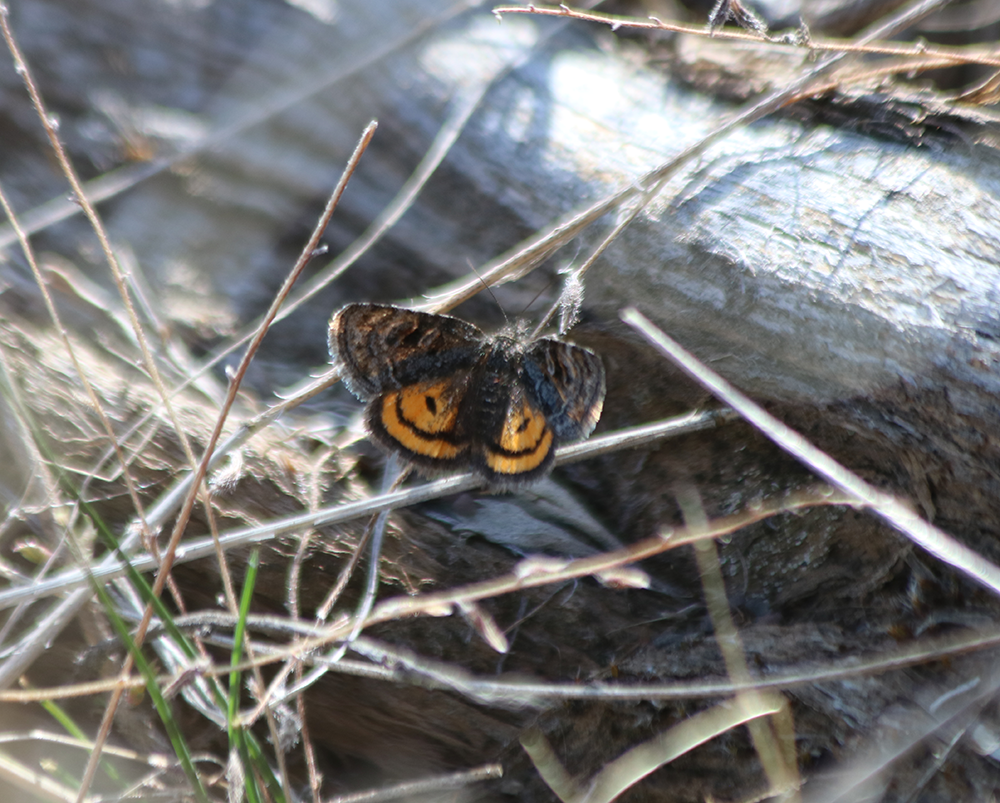
no rights reserved · CC0
Family: Noctuidae · Class: Insecta · Order: Lepidoptera
Annaphila danistica (Dan’s Annaphila) is a California animal in the Noctuidae family.
Dan's Annaphila is a small noctuid moth in the subfamily Amphipyrinae, tribe Stiriini, subtribe Annaphilina. Adults have a forewing length of approximately 8-12 mm, making them among the smaller members of the owlet moth family. The species exhibits marked sexual dimorphism in both size and wing morphology. Males are notably smaller with rounded forewings and distinctly marked wings, while females are larger with pointed forewings that appear uniformly gray with pale outlines of typical noctuid markings. The forewings display variable coloration, and hindwings show bright orange ground color suffused with brown-gray at the base and inner margin, featuring a thick black discal spot and dark gray to black sinuous postmedial line with a thin marginal band (BugGuide). Annaphila danistica occurs in California and the broader Intermountain Region of western North America. Specimens have been documented from California, Nevada, and Utah (BugGuide). Within California, the species has been recorded from multiple counties, with recent observations including Siskiyou County where it was collected at Boulder Peak and surrounding areas at elevations ranging from 3,000 to 8,300 feet during late June to early July 2022 (Lepidopterists' Society 2023). The species inhabits diverse arid and semi-arid environments, being widely distributed in juniper woodlands and sagebrush steppe communities at middle to low elevations (BugGuide). This habitat preference aligns with the Intermountain West's characteristic vegetation zones, where juniper-sagebrush ecosystems dominate the landscape between montane forests and desert valleys. The species' documented elevation range from 3,000 to over 8,000 feet demonstrates considerable ecological flexibility across different elevational zones. Dan's Annaphila belongs to a group of specialized diurnal noctuid moths that exhibit early spring flight periods. Historical observations suggest that members of the genus Annaphila are among the earliest spring fliers for any given locality, with flight timing varying according to the break in cold weather that signals spring's arrival. These moths are reportedly attracted to willow (Salix) blooms, which may serve as both nectar sources and congregation sites during their brief flight periods. The short duration and early timing of adult activity has contributed to these species being frequently overlooked by collectors and researchers. Conservation status information for Annaphila danistica remains limited, with no current federal or state listing status. The limited scientific documentation reflects broader knowledge gaps common to many small, specialized moth species. Like other members of its genus, A. danistica may face conservation challenges due to habitat modification in juniper-sagebrush ecosystems, climate change impacts on spring phenology, and the species' apparent dependence on specific host plants and microhabitat conditions. Further research is needed to assess population trends, detailed habitat requirements, and potential conservation threats across its range.
Classification
Class: Insecta · Order: Lepidoptera · Family: Noctuidae
Frequently asked questions
How is Annaphila danistica classified?
Annaphila danistica belongs to class Insecta, order Lepidoptera, family Noctuidae.
What family does Annaphila danistica belong to?
Annaphila danistica is in the Noctuidae family.
What is Annaphila danistica?
Dan's Annaphila is a small noctuid moth in the subfamily Amphipyrinae, tribe Stiriini, subtribe Annaphilina.
Is Annaphila danistica found in California?
Yes. Annaphila danistica is recorded in California in The California Species Project's catalogue.
Related species
Other California species in the same genus, family, or bioregion.
Data from The California Species Project — 14,000+ California species with verified data from CNPS, CDFW, USFWS, and more.