Anniella alexanderae
Temblor legless lizard
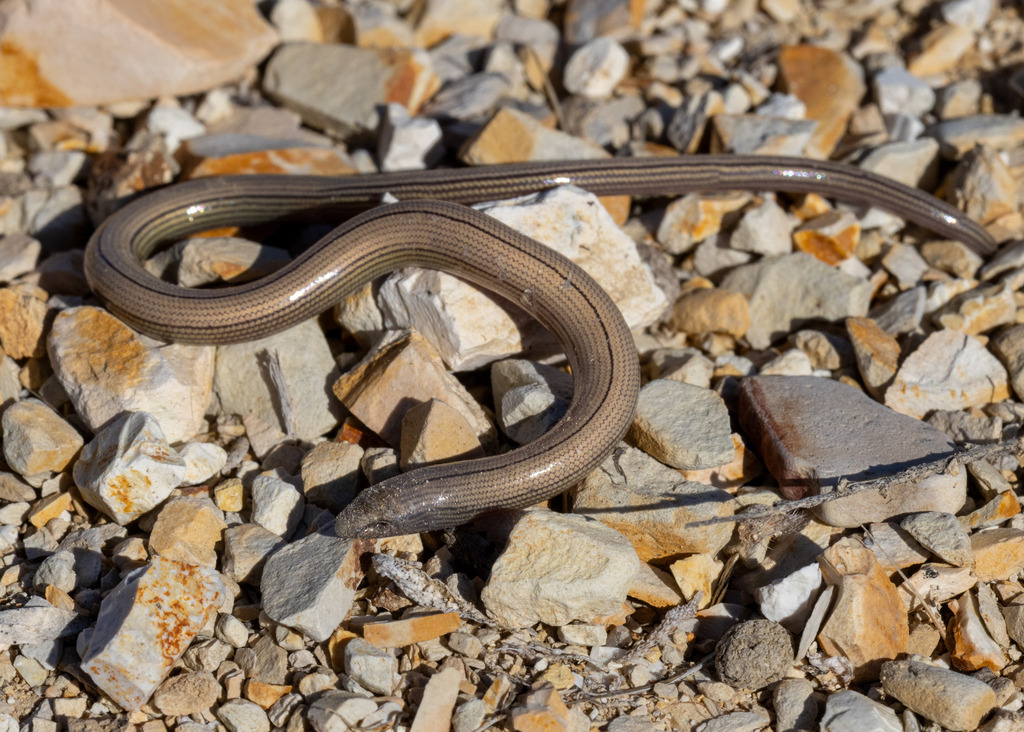
(c) Zack Abbey, some rights reserved (CC BY) · licence
Family: Anniellidae · Class: Reptilia · Order: Squamata
Conservation status: G1 S1
Anniella alexanderae (Temblor legless lizard) is a California animal in the Anniellidae family.
The Temblor legless lizard is a small, limbless reptile endemic to a restricted area of the southwestern San Joaquin Valley in California. Adults typically measure 100 to 180 mm (3.9 to 7.1 inches) in total length, with a cylindrical, snake-like body adapted for fossorial life. The species displays a uniform silvery-gray to light brown coloration dorsally, with a cream-colored to pale yellow ventral surface. The head is small and conical, lacking external ear openings, and the eyes are reduced in size with moveable eyelids distinguishing it from snakes. The species has an extremely limited range, occurring only in two known sites in Kern County, California, located between McKittrick and Taft at the southeastern base of the Temblor Range (Papenfuss and Parham 2013). According to the California Department of Fish and Wildlife, the species is found east of the Temblor mountains at elevations ranging from 168 to 466 meters (551 to 1,529 feet). All documented specimens have been collected between California State Highway 33 and the Temblor Range, with detailed searches failing to locate populations in apparently suitable habitat east of Highway 33 (Papenfuss and Parham 2013). The known range receives limited precipitation, with nearby McKittrick averaging just 184 mm (7.24 inches) of annual rainfall. Temblor legless lizards inhabit alkali desert scrub and annual grassland communities characterized by sandy soils and sparse vegetation. The species requires loose, well-drained substrates suitable for burrowing, typically found in areas with scattered shrubs and seasonal herbaceous cover. These arid habitats support the invertebrate prey base essential for the species' survival. This fossorial and crepuscular species spends most of its time underground, emerging primarily during dawn and dusk periods for feeding and mating activities. Temblor legless lizards are insectivorous, consuming larval insects, adult beetles, termites, and spiders found in soil and leaf litter. The species uses the ground surface, subsurface soil layers, and accumulated organic matter for foraging. Reproductive biology remains poorly documented, though the species is presumed to be viviparous like other members of the genus Anniella. The Temblor legless lizard is currently designated as a candidate species under the California Endangered Species Act, receiving the same legal protection as threatened and endangered species as of July 2022. The species has a global conservation rank of G1 (critically imperiled) and a state rank of S1 (critically imperiled in California). The U.S. Fish and Wildlife Service published a 90-day finding in 2021 indicating that listing under the federal Endangered Species Act may be warranted, with the species scheduled for further review in fiscal year 2026. Primary threats include habitat loss and fragmentation from oil and gas development, urbanization, agriculture, industrial solar projects, climate change, and invasive species establishment. The species' extremely restricted range and specialized habitat requirements make it particularly vulnerable to human activities and environmental changes in the southwestern San Joaquin Valley.
Classification
Class: Reptilia · Order: Squamata · Family: Anniellidae
Conservation status
G1 S1
Frequently asked questions
How is Anniella alexanderae classified?
Anniella alexanderae belongs to class Reptilia, order Squamata, family Anniellidae.
What family does Anniella alexanderae belong to?
Anniella alexanderae is in the Anniellidae family.
Is Anniella alexanderae protected or of conservation concern?
Anniella alexanderae carries the following status: G1 S1.
What is Anniella alexanderae?
The Temblor legless lizard is a small, limbless reptile endemic to a restricted area of the southwestern San Joaquin Valley in California.
Is Anniella alexanderae found in California?
Yes. Anniella alexanderae is recorded in California in The California Species Project's catalogue.
Related species
Other California species in the same genus, family, or bioregion.
Data from The California Species Project — 14,000+ California species with verified data from CNPS, CDFW, USFWS, and more.