Anniella campi
Southern Sierra Legless Lizard
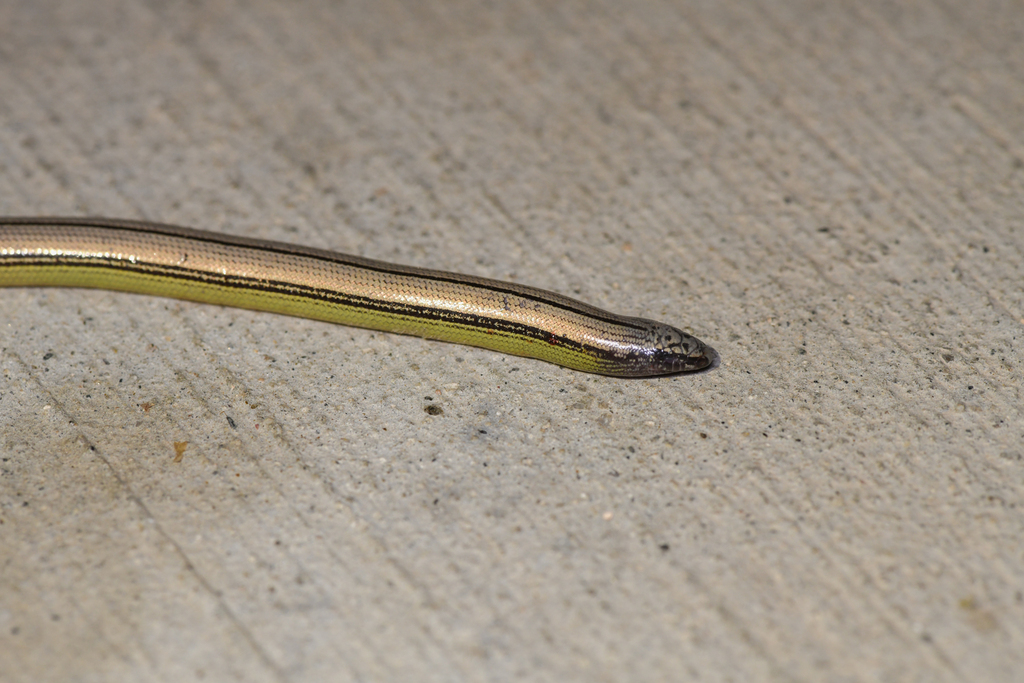
(c) Trevor Van Loon, some rights reserved (CC BY) · licence
Family: Anniellidae · Class: Reptilia · Order: Squamata
Conservation status: G1G2 S2
Anniella campi (Southern Sierra Legless Lizard) is a California animal in the Anniellidae family.
The Southern Sierra Legless Lizard (Anniella campi) is a small, elongated reptile endemic to California's southern Sierra Nevada. Adults typically measure 100 to 180 mm (4 to 7 inches) in total length, with females generally larger than males. The body is cylindrical and snake-like, covered in smooth, overlapping scales that create a shiny appearance. Coloration ranges from silvery-gray to light brown dorsally, with a pale yellow or cream-colored ventral surface. The species lacks external limbs entirely, though vestigial pelvic and shoulder girdle elements remain internally. The head is conical and only slightly wider than the neck, with small, dark eyes and no external ear openings. The tail is blunt and difficult to distinguish from the head, serving as a defensive adaptation. Anniella campi occurs exclusively in the southern Sierra Nevada of California, primarily in Kern County. The species was first scientifically described from specimens collected near Big Spring, hence its alternative common name, Big Spring Legless Lizard. Current known populations are restricted to elevations between 975 and 2,100 meters (3,200 to 6,900 feet) along the western slopes of the Sierra Nevada. The range appears highly fragmented, with confirmed localities scattered across isolated habitat patches. This species inhabits oak woodland and chaparral communities, particularly areas with loose, sandy or decomposed granite soils that facilitate burrowing. Preferred habitats include oak-pine woodlands dominated by interior live oak, blue oak, and foothill pine, often with understory shrubs such as manzanita and ceanothus. The lizards require soil substrates with sufficient moisture retention and organic matter, typically found beneath leaf litter, fallen logs, or large rocks. They occur in areas with 10 to 30 percent canopy cover, avoiding both dense forest and completely open terrain. Southern Sierra Legless Lizards are fossorial, spending most of their lives underground in shallow burrows or beneath surface debris. They are most active during cooler months, particularly spring and fall, becoming largely inactive during hot summer periods. The species feeds primarily on small arthropods, including insect larvae, spiders, and small beetles found in soil and leaf litter. Reproduction is viviparous, with females giving birth to 1 to 4 live young after a gestation period of approximately 4 months. Mating likely occurs in spring, with births occurring in late summer or early fall. The Southern Sierra Legless Lizard has a NatureServe global rank of G1G2, indicating it is critically imperiled to imperiled globally, and a California state rank of S2, reflecting its imperiled status within the state. The species faces significant threats from habitat loss due to development, fire suppression leading to vegetation changes, recreational activities, and climate change impacts on suitable microhabitat conditions. Limited distribution and apparent low population densities make the species particularly vulnerable to local extinctions. Conservation efforts focus on habitat protection and monitoring of known populations to better understand population trends and ecological requirements.
Classification
Class: Reptilia · Order: Squamata · Family: Anniellidae
Conservation status
G1G2 S2
Frequently asked questions
How is Anniella campi classified?
Anniella campi belongs to class Reptilia, order Squamata, family Anniellidae.
What family does Anniella campi belong to?
Anniella campi is in the Anniellidae family.
Is Anniella campi protected or of conservation concern?
Anniella campi carries the following status: G1G2 S2.
What is Anniella campi?
The Southern Sierra Legless Lizard (Anniella campi) is a small, elongated reptile endemic to California's southern Sierra Nevada.
Is Anniella campi found in California?
Yes. Anniella campi is recorded in California in The California Species Project's catalogue.
Related species
Other California species in the same genus, family, or bioregion.
Data from The California Species Project — 14,000+ California species with verified data from CNPS, CDFW, USFWS, and more.