Anniella grinnelli
Bakersfield Legless Lizard
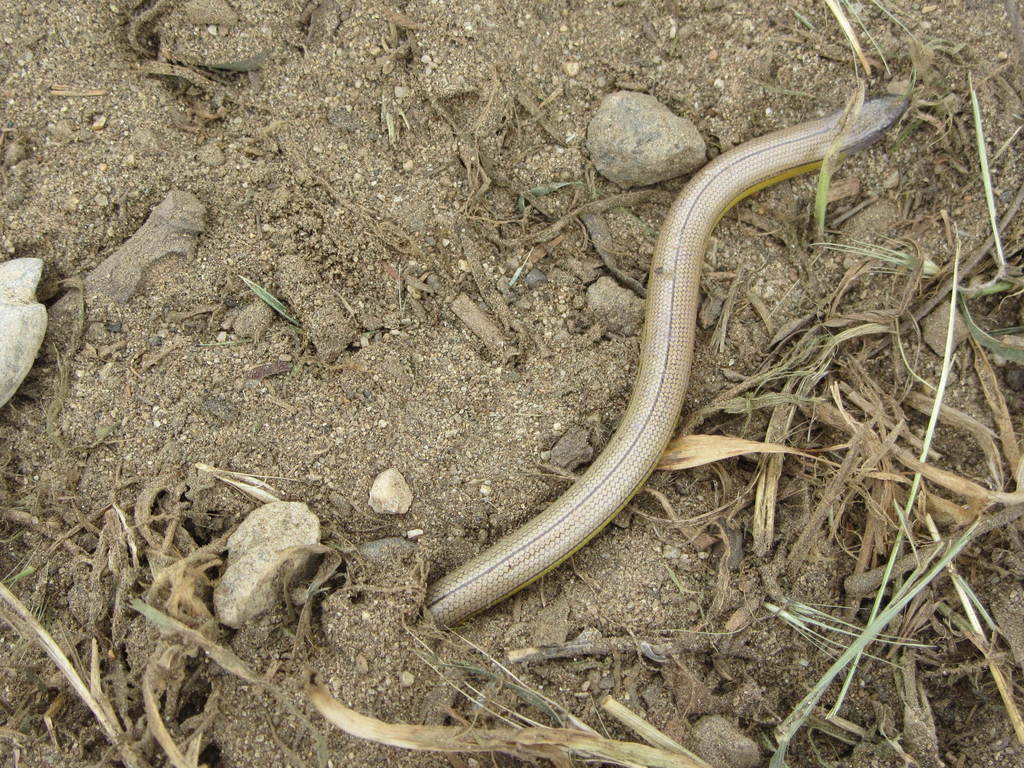
(c) jerrywinkle, some rights reserved (CC BY-SA) · licence
Family: Anniellidae · Class: Reptilia · Order: Squamata
Conservation status: G2G3 S2S3
Anniella grinnelli (Bakersfield Legless Lizard) is a California animal in the Anniellidae family.
The Bakersfield legless lizard is a small, elongated reptile measuring 10 to 18 centimeters (4 to 7 inches) in total length. This fossorial species lacks external limbs and eyelids, appearing snake-like with a blunt, rounded snout and small eyes. The body is covered in smooth, cycloid scales that create a polished appearance. Coloration varies from silvery-gray to brown dorsally, with a distinctive purple to reddish underside. Adults often display a black-tipped tail that may serve as a defensive mimicry of the head (Papenfuss & Parham 2013). The species can be distinguished from other Anniella by its geographic range and subtle morphological characteristics. Anniella grinnelli has an extremely restricted distribution, occurring only in the southern San Joaquin Valley and the eastern edge of the Carrizo Plain in California. The range centers around Bakersfield in Kern County, with additional populations documented in eastern San Luis Obispo County. This species represents one of the most geographically limited legless lizards, with a range significantly smaller than previously recognized for the Anniella complex (Papenfuss & Parham 2013). The fragmented distribution reflects both natural habitat limitations and extensive human modification of the San Joaquin Valley. The species inhabits sandy soils and loose, well-drained substrates characteristic of shrubland and grassland communities. Bakersfield legless lizards are found in areas with sparse vegetation, including coastal sage scrub remnants, annual grasslands, and the margins of agricultural lands. They require friable soils that allow for burrowing and subsurface movement. The type locality at Sand Ridge Preserve near Bakersfield represents typical habitat consisting of sandy ridges with scattered shrubs and native bunch grasses. Bakersfield legless lizards are fossorial, spending most of their time underground or beneath surface debris such as logs, boards, or leaf litter. They create extensive burrow systems in sandy substrates and can be found by gently raking through loose soil and organic matter. The species is ectothermic and exhibits seasonal activity patterns, being most active during moderate temperatures. Diet consists primarily of small invertebrates including insect larvae, spider, and soft-bodied arthropods encountered in their subterranean environment. Reproduction involves live birth, typical of the family Anniellidae, though specific details of breeding behavior and litter size for this species remain poorly documented. Anniella grinnelli faces severe conservation challenges due to its extremely limited range and ongoing habitat loss. The species carries a NatureServe global rank of G2G3, indicating it is imperiled to vulnerable globally. This species is included on the California Department of Fish and Wildlife's Special Animals List. During the past decade, two of three known Bakersfield populations were destroyed by housing development (Papenfuss & Parham 2013). Urban expansion, agricultural conversion, and infrastructure development continue to fragment and eliminate remaining habitat. The Sand Ridge Preserve protects the type locality and represents a critical refuge for the species' long-term survival. Without active conservation measures and habitat protection, this endemic lizard remains at risk of significant population decline or local extinction within its limited range.
Classification
Class: Reptilia · Order: Squamata · Family: Anniellidae
Conservation status
G2G3 S2S3
Frequently asked questions
How is Anniella grinnelli classified?
Anniella grinnelli belongs to class Reptilia, order Squamata, family Anniellidae.
What family does Anniella grinnelli belong to?
Anniella grinnelli is in the Anniellidae family.
Is Anniella grinnelli protected or of conservation concern?
Anniella grinnelli carries the following status: G2G3 S2S3.
What is Anniella grinnelli?
The Bakersfield legless lizard is a small, elongated reptile measuring 10 to 18 centimeters (4 to 7 inches) in total length.
Is Anniella grinnelli found in California?
Yes. Anniella grinnelli is recorded in California in The California Species Project's catalogue.
Related species
Other California species in the same genus, family, or bioregion.
Data from The California Species Project — 14,000+ California species with verified data from CNPS, CDFW, USFWS, and more.