Anniella pulchra
Northern California Legless Lizard
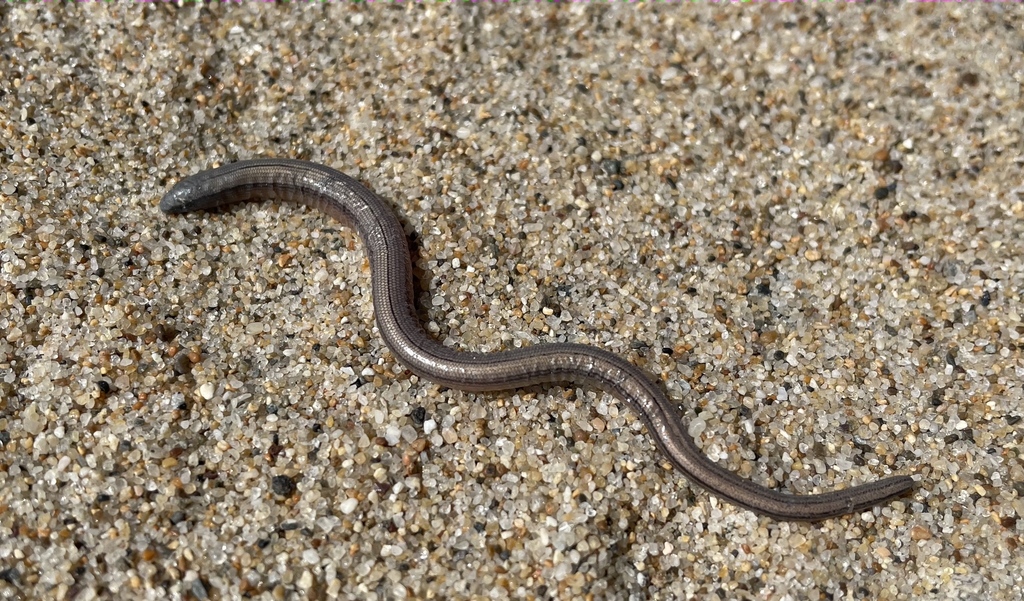
(c) Henrik Kibak, some rights reserved (CC BY) · licence
Family: Anniellidae · Class: Reptilia · Order: Squamata
Conservation status: G3 S2S3
Anniella pulchra (Northern California Legless Lizard) is a California animal in the Anniellidae family.
The Northern California legless lizard is a slender, elongated reptile measuring 100 to 180 mm (4 to 7 inches) in total length. Despite its snake-like appearance, this species possesses moveable eyelids, external ears, and a fleshy tongue, distinguishing it from true snakes. The body is cylindrical with a uniform diameter, tapering to a blunt tail that comprises approximately half the total length. Coloration varies from silver-gray to brown or yellowish-brown dorsally, with a lighter ventral surface. The scales are small, smooth, and overlapping, giving the animal a polished appearance. Adults lack visible limbs, though vestigial hindlimbs are present internally. Historically, Anniella pulchra occurred along California's coast from Monterey County north to Humboldt County, with isolated populations in the Sierra Nevada foothills. The species' current range has contracted significantly, with confirmed populations now restricted to scattered coastal locations from Monterey County to Mendocino County. The most viable populations persist in the Monterey Peninsula area and Point Reyes National Seashore. Fragmented populations may survive in coastal Sonoma and southern Mendocino counties, though recent surveys have failed to detect the species at many historical localities. Northern California legless lizards inhabit coastal scrub, chaparral, and oak woodland environments with loose, sandy or loamy soils. The species requires areas with adequate soil moisture and friable substrate suitable for burrowing. Typical habitat includes dunes, coastal terraces, and sandy washes beneath shrubs such as coyote brush, lupine, and California sagebrush. Elevation ranges from sea level to approximately 1,500 feet. The species demonstrates a preference for south-facing slopes and areas with partial canopy cover that maintain soil moisture while providing thermal regulation opportunities. This fossorial species spends most of its life underground, creating shallow burrow systems in loose soil. Northern California legless lizards are active primarily during cool, humid conditions, emerging at the surface during dawn, dusk, or overcast days. The diet consists of soft-bodied invertebrates including beetle larvae, moth caterpillars, termites, and spider eggs, which are located through chemoreception. Reproduction occurs through live birth, with females producing litters of one to four young after a gestation period of approximately four months. Mating typically occurs in spring, with births occurring in late summer or early fall. The Northern California legless lizard holds no federal listing status but is considered a California Species of Special Concern due to population declines and habitat loss. The species faces significant threats from urban development, agricultural conversion, and recreational activities that compact or disturb soil structure. Coastal development has eliminated substantial portions of suitable habitat, while off-road vehicle use and foot traffic degrade remaining areas. Climate change may further impact the species through altered precipitation patterns and increased temperatures that affect soil moisture levels. Conservation efforts focus on habitat protection within existing parks and reserves, though comprehensive population monitoring and habitat restoration programs remain limited.
Classification
Class: Reptilia · Order: Squamata · Family: Anniellidae
Conservation status
G3 S2S3
Frequently asked questions
How is Anniella pulchra classified?
Anniella pulchra belongs to class Reptilia, order Squamata, family Anniellidae.
What family does Anniella pulchra belong to?
Anniella pulchra is in the Anniellidae family.
Is Anniella pulchra protected or of conservation concern?
Anniella pulchra carries the following status: G3 S2S3.
What is Anniella pulchra?
The Northern California legless lizard is a slender, elongated reptile measuring 100 to 180 mm (4 to 7 inches) in total length.
Is Anniella pulchra found in California?
Yes. Anniella pulchra is recorded in California in The California Species Project's catalogue.
Related species
Other California species in the same genus, family, or bioregion.
Data from The California Species Project — 14,000+ California species with verified data from CNPS, CDFW, USFWS, and more.